Orhan Pamuk - My Name is Red
Здесь есть возможность читать онлайн «Orhan Pamuk - My Name is Red» весь текст электронной книги совершенно бесплатно (целиком полную версию без сокращений). В некоторых случаях можно слушать аудио, скачать через торрент в формате fb2 и присутствует краткое содержание. Жанр: Современная проза, на английском языке. Описание произведения, (предисловие) а так же отзывы посетителей доступны на портале библиотеки ЛибКат.
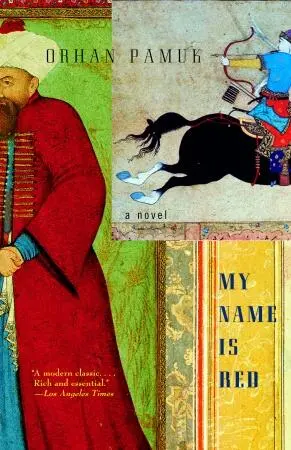
- Название:My Name is Red
- Автор:
- Жанр:
- Год:неизвестен
- ISBN:нет данных
- Рейтинг книги:5 / 5. Голосов: 1
-
Избранное:Добавить в избранное
- Отзывы:
-
Ваша оценка:
My Name is Red: краткое содержание, описание и аннотация
Предлагаем к чтению аннотацию, описание, краткое содержание или предисловие (зависит от того, что написал сам автор книги «My Name is Red»). Если вы не нашли необходимую информацию о книге — напишите в комментариях, мы постараемся отыскать её.
When the Sultan commissions a great book to celebrate his royal self and his extensive dominion, he directs Enishte Effendi to assemble a cadre of the most acclaimed artists in the land. Their task: to illuminate the work in the European style. But because figurative art can be deemed an affront to Islam, this commission is a dangerous proposition indeed, and no one in the elite circle can know the full scope or nature of the project.
Panic erupts when one of the chosen miniaturists disappears, and the Sultan demands answers within three days. The only clue to the mystery-or crime?-lies in the half-finished illuminations themselves. Has an avenging angel discovered the blasphemous work? Or is a jealous contender for the hand of Enishte’s ravishing daughter, the incomparable Shekure, somehow to blame?
Orhan Pamuk’s My Name Is Red is at once a fantasy and a philosophical puzzle, a kaleidoscopic journey to the intersection of art, religion, love, sex, and power.
"Pamuk is a novelist and a great one…My Name is Red is by far the grandest and most astonishing contest in his internal East-West war…It is chock-full of sublimity and sin…The story is told by each of a dozen characters, and now and then by a dog, a tree, a gold coin, several querulous corpses and the color crimson ('My Name is Red')…[Readers will] be lofted by the paradoxical lightness and gaiety of the writing, by the wonderfully winding talk perpetually about to turn a corner, and by the stubborn humanity in the characters' maneuvers to survive. It is a humanity whose lies and silences emerge as endearing and oddly bracing individual truths."- Richard Eder, New York Times Book Review
"A murder mystery set in sixteenth-century Istanbul [that] uses the art of miniature illumination, much as Mann's 'Doctor Faustus' did music, to explore a nation's soul… Erdag Goknar deserves praise for the cool, smooth English in which he has rendered Pamuk's finespun sentences, passionate art appreciations, sly pedantic debates, [and] eerie urban scenes."- John Updike, The New Yorker
"The interweaving of human and philosophical intrigue is very much as I remember it in The Name of the Rose, as is the slow, dense beginning and the relentless gathering of pace… But, in my view, his book is by far the better of the two. I would go so far as to say that Pamuk achieves the very thing his book implies is impossible… More than any other book I can think of, it captures not just Istanbul's past and present contradictions, but also its terrible, timeless beauty. It's almost perfect, in other words. All it needs is the Nobel Prize."-Maureen Freely, New Statesman (UK)
"A perfect example of Pamuk's method as a novelist, which is to combine literary trickery with page-turning readability… As a meditation on art, in particular, My Name is Red is exquisitely subtle, demanding and repaying the closest attention.. We in the West can only feel grateful that such a novelist as Pamuk exists, to act as a bridge between our culture and that of a heritage quite as rich as our own."-Tom Holland, Daily Telegraph (UK)
"Readers… will find themselves lured into a richly described and remarkable world… Reading the novel is like being in a magically exotic dream…Splendidly enjoyable and rewarding… A book in which you can thoroughly immerse yourself." -Allan Massie, The Scotsman (UK)
"A wonderful novel, dreamy, passionate and august, exotic in the most original and exciting way. Orhan Pamuk is indisputably a major novelist."-Philip Hensher, The Spectator (UK)
"[In this] magnificent new novel… Pamuk takes the reader into the strange and beautiful world of Islamic art,in which Western notions no longer make sense… In this world of forgeries, where some might be in danger of losing their faith in literature, Pamuk is the real thing, and this book might well be one of the few recent works of fiction that will be remembered at the end of this century."-Avkar Altinel, The Observer (UK)
My Name is Red — читать онлайн бесплатно полную книгу (весь текст) целиком
Ниже представлен текст книги, разбитый по страницам. Система сохранения места последней прочитанной страницы, позволяет с удобством читать онлайн бесплатно книгу «My Name is Red», без необходимости каждый раз заново искать на чём Вы остановились. Поставьте закладку, и сможете в любой момент перейти на страницу, на которой закончили чтение.
Интервал:
Закладка:
Master Osman took out his magnifying lens and my heart began to pound. Like an eagle gliding elegantly over a tract of land, his eye, which he maintained at a constant distance from the lens, passed ever so slowly over the three marvelous horse illustrations. And like that eagle catching sight of the baby gazelle which would be its prey, he slowed over each of the horses’ noses and focused on it intently and calmly.
“It’s not here,” he said coldly after a time.
“What isn’t here?” asked the Commander.
I’d assumed the great master would work with deliberation, scrutinizing every aspect of the horses from mane to hoof.
“The damned painter hasn’t left a single trace,” said Master Osman. “We won’t be able to determine who illustrated the chestnut horse from these pictures.”
Taking up the magnifying lens he’d put aside, I looked at the horses’ nostrils: The master was correct; there was nothing in the three horses resembling the peculiar nostrils of the chestnut horse drawn for my Enishte’s manuscript. Just then, my attention turned to the torturers waiting outside with an implement whose purpose I couldn’t fathom. As I was trying to observe them through the half-opened door, I saw somebody scuttle quickly backward as if possessed by a jinn, seeking shelter behind one of the mulberry trees.
At that moment, like an ethereal light that illuminatedthe leaden morning, His Excellency Our Sultan, the Foundation of the World, entered the room.
Master Osman confessed to Him that he hadn’t been able to determine anything from the illustrations. Nevertheless, he couldn’t refrain from drawing Our Sultan’s attention to the horses in these magnificent paintings: the way one reared, the delicate stance of the next and, in the third, a dignity and pride matching the content of ancient books. Meanwhile, he speculated about which artist had made each picture, and the pageboy who’d gone door to door to the artists’ houses confirmed what Master Osman said.
“My Sovereign, don’t be surprised that I know my painters like the back of my hand,” said the master. “What bewilders me is how one of these men, whom I indeed know like the back of my hand, could make a completely unfamiliar mark. For even the flaw of a master miniaturist has its origins.”
“You mean to say?” said Our Sultan.
“Your Excellency, Prosperous Sultan and Refuge of the World, in my opinion, this concealed signature, evident here in the nostrils of this chestnut horse, is not simply the meaningless and absurd mistake of a painter, but a sign whose roots reach into the distant past to other pictures, other techniques, other styles and perhaps even other horses. If we were allowed to examine the marvelous pages of centuries-old books that You keep under lock and key in the cellars, iron chests, and cabinets of the Inner Treasury, we might be able to identify as technique what we now see as mistake; then, we could attribute it to the brush of one of the three miniaturists.”
“You wish to enter my Treasury?” said the Sultan in amazement.
“That is my wish,” said my master.
This was a request as brazen as asking to enter the harem. Just then, I understood that in as much as the harem and the Treasury occupied the two prettiest spots in the courtyard of the Private Paradise of Our Sultan’s Palace, they also occupied the two dearest spots in Our Sultan’s heart.
I was trying to read what would happen from Our Sultan’s beautiful face, which I could now look upon without fear, but He suddenly vanished. Had He been incensed and offended? Would we, or even the miniaturists as a whole, be punished on account of my master’s impudence?
Looking at the three horses before me, I imagined that I would be killed before seeing Shekure again, without ever sharing her bed. Despite the immediacy of all their beautiful attributes, these magnificent horses now seemed to have emerged from a quite distant world.
I thoroughly realized during this horrifying silence that just as being taken into the heart of the palace as a child, being raised here and living here meant serving Our Sultan and perhaps dying for Him, so being a miniaturist meant serving God and dying for the sake of His beauty.
Much later, when the Head Treasurer’s men brought us up toward the Middle Gate, death occupied my mind, the silence of death. But, as I passed through the gate where countless pashas had been executed, the guards acted as if they didn’t even see us. The Divan Square, which yesterday had dazzled me as if it were Heaven itself, the tower and the peacocks didn’t affect me in the least, for I knew that we were being taken further inside, to the heart of Our Sultan’s secret world, to the Private Quarters of the Enderun.
We passed through doors barred even to the Grand Viziers. Like a child who’d entered a fairy tale, I kept my eyes trained on the ground to avoid coming face-to-face with the wonders and creatures that might confront me. I couldn’t even look at the chamber where the Sultan held audiences. But my gaze happened to fall momentarily on the walls of the harem near an ordinary plane tree, one no different from other trees, and on a tall man in a caftan of shimmering blue silk. We passed among towering columns. Finally, we stopped before a portal, larger and more imposing than the rest, framed in ornate stalactite patterns. At its threshold stood Treasury chiefs in glimmering caftans; one of them was bending to open the lock.
Staring directly into our eyes, the Head Treasurer said: “You are truly blessed by fortune, His Excellency Our Sultan has granted you permission to enter the treasury of the Enderun. There, you will examine books that no one else has seen; you will gaze upon incredible pictures and pages of gold, and like hunters, you will track the spoor of your prey, the murderer. My Sultan bade me remind you that good Master Osman has three days-one of which is now over-until Thursday noon, in which to name the culprit in the miniaturists’ midst; failing that, the matter shall be turned over to the Commander of the Imperial Guard to be resolved by torture.”
First, they removed the cloth sheath around the padlock, sealed to ensure no key entered the keyhole without permission. The Doorkeeper of the Treasury and the two chiefs confirmed the seal was intact, signaling with a nod. The seal was broken, and when the key was introduced, the lock opened with a clatter that filled the pervasive silence. Master Osman suddenly turned an ashen gray. When one wing of the heavy, embellished-wood double door was opened, his face was struck by a dark radiance that seemed a remnant of ancient days.
“My Sultan didn’t want the scribal chiefs and the secretaries who keep inventory records to enter unnecessarily,” said the Head Treasurer. “The Royal Librarian has passed away and there’s no one to look after the books in his stead. For this reason, My Sultan has commanded that Jezmi Agha alone should accompany you within.”
Jezmi Agha was a dwarf with bright, shining eyes who appeared to be at least seventy years old. His headdress, which resembled a sail, was even more peculiar than he.
“Jezmi Agha knows the interior of the treasury like his own house; he knows the locations of books and all else better than anyone.”
The aging dwarf displayed no pride in this. He was running an eye over the silver-legged heating brazier, the chamber pot with a mother-of-pearl inlaid handle, the oil lamp and the candlesticks that the palace pages were carrying.
The Head Treasurer announced that the door would again be locked behind us and sealed with the seventy-year-old signet of Sultan Selim the Grim. After the evening prayers, at sunset, the seal would again be broken, before the witness of the attendant crowd of Treasury chiefs. Moreover, we should exercise great caution that nothing whatsoever “mistakenly” found its way into our clothes, pockets or sashes: we would be searched down to our undergarments upon exiting.
Читать дальшеИнтервал:
Закладка:
Похожие книги на «My Name is Red»
Представляем Вашему вниманию похожие книги на «My Name is Red» списком для выбора. Мы отобрали схожую по названию и смыслу литературу в надежде предоставить читателям больше вариантов отыскать новые, интересные, ещё непрочитанные произведения.







Обсуждение, отзывы о книге «My Name is Red» и просто собственные мнения читателей. Оставьте ваши комментарии, напишите, что Вы думаете о произведении, его смысле или главных героях. Укажите что конкретно понравилось, а что нет, и почему Вы так считаете.