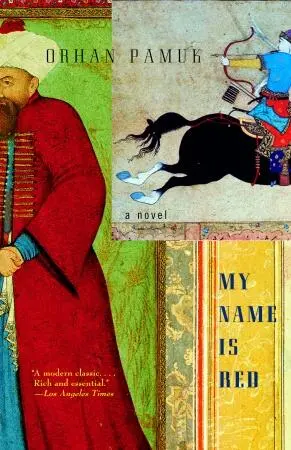
Orhan Pamuk - My Name is Red
Здесь есть возможность читать онлайн «Orhan Pamuk - My Name is Red» весь текст электронной книги совершенно бесплатно (целиком полную версию без сокращений). В некоторых случаях можно слушать аудио, скачать через торрент в формате fb2 и присутствует краткое содержание. Жанр: Современная проза, на английском языке. Описание произведения, (предисловие) а так же отзывы посетителей доступны на портале библиотеки ЛибКат.
- Название:My Name is Red
- Автор:
- Жанр:
- Год:неизвестен
- ISBN:нет данных
- Рейтинг книги:5 / 5. Голосов: 1
-
Избранное:Добавить в избранное
- Отзывы:
-
Ваша оценка:
My Name is Red: краткое содержание, описание и аннотация
Предлагаем к чтению аннотацию, описание, краткое содержание или предисловие (зависит от того, что написал сам автор книги «My Name is Red»). Если вы не нашли необходимую информацию о книге — напишите в комментариях, мы постараемся отыскать её.
When the Sultan commissions a great book to celebrate his royal self and his extensive dominion, he directs Enishte Effendi to assemble a cadre of the most acclaimed artists in the land. Their task: to illuminate the work in the European style. But because figurative art can be deemed an affront to Islam, this commission is a dangerous proposition indeed, and no one in the elite circle can know the full scope or nature of the project.
Panic erupts when one of the chosen miniaturists disappears, and the Sultan demands answers within three days. The only clue to the mystery-or crime?-lies in the half-finished illuminations themselves. Has an avenging angel discovered the blasphemous work? Or is a jealous contender for the hand of Enishte’s ravishing daughter, the incomparable Shekure, somehow to blame?
Orhan Pamuk’s My Name Is Red is at once a fantasy and a philosophical puzzle, a kaleidoscopic journey to the intersection of art, religion, love, sex, and power.
"Pamuk is a novelist and a great one…My Name is Red is by far the grandest and most astonishing contest in his internal East-West war…It is chock-full of sublimity and sin…The story is told by each of a dozen characters, and now and then by a dog, a tree, a gold coin, several querulous corpses and the color crimson ('My Name is Red')…[Readers will] be lofted by the paradoxical lightness and gaiety of the writing, by the wonderfully winding talk perpetually about to turn a corner, and by the stubborn humanity in the characters' maneuvers to survive. It is a humanity whose lies and silences emerge as endearing and oddly bracing individual truths."- Richard Eder, New York Times Book Review
"A murder mystery set in sixteenth-century Istanbul [that] uses the art of miniature illumination, much as Mann's 'Doctor Faustus' did music, to explore a nation's soul… Erdag Goknar deserves praise for the cool, smooth English in which he has rendered Pamuk's finespun sentences, passionate art appreciations, sly pedantic debates, [and] eerie urban scenes."- John Updike, The New Yorker
"The interweaving of human and philosophical intrigue is very much as I remember it in The Name of the Rose, as is the slow, dense beginning and the relentless gathering of pace… But, in my view, his book is by far the better of the two. I would go so far as to say that Pamuk achieves the very thing his book implies is impossible… More than any other book I can think of, it captures not just Istanbul's past and present contradictions, but also its terrible, timeless beauty. It's almost perfect, in other words. All it needs is the Nobel Prize."-Maureen Freely, New Statesman (UK)
"A perfect example of Pamuk's method as a novelist, which is to combine literary trickery with page-turning readability… As a meditation on art, in particular, My Name is Red is exquisitely subtle, demanding and repaying the closest attention.. We in the West can only feel grateful that such a novelist as Pamuk exists, to act as a bridge between our culture and that of a heritage quite as rich as our own."-Tom Holland, Daily Telegraph (UK)
"Readers… will find themselves lured into a richly described and remarkable world… Reading the novel is like being in a magically exotic dream…Splendidly enjoyable and rewarding… A book in which you can thoroughly immerse yourself." -Allan Massie, The Scotsman (UK)
"A wonderful novel, dreamy, passionate and august, exotic in the most original and exciting way. Orhan Pamuk is indisputably a major novelist."-Philip Hensher, The Spectator (UK)
"[In this] magnificent new novel… Pamuk takes the reader into the strange and beautiful world of Islamic art,in which Western notions no longer make sense… In this world of forgeries, where some might be in danger of losing their faith in literature, Pamuk is the real thing, and this book might well be one of the few recent works of fiction that will be remembered at the end of this century."-Avkar Altinel, The Observer (UK)
My Name is Red — читать онлайн бесплатно полную книгу (весь текст) целиком
Ниже представлен текст книги, разбитый по страницам. Система сохранения места последней прочитанной страницы, позволяет с удобством читать онлайн бесплатно книгу «My Name is Red», без необходимости каждый раз заново искать на чём Вы остановились. Поставьте закладку, и сможете в любой момент перейти на страницу, на которой закончили чтение.
Интервал:
Закладка:
Thus did we persist in opening other cabinets, other chests shown us by the aged dwarf, to examine the pictures therein. Periodically, I’d get fed up with the pictures, which all looked alike, and wish never again to watch Hüsrev visit Shirin under the castle window; I’d leave the master’s side-without even a glance at the nostrils of the horse Hüsrev rode-and try to warm myself at the brazier or I’d walk respectfully and awestruck among the heaps of cloth, gold, weapons, armor and plunder in the adjacent rooms of the Treasury. At times, prompted by an abrupt cry and hand gesture by Master Osman, I’d imagine that a new masterpiece had been found or, yes, at last a horse with a curious nose, and running to his side, I’d look at the picture the master was holding with his hand slightly atremble as he sat curled up on an Ushak carpet dating from the time of Sultan Mehmed the Conqueror, only to encounter an illustration, the likes of which I’d never before seen, depicting, say, Satan slyly boarding Noah’s ark.
We watched as hundreds of shahs, kings, sultans and khans-who’d ruled from the thrones of various kingdoms and empires from the time of Tamerlane to Sultan Süleyman the Magnificent-happily and excitedly hunted gazelles, lions and rabbits. We saw how even the Devil bit his finger and recoiled in embarrassment at the shameless man who stood upon scraps of wood tied to the back legs of a camel so he could violate the poor animal. In an Arabic book that had come by way of Baghdad, we watched the flight of the merchant who clung to the feet of a mythical bird as he spanned the seas. In the next volume, which opened by itself to the first page, we saw the scene that Shekure and I loved the most, in which Shirin beheld Hüsrev’s picture hanging from a branch and fell in love with him. Then, looking at an illustration that brought to life the inner workings of a complicated clock made from bobbins and metal balls, birds and Arabic statuettes seated on the back of an elephant, we remembered time.
I don’t know how much more time we spent examining book after book and illustration after illustration in this manner. It was as if the unchanging, frozen golden time revealed in the pictures and stories we viewed had thoroughly mingled with the damp and moldy time we experienced in the Treasury. It seemed that these illuminated pages, created over the centuries by the lavish expenditure of eyesight in the workshops of countless shahs, khans and sultans, would come to life, as would the objects that seemed to besiege us: The helmets, scimitars, daggers with diamond-studded handles, armor, porcelain cups from China, dusty and delicate lutes, and the pearl-embellished cushions and kilims-the likes of which we’d seen in countless illustrations.
“I now understand that by furtively and gradually re-creating the same pictures for hundreds and hundreds of years, thousands of artists had cunningly depicted the gradual transformation of their world into another.”
I’ll be first to admit that I didn’t completely understand what the great master meant. But the close attention my master had shown to the thousands of pictures made over the last two hundred years from Bukhara to Herat, from Tabriz to Baghdad and all the way to Istanbul, had far exceeded the search for a clue in the depiction of some horse’s nostrils. We’d participated in a kind of melancholy elegy to the inspiration, talent and patience of all the masters who’d painted and illuminated in these lands over the years.
For this reason, when the doors of the Treasury were opened at the time of the evening prayer and Master Osman explained to me that he had no desire whatsoever to leave, and that furthermore, only by remaining here until morning examining pictures by the light of oil lamps and candles could he execute properly Our Sultan’s charge, my first response, as I informed him, was to remain here with him and the dwarf.
However, when the door was opened and my master conveyed our wish to the waiting chiefs and asked permission of the Head Treasurer, immediately regretted my decision. I longed for Shekure and our house. I grew increasingly restless as I wondered how she would manage, spending the night alone with the children and how she would batten down the now-repaired shutters of the windows.
Through the opened half of the Treasury portal, I was beckoned to the magnificence of life outside by the large damp plane trees in the courtyard of the Enderun-now under a hint of fog-and by the gestures of two royal pages, speaking to each other in a sign language so as not to disturb the peace of Our Sultan; but I remained where I was, frozen by embarrassment and guilt.
WE TWO DERVISHES
Yea, the rumor that our picture was among the pages from China, Samarkand and Herat comprising an album hidden away in the remotest corner of the Treasury filled with the plunder of hundreds of countries over hundreds of years by the ancestors of His Excellency, Our Sultan, was most probably spread to the miniaturists’ division by the dwarf Jezmi Agha. If we might now recount our own story in our own fashion-the will of God be with us-we hope that none of the crowd in this fine coffeehouse will take offense.
One hundred and ten years have passed since our deaths, forty since the closing of our irredeemable, Persia-partisan dervish lodges, those dens of heresy and nests of devilry, but see for yourselves, here we are before you. How could this be? I’ll tell you how: We were rendered in the Venetian style! As this illustration indicates, one day we two dervishes were tramping through Our Sultan’s domains from one city to the next.
We were barefoot, our heads were shaven, and we were half naked; each of us was wearing a vest and the hide of a deer, a belt around our waists and we were holding our walking sticks, our begging bowls dangling from our necks by a chain; one of us was carrying an axe for cutting wood, and the other a spoon to eat whatever food God had blessed us with.
At that moment, standing before a caravansary beside a fountain, my dear friend, nay, my beloved, nay, my brother and I had given ourselves over to the usual argument: “You first please, no you first,” we were noisily deferring to each other as to who’d be the first to take up the spoon and eat from the bowl, when a Frank traveler, a strange man, stopped us, gave us each a silver Venetian coin and began to draw our picture.
He was a Frank; of course, he was weird. He situated us right in the center of the page as if we were the very tent of the Sultan, and was depicting us in our half-naked state when I shared with my companion a thought that had just then dawned upon me: To appear like a pair of truly impoverished Kalenderi beggar dervishes, we should roll our eyes back so our pupils look inward, the whites of our eyes facing the world like blind men-and that’s exactly what we proceeded to do. In this situation, it’s the nature of a dervish to behold the world in his head rather than the world outside; since our heads were full of hashish, the landscape of our minds was more pleasant than what the Frank painter saw.
Meanwhile, the scene outside had grown even worse; we heard the ranting of a Hoja Effendi.
Pray, let us not give the wrong idea. We’ve now made mention of the respected “Hoja Effendi,” but last week in this fine coffeehouse there was a great misunderstanding: This respected “Hoja Effendi” of whom we speak has nothing whatsoever to do with His Excellency Nusret Hoja the cleric from Erzurum, nor with the bastard Husret Hoja, nor with the hoja from Sivas who made it with the Devil atop a tree. Those who interpret everything negatively have said that if His Excellency Hoja Effendi becomes a target of reproach here once again, they’ll cut out the storyteller’s tongue and lower this coffeehouse about his head.
Читать дальшеИнтервал:
Закладка:
Похожие книги на «My Name is Red»
Представляем Вашему вниманию похожие книги на «My Name is Red» списком для выбора. Мы отобрали схожую по названию и смыслу литературу в надежде предоставить читателям больше вариантов отыскать новые, интересные, ещё непрочитанные произведения.









Обсуждение, отзывы о книге «My Name is Red» и просто собственные мнения читателей. Оставьте ваши комментарии, напишите, что Вы думаете о произведении, его смысле или главных героях. Укажите что конкретно понравилось, а что нет, и почему Вы так считаете.