Orhan Pamuk - My Name is Red
Здесь есть возможность читать онлайн «Orhan Pamuk - My Name is Red» весь текст электронной книги совершенно бесплатно (целиком полную версию без сокращений). В некоторых случаях можно слушать аудио, скачать через торрент в формате fb2 и присутствует краткое содержание. Жанр: Современная проза, на английском языке. Описание произведения, (предисловие) а так же отзывы посетителей доступны на портале библиотеки ЛибКат.
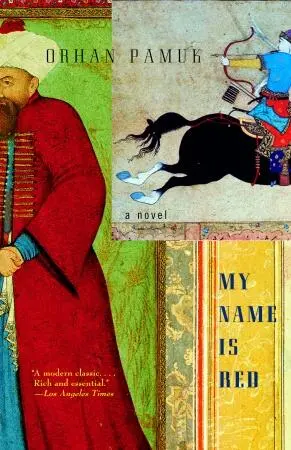
- Название:My Name is Red
- Автор:
- Жанр:
- Год:неизвестен
- ISBN:нет данных
- Рейтинг книги:5 / 5. Голосов: 1
-
Избранное:Добавить в избранное
- Отзывы:
-
Ваша оценка:
My Name is Red: краткое содержание, описание и аннотация
Предлагаем к чтению аннотацию, описание, краткое содержание или предисловие (зависит от того, что написал сам автор книги «My Name is Red»). Если вы не нашли необходимую информацию о книге — напишите в комментариях, мы постараемся отыскать её.
When the Sultan commissions a great book to celebrate his royal self and his extensive dominion, he directs Enishte Effendi to assemble a cadre of the most acclaimed artists in the land. Their task: to illuminate the work in the European style. But because figurative art can be deemed an affront to Islam, this commission is a dangerous proposition indeed, and no one in the elite circle can know the full scope or nature of the project.
Panic erupts when one of the chosen miniaturists disappears, and the Sultan demands answers within three days. The only clue to the mystery-or crime?-lies in the half-finished illuminations themselves. Has an avenging angel discovered the blasphemous work? Or is a jealous contender for the hand of Enishte’s ravishing daughter, the incomparable Shekure, somehow to blame?
Orhan Pamuk’s My Name Is Red is at once a fantasy and a philosophical puzzle, a kaleidoscopic journey to the intersection of art, religion, love, sex, and power.
"Pamuk is a novelist and a great one…My Name is Red is by far the grandest and most astonishing contest in his internal East-West war…It is chock-full of sublimity and sin…The story is told by each of a dozen characters, and now and then by a dog, a tree, a gold coin, several querulous corpses and the color crimson ('My Name is Red')…[Readers will] be lofted by the paradoxical lightness and gaiety of the writing, by the wonderfully winding talk perpetually about to turn a corner, and by the stubborn humanity in the characters' maneuvers to survive. It is a humanity whose lies and silences emerge as endearing and oddly bracing individual truths."- Richard Eder, New York Times Book Review
"A murder mystery set in sixteenth-century Istanbul [that] uses the art of miniature illumination, much as Mann's 'Doctor Faustus' did music, to explore a nation's soul… Erdag Goknar deserves praise for the cool, smooth English in which he has rendered Pamuk's finespun sentences, passionate art appreciations, sly pedantic debates, [and] eerie urban scenes."- John Updike, The New Yorker
"The interweaving of human and philosophical intrigue is very much as I remember it in The Name of the Rose, as is the slow, dense beginning and the relentless gathering of pace… But, in my view, his book is by far the better of the two. I would go so far as to say that Pamuk achieves the very thing his book implies is impossible… More than any other book I can think of, it captures not just Istanbul's past and present contradictions, but also its terrible, timeless beauty. It's almost perfect, in other words. All it needs is the Nobel Prize."-Maureen Freely, New Statesman (UK)
"A perfect example of Pamuk's method as a novelist, which is to combine literary trickery with page-turning readability… As a meditation on art, in particular, My Name is Red is exquisitely subtle, demanding and repaying the closest attention.. We in the West can only feel grateful that such a novelist as Pamuk exists, to act as a bridge between our culture and that of a heritage quite as rich as our own."-Tom Holland, Daily Telegraph (UK)
"Readers… will find themselves lured into a richly described and remarkable world… Reading the novel is like being in a magically exotic dream…Splendidly enjoyable and rewarding… A book in which you can thoroughly immerse yourself." -Allan Massie, The Scotsman (UK)
"A wonderful novel, dreamy, passionate and august, exotic in the most original and exciting way. Orhan Pamuk is indisputably a major novelist."-Philip Hensher, The Spectator (UK)
"[In this] magnificent new novel… Pamuk takes the reader into the strange and beautiful world of Islamic art,in which Western notions no longer make sense… In this world of forgeries, where some might be in danger of losing their faith in literature, Pamuk is the real thing, and this book might well be one of the few recent works of fiction that will be remembered at the end of this century."-Avkar Altinel, The Observer (UK)
My Name is Red — читать онлайн бесплатно полную книгу (весь текст) целиком
Ниже представлен текст книги, разбитый по страницам. Система сохранения места последней прочитанной страницы, позволяет с удобством читать онлайн бесплатно книгу «My Name is Red», без необходимости каждый раз заново искать на чём Вы остановились. Поставьте закладку, и сможете в любой момент перейти на страницу, на которой закончили чтение.
Интервал:
Закладка:
How much of an aging master’s interest and excitement did Black and the dwarf share? As I opened new volumes and turned their pages, I sensed the profound sorrow of thousands of illustrators from hundreds of cities large and small, each with a distinctive temperament, each painting under the patronage of a different cruel shah, khan or chieftain, each displaying his talent and succumbing to blindness. I felt the pain of the beatings we all received during our long apprenticeships, the blows inflicted with rulers, until our cheeks turned bright red, or with marble polishing stones upon our shaven heads, as I flipped-with humiliation-through the pages of a primitive book that displayed methods and implements of torture. I had no idea what this miserable book was doing in the Ottoman Treasury: Instead of seeing torture as a necessary practice administered before the supervision of a judge to ensure Allah’s justice in the world, infidel travelers would convince their coreligionists of our cruelty and evil-heartedness by having dishonorable miniaturists abase themselves and dash off these pictures in exchange for a few gold pieces. I was embarrassed at the obvious depraved pleasure with which this miniaturist had drawn pictures of bastinados, beatings, crucifixions, hangings by the neck or the feet, hookings, impalings, firings from cannon, nailings, stranglings, the cutting of throats, feedings to hungry dogs, whippings, baggings, pressings, soakings in cold water, the plucking of hair, the breaking of fingers, the delicate flayings, the cutting off of noses and the removal of eyes. Only true artists like us who’d suffered throughout our apprenticeships merciless bastinados, random pummelings and fists so that the irritable master who drew a line incorrectly might feel better-not to mention hours of blows from sticks and rulers so that the devil within us would perish to be reborn as the jinn of inspiration-only we could feel such extreme joy by depicting bastinados and tortures, only we could color these implements with the gaiety of coloring a child’s kite.
Hundreds of years hence, men looking at our world through the illustrations we’ve made won’t understand anything. Desiring to take a closer look, yet lacking the patience, they might feel the embarrassment, the joy, the deep pain and pleasure of observation I now feel as I examine pictures in this freezing Treasury-but they’ll never truly know. As I turned the pages with my old fingers numbed from the cold, my trusty mother-of-pearl-handled magnifying lens and my left eye passed over the pictures like an old stork traversing the earth, little surprised by the view below, yet still astonished to see new things. From these pages withheld from us for years, some of them legendary, I came to know which artist had learned what from whom, in which workshop under which shah’s patronage the thing we now call “style” first took shape, which fabled master had worked for whom, and how, for example, the curling Chinese clouds I knew had spread throughout Persia from Herat under Chinese influence were also used in Kazvin. I would occasionally allow myself an exhausted “Aha!”; but an agony lurked deeper within me, a melancholy and regret I can scarcely share with you for the belittled, tormented, pretty, moon-faced, gazelle-eyed, sapling-thin painters-battered by masters-who suffered for their art, yet remained full of excitement and hope, enjoying the affection that developed between them and their masters and their shared love of painting, before succumbing to anonymity and blindness after long years of toil.
It was with such melancholy and regret that I entered this world of fine and delicate feelings, the possibility of whose depiction my soul had quietly forgotten over years of rendering wars and celebrations for Our Sultan. In an album of collected pictures I saw a red-lipped, thin-waisted Persian boy holding a book on his lap exactly as I was holding one at that moment, and it reminded me of what shahs with a weakness for gold and power always forget: The world’s beauty belongs to Allah. On the page of another album drawn by a young master from Isfahan, with tears in my eyes, I beheld two marvelous youths in love with each other, and was reminded of the love my own handsome apprentices nourished for painting. A tiny-footed, transparent-skinned, weak and girlish youth had bared a delicate forearm, which aroused in one the desire to kiss it and die, while a cherry-lipped, almond-eyed, sapling-thin, button-nosed beauty of a maiden gazed with wonder-as though viewing three lovely flowers-upon the three small, deep marks of passion the youth had burned onto the inside of that adorable arm to demonstrate the strength of his love and his attachment to her.
Oddly, my heart began to quicken and pound. As had happened sixty years ago in my early apprenticeship, while I was looking at some rather indecent illustrations of handsome marble-skinned boys and slim small-breasted maidens drawn in the black-ink style of Tabriz, beads of sweat accumulated on my forehead. I recalled the passion for painting I felt and the depth of thought I experienced when, a few years after I’d married and taken my first steps toward master status, I saw a lovely angel-faced, almond-eyed, rose-petal-skinned youth brought in as an apprentice candidate. For a moment, I had the strong feeling that painting was not about melancholy and regret but about this desire I felt and that it was the talent of the master artist that first transformed this desire into a love of God and then into a love of the world as God saw it; so strong was this feeling that it caused me to relive with ecstatic delight all the years I’d spent over the drawing board until my back was hunched, all the beatings I’d endured while learning my craft, my dedication to courting blindness through illustration and all the agonies of painting I’d suffered and made others suffer. As if running my eyes over something forbidden, I stared long and silently at this wondrous illustration with the same delight. Much later I was still staring. A teardrop slid from my eye over my cheek into my beard.
When I noticed that one of the candlesticks slowly floating through the Treasury was approaching me, I put the album away and randomly opened one of the volumes the dwarf had recently set beside me. This was a special album prepared for shahs: I saw two deer at the edge of a green copse enamored of each other, with jackals watching them in hostile envy. I turned the page: Chestnut and bay horses that could’ve been the work of only one of the old masters of Herat -how spectacular they were! I turned the page: A confidently seated governmental official greeted me from a seventy-year-old picture; I couldn’t determine who it was from the face because he looked like anybody, or so I thought, yet the air of the painting, the seated man’s beard painted in various hues recalled something. My heart beat quickly as I recognized the execution of the magnificent hand in the piece. My heart knew before I did, only he could’ve drawn such a splendid hand: This was the work of Bihzad. It was as if light were gushing from the painting to my face.
I had seen pictures drawn by the Great Master Bihzad a few times before; perhaps because I hadn’t looked at them alone, but in a group of former masters years ago, perhaps because we couldn’t be certain whether it was indeed the work of the great Bihzad, I hadn’t been as taken as I was now.
The heavy moldy darkness of the Treasury chamber seemed to brighten. This beautifully drawn hand merged in my mind with that thin, magnificent arm branded with signs of love, which I’d just now seen. Again, I praised God for showing me such spectacular beauty before I went blind. How do I know I’ll soon be blind? I don’t know! I sensed that I could share this intuition of mine with Black, who’d sidled up to me holding a candle and was looking at the page, but something else came out of my mouth.
Читать дальшеИнтервал:
Закладка:
Похожие книги на «My Name is Red»
Представляем Вашему вниманию похожие книги на «My Name is Red» списком для выбора. Мы отобрали схожую по названию и смыслу литературу в надежде предоставить читателям больше вариантов отыскать новые, интересные, ещё непрочитанные произведения.








Обсуждение, отзывы о книге «My Name is Red» и просто собственные мнения читателей. Оставьте ваши комментарии, напишите, что Вы думаете о произведении, его смысле или главных героях. Укажите что конкретно понравилось, а что нет, и почему Вы так считаете.