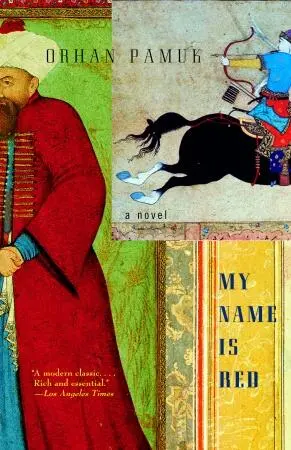
Orhan Pamuk - My Name is Red
Здесь есть возможность читать онлайн «Orhan Pamuk - My Name is Red» весь текст электронной книги совершенно бесплатно (целиком полную версию без сокращений). В некоторых случаях можно слушать аудио, скачать через торрент в формате fb2 и присутствует краткое содержание. Жанр: Современная проза, на английском языке. Описание произведения, (предисловие) а так же отзывы посетителей доступны на портале библиотеки ЛибКат.
- Название:My Name is Red
- Автор:
- Жанр:
- Год:неизвестен
- ISBN:нет данных
- Рейтинг книги:5 / 5. Голосов: 1
-
Избранное:Добавить в избранное
- Отзывы:
-
Ваша оценка:
My Name is Red: краткое содержание, описание и аннотация
Предлагаем к чтению аннотацию, описание, краткое содержание или предисловие (зависит от того, что написал сам автор книги «My Name is Red»). Если вы не нашли необходимую информацию о книге — напишите в комментариях, мы постараемся отыскать её.
When the Sultan commissions a great book to celebrate his royal self and his extensive dominion, he directs Enishte Effendi to assemble a cadre of the most acclaimed artists in the land. Their task: to illuminate the work in the European style. But because figurative art can be deemed an affront to Islam, this commission is a dangerous proposition indeed, and no one in the elite circle can know the full scope or nature of the project.
Panic erupts when one of the chosen miniaturists disappears, and the Sultan demands answers within three days. The only clue to the mystery-or crime?-lies in the half-finished illuminations themselves. Has an avenging angel discovered the blasphemous work? Or is a jealous contender for the hand of Enishte’s ravishing daughter, the incomparable Shekure, somehow to blame?
Orhan Pamuk’s My Name Is Red is at once a fantasy and a philosophical puzzle, a kaleidoscopic journey to the intersection of art, religion, love, sex, and power.
"Pamuk is a novelist and a great one…My Name is Red is by far the grandest and most astonishing contest in his internal East-West war…It is chock-full of sublimity and sin…The story is told by each of a dozen characters, and now and then by a dog, a tree, a gold coin, several querulous corpses and the color crimson ('My Name is Red')…[Readers will] be lofted by the paradoxical lightness and gaiety of the writing, by the wonderfully winding talk perpetually about to turn a corner, and by the stubborn humanity in the characters' maneuvers to survive. It is a humanity whose lies and silences emerge as endearing and oddly bracing individual truths."- Richard Eder, New York Times Book Review
"A murder mystery set in sixteenth-century Istanbul [that] uses the art of miniature illumination, much as Mann's 'Doctor Faustus' did music, to explore a nation's soul… Erdag Goknar deserves praise for the cool, smooth English in which he has rendered Pamuk's finespun sentences, passionate art appreciations, sly pedantic debates, [and] eerie urban scenes."- John Updike, The New Yorker
"The interweaving of human and philosophical intrigue is very much as I remember it in The Name of the Rose, as is the slow, dense beginning and the relentless gathering of pace… But, in my view, his book is by far the better of the two. I would go so far as to say that Pamuk achieves the very thing his book implies is impossible… More than any other book I can think of, it captures not just Istanbul's past and present contradictions, but also its terrible, timeless beauty. It's almost perfect, in other words. All it needs is the Nobel Prize."-Maureen Freely, New Statesman (UK)
"A perfect example of Pamuk's method as a novelist, which is to combine literary trickery with page-turning readability… As a meditation on art, in particular, My Name is Red is exquisitely subtle, demanding and repaying the closest attention.. We in the West can only feel grateful that such a novelist as Pamuk exists, to act as a bridge between our culture and that of a heritage quite as rich as our own."-Tom Holland, Daily Telegraph (UK)
"Readers… will find themselves lured into a richly described and remarkable world… Reading the novel is like being in a magically exotic dream…Splendidly enjoyable and rewarding… A book in which you can thoroughly immerse yourself." -Allan Massie, The Scotsman (UK)
"A wonderful novel, dreamy, passionate and august, exotic in the most original and exciting way. Orhan Pamuk is indisputably a major novelist."-Philip Hensher, The Spectator (UK)
"[In this] magnificent new novel… Pamuk takes the reader into the strange and beautiful world of Islamic art,in which Western notions no longer make sense… In this world of forgeries, where some might be in danger of losing their faith in literature, Pamuk is the real thing, and this book might well be one of the few recent works of fiction that will be remembered at the end of this century."-Avkar Altinel, The Observer (UK)
My Name is Red — читать онлайн бесплатно полную книгу (весь текст) целиком
Ниже представлен текст книги, разбитый по страницам. Система сохранения места последней прочитанной страницы, позволяет с удобством читать онлайн бесплатно книгу «My Name is Red», без необходимости каждый раз заново искать на чём Вы остановились. Поставьте закладку, и сможете в любой момент перейти на страницу, на которой закончили чтение.
Интервал:
Закладка:
2. There’s a claim that has been a persistent topic of gossip among master illuminators for the last twenty-five years: With the express permission of the Sultan, an illustrator entered this forbidden Treasury, found this spectacular book, opened it and by candlelight copied into his sketchbook examples of a number of exquisite horses, trees, clouds, flowers, birds, gardens and scenes of war and love for later use in his work…Whenever an artist created an amazing and exceptional piece, jealousy prompted such gossip from the others, who sought to belittle the picture as nothing but Persian work from Tabriz. Back then, Tabriz was not Ottoman territory. When such slander was directed at me, I felt justifiably angry, yet secretly proud; but when I heard the same accusation about others, I believed it. Now, I sadly realized that in some strange way the four of us miniaturists who’d looked at this book once twenty-five years ago ingrained its images into our memories, and since then, we’ve recalled, transformed, altered and painted them into the books of Our Sultan. My spirits were dampened not by the mercilessness of overly suspicious sultans who wouldn’t take such books out of their treasuries and show them to us, but by the narrowness of our own world of painting. Whether it be the great masters of Herat or the new masters of Tabriz, Persian artists had made more extraordinary illustrations, more masterpieces, than we Ottomans.
Like a lightning flash, it occurred to me how appropriate it’d be if two days hence all my miniaturists and I were put to torture; using the point of my penknife I ruthlessly scraped away the eyes beneath my hand in the picture that lay open before me. It was the account of the Persian scholar who learned chess simply by looking at a chess set brought by the ambassador from Hindustan, before defeating the Hindu master at his own game! A Persian lie! One by one, I scraped away the eyes of the chess players and of the shah and his men who were watching them. Flipping back through the pages, I also pitilessly gouged out the eyes of the shahs who battled mercilessly, of the soldiers of imposing armies bedecked in magnificent armor and of severed heads lying on the ground. After doing the same to three pages, I slid my penknife back into my sash.
My hands trembled, but I didn’t feel so bad. Did I now feel what so many lunatics felt after committing this strange act whose results I encountered frequently during my fifty-year tenure as a painter? I wanted nothing more than blood to flow onto the pages of this book from the eyes I had blinded.
3. This brings me to the torment and consolation awaiting me at the end of my life. No part of this excellent book, which Shah Tahmasp had completed by spurring Persia ’s most masterful artists for ten years, had seen the touch of the great Bihzad’s pen, and his excellent rendering of hands was nowhere to be found. This fact confirmed that Bihzad was blind in the last years of his life, when he fled from Herat -then a city out of favor-to Tabriz. So, I once again decided happily that after he attained the perfection of the old masters by working his entire life, the great master blinded himself to avoid tainting his painting with the desires of any other workshop or shah.
Just then, Black and the dwarf opened a thick volume they were carrying and placed it before me.
“No, this isn’t it,” I said without being contrary. “This is a Mongol Book of Kings : The iron horses of Alexander’s iron cavalry were filled with naphtha and set aflame like lamps, before being set against the enemy with flames shooting from their nostrils.”
We stared at the flaming army of iron copied from Chinese paintings.
“Jezmi Agha,” I said, “we later depicted in the Chronicle of Sultan Selim the gifts that Shah Tahmasp’s Persian ambassadors, who also presented this book, brought with them twenty-five years ago…”
He swiftly located the Chronicle of Sultan Selim and placed it in front of me. Paired with the vibrantly colored page that showed the ambassadors presenting the Book of Kings along with the other gifts to Sultan Selim, my eyes found, among the gifts which were listed one by one, what I’d long ago read but had forgotten because it was so incredible:
The turquoise-and-mother-of-pearl-handled golden plume needle which the Venerated Talent of Herat, Master of Master Illuminators Bihzad, used in the act of blinding his exalted self.
I asked the dwarf where he found the Chronicle of Sultan Selim . I followed him through the dusty darkness of the Treasury, meandering between chests, piles of cloth and carpet, cabinets and beneath stairways. I noticed how our shadows, now shrinking, now enlarging, slipped over shields, elephant tusks and tiger skins. In one of the adjoining rooms, this one also suffused with the same strange redness of cloth and velvet, beside the iron chest whence emerged the Book of Kings , amid other volumes, cloth sheets embroidered with silver and gold wire, raw and unpolished Ceylon stone, and ruby-studded daggers, I saw some of the other gifts that Shah Tahmasp had sent: silk carpets from Isfahan, an ivory chess set and an object that immediately caught my attention-a pen case decorated with Chinese dragons and branches with a mother-of-pearl-inlaid rosette obviously from the time of Tamerlane. I opened the case and out came the subtle scent of burned paper and rosewater; within rested the turquoise-and mother-of-pearl-handled golden needle used to fasten plumes to turbans. I took up the needle and returned to my spot like a specter.
Alone again, I placed the needle that Master Bihzad had used to blind himself upon the open page of the Book of Kings and gazed at it. It wasn’t the needle he’d blinded himself with that made me shudder, but seeing an object he’d taken into his miraculous hands.
Why did Shah Tahmasp send this terrifying needle with the book he’d presented to Sultan Selim? Was it because this Shah, who as a child was a student of Bihzad’s and a patron of artists in his youth, had changed in his old age, distancing poets and artists from his inner circle and giving himself over entirely to faith and worship? Was this the reason he was willing to relinquish this exquisite book, which the greatest of masters had labored over for ten years? Had he sent this needle so all would know that the great artist was blinded of his own volition or, as was rumored for a time, to make the statement that whosoever beheld the pages of this book even once would no longer wish to see anything else in this world? In any event, this volume was no longer considered a masterpiece by the Shah, who felt poignant regret, afraid that he’d committed a sacrilege through his youthful love of illustrating, as happened with many rulers in their old age.
I was reminded of stories told by spiteful illuminators who’d grown old to find their dreams unfulfilled: As the armies of the Blacksheep ruler, Jihan Shah, were poised to enter Shiraz, Ibn Hüsam, the city’s legendary Head Illuminator, declared, “I refuse to paint in any other way,” and had his apprentice blind him with a hot iron. Among the miniaturists that the armies of Sultan Selim the Grim brought back to Istanbul after the defeat of Shah Ismail, the capture of Tabriz and the plunder of the Seven Heavens Palace was an old Persian master who it was rumored blinded himself with medicines because he believed he could never bring himself to paint in the Ottoman style-not as the result of an illness he’d had on the road as some claimed. To set an example for them, I used to tell my illuminators in their moments of frustration how Bihzad had blinded himself.
Was there no other recourse? If a master miniaturist made use of the new methods here and there in out-of-the-way places, couldn’t he then, if only a little, save the entire workshop and the styles of the old masters?
Читать дальшеИнтервал:
Закладка:
Похожие книги на «My Name is Red»
Представляем Вашему вниманию похожие книги на «My Name is Red» списком для выбора. Мы отобрали схожую по названию и смыслу литературу в надежде предоставить читателям больше вариантов отыскать новые, интересные, ещё непрочитанные произведения.








Обсуждение, отзывы о книге «My Name is Red» и просто собственные мнения читателей. Оставьте ваши комментарии, напишите, что Вы думаете о произведении, его смысле или главных героях. Укажите что конкретно понравилось, а что нет, и почему Вы так считаете.