Orhan Pamuk - My Name is Red
Здесь есть возможность читать онлайн «Orhan Pamuk - My Name is Red» весь текст электронной книги совершенно бесплатно (целиком полную версию без сокращений). В некоторых случаях можно слушать аудио, скачать через торрент в формате fb2 и присутствует краткое содержание. Жанр: Современная проза, на английском языке. Описание произведения, (предисловие) а так же отзывы посетителей доступны на портале библиотеки ЛибКат.
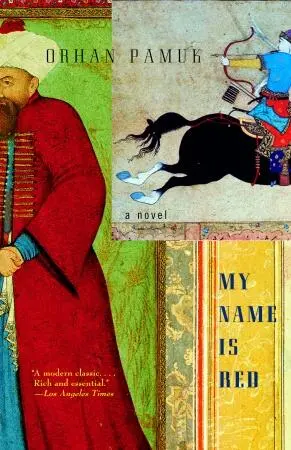
- Название:My Name is Red
- Автор:
- Жанр:
- Год:неизвестен
- ISBN:нет данных
- Рейтинг книги:5 / 5. Голосов: 1
-
Избранное:Добавить в избранное
- Отзывы:
-
Ваша оценка:
My Name is Red: краткое содержание, описание и аннотация
Предлагаем к чтению аннотацию, описание, краткое содержание или предисловие (зависит от того, что написал сам автор книги «My Name is Red»). Если вы не нашли необходимую информацию о книге — напишите в комментариях, мы постараемся отыскать её.
When the Sultan commissions a great book to celebrate his royal self and his extensive dominion, he directs Enishte Effendi to assemble a cadre of the most acclaimed artists in the land. Their task: to illuminate the work in the European style. But because figurative art can be deemed an affront to Islam, this commission is a dangerous proposition indeed, and no one in the elite circle can know the full scope or nature of the project.
Panic erupts when one of the chosen miniaturists disappears, and the Sultan demands answers within three days. The only clue to the mystery-or crime?-lies in the half-finished illuminations themselves. Has an avenging angel discovered the blasphemous work? Or is a jealous contender for the hand of Enishte’s ravishing daughter, the incomparable Shekure, somehow to blame?
Orhan Pamuk’s My Name Is Red is at once a fantasy and a philosophical puzzle, a kaleidoscopic journey to the intersection of art, religion, love, sex, and power.
"Pamuk is a novelist and a great one…My Name is Red is by far the grandest and most astonishing contest in his internal East-West war…It is chock-full of sublimity and sin…The story is told by each of a dozen characters, and now and then by a dog, a tree, a gold coin, several querulous corpses and the color crimson ('My Name is Red')…[Readers will] be lofted by the paradoxical lightness and gaiety of the writing, by the wonderfully winding talk perpetually about to turn a corner, and by the stubborn humanity in the characters' maneuvers to survive. It is a humanity whose lies and silences emerge as endearing and oddly bracing individual truths."- Richard Eder, New York Times Book Review
"A murder mystery set in sixteenth-century Istanbul [that] uses the art of miniature illumination, much as Mann's 'Doctor Faustus' did music, to explore a nation's soul… Erdag Goknar deserves praise for the cool, smooth English in which he has rendered Pamuk's finespun sentences, passionate art appreciations, sly pedantic debates, [and] eerie urban scenes."- John Updike, The New Yorker
"The interweaving of human and philosophical intrigue is very much as I remember it in The Name of the Rose, as is the slow, dense beginning and the relentless gathering of pace… But, in my view, his book is by far the better of the two. I would go so far as to say that Pamuk achieves the very thing his book implies is impossible… More than any other book I can think of, it captures not just Istanbul's past and present contradictions, but also its terrible, timeless beauty. It's almost perfect, in other words. All it needs is the Nobel Prize."-Maureen Freely, New Statesman (UK)
"A perfect example of Pamuk's method as a novelist, which is to combine literary trickery with page-turning readability… As a meditation on art, in particular, My Name is Red is exquisitely subtle, demanding and repaying the closest attention.. We in the West can only feel grateful that such a novelist as Pamuk exists, to act as a bridge between our culture and that of a heritage quite as rich as our own."-Tom Holland, Daily Telegraph (UK)
"Readers… will find themselves lured into a richly described and remarkable world… Reading the novel is like being in a magically exotic dream…Splendidly enjoyable and rewarding… A book in which you can thoroughly immerse yourself." -Allan Massie, The Scotsman (UK)
"A wonderful novel, dreamy, passionate and august, exotic in the most original and exciting way. Orhan Pamuk is indisputably a major novelist."-Philip Hensher, The Spectator (UK)
"[In this] magnificent new novel… Pamuk takes the reader into the strange and beautiful world of Islamic art,in which Western notions no longer make sense… In this world of forgeries, where some might be in danger of losing their faith in literature, Pamuk is the real thing, and this book might well be one of the few recent works of fiction that will be remembered at the end of this century."-Avkar Altinel, The Observer (UK)
My Name is Red — читать онлайн бесплатно полную книгу (весь текст) целиком
Ниже представлен текст книги, разбитый по страницам. Система сохранения места последней прочитанной страницы, позволяет с удобством читать онлайн бесплатно книгу «My Name is Red», без необходимости каждый раз заново искать на чём Вы остановились. Поставьте закладку, и сможете в любой момент перейти на страницу, на которой закончили чтение.
Интервал:
Закладка:
“Behold the remarkable rendering of the hand,” I said. “It’s Bihzad.”
My hand went of its own will to hold Black’s, as if it were holding the hand of one of those soft, velvet-skinned, beautiful apprentice boys, each of whom I’d loved in my youth. His hand was smooth and firm, warmer than my own, delicate and broad, and I was thrilled by the veined side of his wrist. When I was young, I would take an apprentice child’s hand into my palm and, before telling him how to hold the brush, I’d gaze with affection into his sweet, frightened eyes. That’s how I looked at Black. Reflected in his pupils, I saw the flame of the candle he held aloft. “We miniaturists are brethren,” I said, “but now everything is coming to an end.”
“How do you mean?”
I said, “Everything is coming to an end” like a great master who longs for blindness, having devoted his years to a lord or a prince, having created masterpieces in his workshop in the style of the ancients, having even ensured that this workshop had its own style, a great master who knows, whenever his patron lord loses his last battle, that new lords will come in the wake of the plundering enemy, disband the workshop, tear apart bound volumes leaving the pages in disarray and belittle and destroy what remains, including the fine details that he long believed in, that were of his own discovery and that he loved like his own children. But I needed to explain this to Black differently.
“This illustration is of the great Poet Abdullah Hatifi,” I said. “Hatifi was such a great poet that he simply stayed home while everybody else rushed out and toadied up to Shah Ismail after the king took Herat. In response, Shah Ismail personally went all the way to his house on the outskirts of the city to see him. We know this is Hatifi, not from Bihzad’s rendering of Hatifi’s face, but from the writing beneath the illustration, don’t we?”
Black looked at me, indicating “yes” with his pretty eyes. “When we look at the face of the poet in the painting,” I said, “we see that it could be a face like any other face. If Abdullah Hatifi were here, God rest his soul, we could never hope to recognize him from the face in this picture. However, we could do so relying on the illustration in its entirety: There’s something in the manner of the composition, in Hatifi’s pose, in the colors, the gilding and the stunning hand rendered by Master Bihzad that at once indicates the picture is of a poet. Meaning precedes form in the world of our art. As we begin to paint in imitation of the Frankish and Venetian masters, as in the book that Our Sultan had commissioned from your Enishte, the domain of meaning ends and the domain of form begins. However, with the Venetian methods…”
“My Enishte, may he rest in eternal peace, was murdered,” Black said rudely.
I caressed Black’s hand, which rested within my own, as if respectfully stroking the tiny hand of a young apprentice who might one day indeed illustrate masterpieces. Quietly and reverently we looked at Bihzad’s masterpiece for a time. Later, Black withdrew his hand from mine.
“We passed quickly over the chestnut horses on the previous page without examining their noses,” he said.
“There’s nothing to them,” I said, and turned back to the previous page so he might see for himself: There was nothing extraordinary about the nostrils of the horses.
“When shall we find the horses with peculiar noses?” Black asked like a child.
But, in the middle of the night, toward morning, when we found Shah Tahmasp’s legendary Book of Kings in an iron chest beneath piles of various shades of green watered silk and drew it forth, Black was curled up fast asleep on a red Ushak carpet, with his well-formed head lying on a velvet pillow embroidered with pearls. Meanwhile, as soon as I laid eyes upon the legendary tome again after so many years, I quickly understood that the day had only just begun for me.
The legendary volume I’d seen only from afar twenty-five years ago was so large and heavy that Jezmi Agha and I had difficulty lifting and carrying it. When I touched the binding, I knew there was wood within the leather. Twenty-five years ago, upon the death of Sultan Süleyman the Magnificent, Shah Tahmasp was so elated to be finally rid of this sultan who’d occupied Tabriz three times, that along with the gift-laden camels he sent to Süleyman’s successor, Sultan Selim, he included a spectacular Koran and this volume, the most beautiful of the books in his treasury. First, a Persian ambassadorial delegation three hundred strong took the tome to Edirne where the new sultan spent the winter hunting; after it arrived here in Istanbul along with the other presents carried on camels and mules, Head Illuminator Black Memi and we three young masters went to see the book before it was locked up in the Treasury. Just like the Istanbulites who would rush to see an elephant brought from Hindustan or a giraffe from Africa, we hurried to the palace where I learned from Master Black Memi that the great Master Bihzad, who’d left Herat for Tabriz in his old age, hadn’t contributed to this book because he’d gone blind.
For Ottoman miniaturists like us who were astonished by ordinary books with seven or eight illustrations, looking through this volume, which contained 250 large illustrations, was like roaming through an exquisite palace while its inhabitants slept. We stared at the incredibly rich pages with a quiet pious reverence as if beholding the Gardens of Paradise that had appeared miraculously for a fleeting moment. And for the following twenty-five years we discussed this book which remained locked in the Treasury.
I silently opened the thick cover of the Book of Kings as if opening a huge palace door. As I turned the pages, each of which made a pleasant rustle, I was overcome by melancholy more than awe.
1. Mindful of the stories suggesting that all the master miniaturists of Istanbul had stolen images from the pages of this book, I couldn’t give my full attention to the pictures.
2. Thinking that I might chance upon a hand drawn by Bihzad in some corner, I couldn’t devote myself wholeheartedly to the masterpieces that appeared in one of every five or six pictures (how decisively and with what grace did Tahmuras lower his mace upon the heads of the demons and giants, who later, in a time of peace, would teach him the alphabet, Greek and various other languages!).
3. The noses of horses and the presence of Black and the dwarf prevented me from surrendering myself to what I saw.
Naturally, I was disappointed to find myself observing more with my mind than with my heart, despite the great luck of having Allah, in His munificence, grant me the chance to have my fill of this legendary book before the velvet curtain of darkness descended over my eyes-the divine grace bestowed upon all great miniaturists. By the time the light of dawn reached the Treasury, which had gradually begun to resemble an icy tomb, I’d gazed upon each of the 259 pictures in this superlative book. Since I looked with my mind, allow me once more to categorize, as if I were an Arab scholar interested only in reasoning:
1. Nowhere could I locate a horse with nostrils that resembled what the wretched murderer had drawn: Not among the variously colored horses that Rüstem encountered while pursuing horse thieves in Turan; not among Feridun Shah’s extraordinary horses which swam the Tigris after the Arab Sultan had denied him permission to do so; not among the gray horses sorrowfully watching Tur’s treachery in beheading his younger brother Iraj, of whom he was jealous because their father, while doling out his territory, gave the best country, Persia, and far away China to Iraj, while leaving only the western lands to Tur; not among the horses of the heroic armies of Alexander that included Khazars, Egyptians, Berbers and Arabs, all equipped with armor, iron shields, indestructible swords and glimmering helmets; not the fabled horse that killed Shah Yazdgird-whose nose bled perpetually as a result of the divine punishment for rebelling against God’s fate-by trampling him on the shores of the green lake whose restorative waters eased his affliction; and not among the hundreds of mythical and perfect horses all drawn by six or seven miniaturists. Yet, there was still more than one entire day ahead of me in which to examine the other books in the Treasury.
Читать дальшеИнтервал:
Закладка:
Похожие книги на «My Name is Red»
Представляем Вашему вниманию похожие книги на «My Name is Red» списком для выбора. Мы отобрали схожую по названию и смыслу литературу в надежде предоставить читателям больше вариантов отыскать новые, интересные, ещё непрочитанные произведения.









Обсуждение, отзывы о книге «My Name is Red» и просто собственные мнения читателей. Оставьте ваши комментарии, напишите, что Вы думаете о произведении, его смысле или главных героях. Укажите что конкретно понравилось, а что нет, и почему Вы так считаете.