Orhan Pamuk - My Name is Red
Здесь есть возможность читать онлайн «Orhan Pamuk - My Name is Red» весь текст электронной книги совершенно бесплатно (целиком полную версию без сокращений). В некоторых случаях можно слушать аудио, скачать через торрент в формате fb2 и присутствует краткое содержание. Жанр: Современная проза, на английском языке. Описание произведения, (предисловие) а так же отзывы посетителей доступны на портале библиотеки ЛибКат.
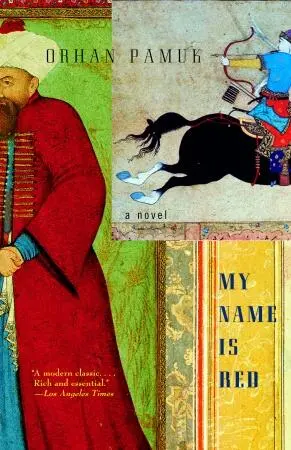
- Название:My Name is Red
- Автор:
- Жанр:
- Год:неизвестен
- ISBN:нет данных
- Рейтинг книги:5 / 5. Голосов: 1
-
Избранное:Добавить в избранное
- Отзывы:
-
Ваша оценка:
My Name is Red: краткое содержание, описание и аннотация
Предлагаем к чтению аннотацию, описание, краткое содержание или предисловие (зависит от того, что написал сам автор книги «My Name is Red»). Если вы не нашли необходимую информацию о книге — напишите в комментариях, мы постараемся отыскать её.
When the Sultan commissions a great book to celebrate his royal self and his extensive dominion, he directs Enishte Effendi to assemble a cadre of the most acclaimed artists in the land. Their task: to illuminate the work in the European style. But because figurative art can be deemed an affront to Islam, this commission is a dangerous proposition indeed, and no one in the elite circle can know the full scope or nature of the project.
Panic erupts when one of the chosen miniaturists disappears, and the Sultan demands answers within three days. The only clue to the mystery-or crime?-lies in the half-finished illuminations themselves. Has an avenging angel discovered the blasphemous work? Or is a jealous contender for the hand of Enishte’s ravishing daughter, the incomparable Shekure, somehow to blame?
Orhan Pamuk’s My Name Is Red is at once a fantasy and a philosophical puzzle, a kaleidoscopic journey to the intersection of art, religion, love, sex, and power.
"Pamuk is a novelist and a great one…My Name is Red is by far the grandest and most astonishing contest in his internal East-West war…It is chock-full of sublimity and sin…The story is told by each of a dozen characters, and now and then by a dog, a tree, a gold coin, several querulous corpses and the color crimson ('My Name is Red')…[Readers will] be lofted by the paradoxical lightness and gaiety of the writing, by the wonderfully winding talk perpetually about to turn a corner, and by the stubborn humanity in the characters' maneuvers to survive. It is a humanity whose lies and silences emerge as endearing and oddly bracing individual truths."- Richard Eder, New York Times Book Review
"A murder mystery set in sixteenth-century Istanbul [that] uses the art of miniature illumination, much as Mann's 'Doctor Faustus' did music, to explore a nation's soul… Erdag Goknar deserves praise for the cool, smooth English in which he has rendered Pamuk's finespun sentences, passionate art appreciations, sly pedantic debates, [and] eerie urban scenes."- John Updike, The New Yorker
"The interweaving of human and philosophical intrigue is very much as I remember it in The Name of the Rose, as is the slow, dense beginning and the relentless gathering of pace… But, in my view, his book is by far the better of the two. I would go so far as to say that Pamuk achieves the very thing his book implies is impossible… More than any other book I can think of, it captures not just Istanbul's past and present contradictions, but also its terrible, timeless beauty. It's almost perfect, in other words. All it needs is the Nobel Prize."-Maureen Freely, New Statesman (UK)
"A perfect example of Pamuk's method as a novelist, which is to combine literary trickery with page-turning readability… As a meditation on art, in particular, My Name is Red is exquisitely subtle, demanding and repaying the closest attention.. We in the West can only feel grateful that such a novelist as Pamuk exists, to act as a bridge between our culture and that of a heritage quite as rich as our own."-Tom Holland, Daily Telegraph (UK)
"Readers… will find themselves lured into a richly described and remarkable world… Reading the novel is like being in a magically exotic dream…Splendidly enjoyable and rewarding… A book in which you can thoroughly immerse yourself." -Allan Massie, The Scotsman (UK)
"A wonderful novel, dreamy, passionate and august, exotic in the most original and exciting way. Orhan Pamuk is indisputably a major novelist."-Philip Hensher, The Spectator (UK)
"[In this] magnificent new novel… Pamuk takes the reader into the strange and beautiful world of Islamic art,in which Western notions no longer make sense… In this world of forgeries, where some might be in danger of losing their faith in literature, Pamuk is the real thing, and this book might well be one of the few recent works of fiction that will be remembered at the end of this century."-Avkar Altinel, The Observer (UK)
My Name is Red — читать онлайн бесплатно полную книгу (весь текст) целиком
Ниже представлен текст книги, разбитый по страницам. Система сохранения места последней прочитанной страницы, позволяет с удобством читать онлайн бесплатно книгу «My Name is Red», без необходимости каждый раз заново искать на чём Вы остановились. Поставьте закладку, и сможете в любой момент перейти на страницу, на которой закончили чтение.
Интервал:
Закладка:
We saw pictures of war and death, each more frightening and more expertly done than the next: Rüstem together with Shah Mazenderan; Rüstem attacking Afrasiyab’s army; and Rüstem, disguised in armor, a mysterious and unidentified hero warrior…In another album we saw dismembered corpses, daggers drenched in red blood, sorrowful soldiers in whose eyes the light of death gleamed and warriors cutting each other down like reeds, as fabled armies, which we could not name, clashed mercilessly. Master Osman-for who knows how many thousandth time-looked upon Hüsrev spying on Shirin bathing in a lake by moonlight, upon the lovers Leyla and Mejnun fainting as they beheld each other after an extended separation, and a spirited picture, all aflutter with birds, trees and flowers, of Salaman and Absal as they fled the entire world and lived together on an isle of bliss. Like a true great master, he couldn’t help drawing my attention to some oddity in a corner of even the worst painting, perhaps having to do with an oversight on the part of the illuminator or perhaps with the conversation of colors: As might be expected, Hüsrev and Shirin are listening to a charming recital by her ladies-in-waiting, but see there, what kind of sad and spiteful painter had needlessly perched that ominous owl on a tree branch?; who had included that lovely boy dressed in woman’s garb among the Egyptian women who cut their fingers trying to peel tasty oranges while gazing upon the beauty of handsome Joseph?; could the miniaturist who painted İsfendiyar’s blinding with an arrow foresee that later on he, too, would be blinded?
We saw the angels accompanying Our Exalted Prophet during his Ascension; the dark-skinned, six-armed, long-white-bearded old man symbolizing Saturn; and baby Rüstem sleeping peacefully in his mother-of-pearl-inlaid cradle beneath the watchful eyes of his mother and nursemaids. We saw the way Darius died an agonizing death in Alexander’s arms, how Behram Gür withdrew to the red room with his Russian princess, how Siyavush passed through fire mounted on a black horse whose nostrils bore no peculiarity, and the woeful funeral procession of Hüsrev, murdered by his own son. As Master Osman rapidly picked out the volumes and set them aside, he would at times recognize an artist and show me, or winkle out an illustrator’s signature humbly hidden among flowers growing in the seclusion of a ruined building, or hiding in a black well along with a jinn. By comparing signatures and colophons, he could determine who’d taken what from whom. He’d flip through certain books exhaustively in hope of finding a series of pictures. Long silences passed wherein nothing but the faint susurrus of turning pages could be heard. Occasionally, Master Osman would cry out “Aha!” but I kept my peace, unable to understand what had excited him. At times he would remind me that we’d already encountered the page composition or arrangement of trees and mounted soldiers of a particular illustration in other books, in different scenes of completely different stories, and he’d point out these pictures again to jog my memory. He compared a picture in a version of Nizami’s Quintet from the time of Tamerlane’s son Shah Rıza-that is, from nearly two hundred years ago-with another picture he said was made in Tabriz seventy or eighty years earlier, and then go on to ask me what we could learn from the fact that two miniaturists had created the same picture without having seen each other’s work. He answered the question himself:
“To paint is to remember.”
Opening and shutting old illuminated manuscripts, Master Osman would sink his face with sorrow into the wondrous artwork (because nobody could paint this way anymore) and then become animated with joy before poorly executed pieces (for all miniaturists were brethren!)-and he’d show me what the artist had remembered, that is, old pictures of trees, angels, parasols, tigers, tents, dragons and melancholy princes, and in the process, what he hinted at was this: There was a time when Allah looked upon the world in all its uniqueness, and believing in the beauty of what he saw, bequeathed his creation to us, his servants. The duty of illustrators and of those who, loving art, gaze upon the world, is to remember the magnificence that Allah beheld and left to us. The greatest masters in each generation of painters, expending their lives and toiling until blind, strove with great effort and inspiration to attain and record the wondrous dream that Allah commanded us to see. Their work resembled Mankind recalling his own golden memories from the very beginning. Unfortunately, even the greatest masters, just like tired old men or great miniaturists gone blind from their labors, were only vaguely able to recollect random parts of that magnificent vision. This was the mysterious wisdom behind the phenomenon of old masters who miraculously drew a tree, a bird, the pose of a prince washing himself in the public baths or a sad young woman at a window in exactly the same way despite never having seen each other’s work and despite the hundreds of years that separated them.
Long afterward, once the red light of the Treasury had dimmed and it became evident that the cabinet contained none of the gift books that Shah Tahmasp had sent to Our Sultan’s grandfather, Master Osman revisited the same logic:
“At times, a bird’s wing, the way a leaf holds to a tree, the curves of eaves, the way a cloud floats or the laugh of a woman is preserved for centuries by passing from master to disciple and being shown, taught and memorized over generations. Having learned this detail from his master, the miniaturist believes it to be a perfect form, and is as convinced of its immutability as he is of the glorious Koran’s, and just as he memorizes the Koran, he’ll never forget this detail indelibly painted in his memory. However, never forgetting does not mean the master artist will always use this detail. The customs of the workshop wherein he extinguishes the light of his eyes, the habits and taste for color of the ornery master beside him or the whims of his sultan will, at times, prevent him from painting that detail, and he’ll draw a bird’s wing, or the way a woman laughs-”
“Or the nostrils of a horse.”
“-or the nostrils of a horse,” said a stone-faced Master Osman, “not the way it’s been ingrained in the depths of his soul, but according to the custom of the workshop where he presently finds himself, just like the others there. Do you understand me?”
From a page in Nizami’s Hüsrev and Shirin , quite a few versions of which we’d thumbed through already, in a picture depicting Shirin seated on her throne, Master Osman read aloud an inscription engraved on two stone plates above the palace walls: EXALTED ALLAH PRESERVE THE POWER OF THE VICTORIOUS SON OF TAMERLANE KHAN, OUR NOBLE SULTAN, OUR JUST KHAN, PROTECT HIS SOVEREIGNTY AND DOMAINS SO HE MAY FOREVER BE CONTENTED (the leftmost stone read) AND WEALTHY (the rightmost stone read).
Later, I asked, “Where might we find illustrations wherein the miniaturist has rendered a horse’s nostrils in the same way they were etched upon his memory?”
“We must locate the legendary Book of Kings volume that Shah Tahmasp sent as a gift,” said Master Osman. “We must revisit those glorious old days of legend, when Allah had a hand in the painting of miniatures. We have many more books yet to examine.”
It crossed my mind that, just perhaps, Master Osman’s main goal was not to find horses with peculiarly drawn noses, but to scrutinize as much as possible these spectacular pictures that had slept quietly for years in this Treasury safe from prying eyes. I grew so impatient to find the clues that would unite me with Shekure, who awaited me at the house, that I’d been loath to believe that the great master might want to stay in the icy Treasury as long as possible.
Читать дальшеИнтервал:
Закладка:
Похожие книги на «My Name is Red»
Представляем Вашему вниманию похожие книги на «My Name is Red» списком для выбора. Мы отобрали схожую по названию и смыслу литературу в надежде предоставить читателям больше вариантов отыскать новые, интересные, ещё непрочитанные произведения.








Обсуждение, отзывы о книге «My Name is Red» и просто собственные мнения читателей. Оставьте ваши комментарии, напишите, что Вы думаете о произведении, его смысле или главных героях. Укажите что конкретно понравилось, а что нет, и почему Вы так считаете.