Orhan Pamuk - My Name is Red
Здесь есть возможность читать онлайн «Orhan Pamuk - My Name is Red» весь текст электронной книги совершенно бесплатно (целиком полную версию без сокращений). В некоторых случаях можно слушать аудио, скачать через торрент в формате fb2 и присутствует краткое содержание. Жанр: Современная проза, на английском языке. Описание произведения, (предисловие) а так же отзывы посетителей доступны на портале библиотеки ЛибКат.
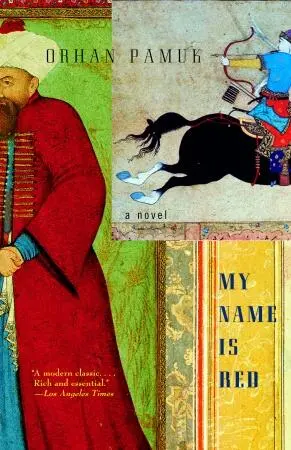
- Название:My Name is Red
- Автор:
- Жанр:
- Год:неизвестен
- ISBN:нет данных
- Рейтинг книги:5 / 5. Голосов: 1
-
Избранное:Добавить в избранное
- Отзывы:
-
Ваша оценка:
My Name is Red: краткое содержание, описание и аннотация
Предлагаем к чтению аннотацию, описание, краткое содержание или предисловие (зависит от того, что написал сам автор книги «My Name is Red»). Если вы не нашли необходимую информацию о книге — напишите в комментариях, мы постараемся отыскать её.
When the Sultan commissions a great book to celebrate his royal self and his extensive dominion, he directs Enishte Effendi to assemble a cadre of the most acclaimed artists in the land. Their task: to illuminate the work in the European style. But because figurative art can be deemed an affront to Islam, this commission is a dangerous proposition indeed, and no one in the elite circle can know the full scope or nature of the project.
Panic erupts when one of the chosen miniaturists disappears, and the Sultan demands answers within three days. The only clue to the mystery-or crime?-lies in the half-finished illuminations themselves. Has an avenging angel discovered the blasphemous work? Or is a jealous contender for the hand of Enishte’s ravishing daughter, the incomparable Shekure, somehow to blame?
Orhan Pamuk’s My Name Is Red is at once a fantasy and a philosophical puzzle, a kaleidoscopic journey to the intersection of art, religion, love, sex, and power.
"Pamuk is a novelist and a great one…My Name is Red is by far the grandest and most astonishing contest in his internal East-West war…It is chock-full of sublimity and sin…The story is told by each of a dozen characters, and now and then by a dog, a tree, a gold coin, several querulous corpses and the color crimson ('My Name is Red')…[Readers will] be lofted by the paradoxical lightness and gaiety of the writing, by the wonderfully winding talk perpetually about to turn a corner, and by the stubborn humanity in the characters' maneuvers to survive. It is a humanity whose lies and silences emerge as endearing and oddly bracing individual truths."- Richard Eder, New York Times Book Review
"A murder mystery set in sixteenth-century Istanbul [that] uses the art of miniature illumination, much as Mann's 'Doctor Faustus' did music, to explore a nation's soul… Erdag Goknar deserves praise for the cool, smooth English in which he has rendered Pamuk's finespun sentences, passionate art appreciations, sly pedantic debates, [and] eerie urban scenes."- John Updike, The New Yorker
"The interweaving of human and philosophical intrigue is very much as I remember it in The Name of the Rose, as is the slow, dense beginning and the relentless gathering of pace… But, in my view, his book is by far the better of the two. I would go so far as to say that Pamuk achieves the very thing his book implies is impossible… More than any other book I can think of, it captures not just Istanbul's past and present contradictions, but also its terrible, timeless beauty. It's almost perfect, in other words. All it needs is the Nobel Prize."-Maureen Freely, New Statesman (UK)
"A perfect example of Pamuk's method as a novelist, which is to combine literary trickery with page-turning readability… As a meditation on art, in particular, My Name is Red is exquisitely subtle, demanding and repaying the closest attention.. We in the West can only feel grateful that such a novelist as Pamuk exists, to act as a bridge between our culture and that of a heritage quite as rich as our own."-Tom Holland, Daily Telegraph (UK)
"Readers… will find themselves lured into a richly described and remarkable world… Reading the novel is like being in a magically exotic dream…Splendidly enjoyable and rewarding… A book in which you can thoroughly immerse yourself." -Allan Massie, The Scotsman (UK)
"A wonderful novel, dreamy, passionate and august, exotic in the most original and exciting way. Orhan Pamuk is indisputably a major novelist."-Philip Hensher, The Spectator (UK)
"[In this] magnificent new novel… Pamuk takes the reader into the strange and beautiful world of Islamic art,in which Western notions no longer make sense… In this world of forgeries, where some might be in danger of losing their faith in literature, Pamuk is the real thing, and this book might well be one of the few recent works of fiction that will be remembered at the end of this century."-Avkar Altinel, The Observer (UK)
My Name is Red — читать онлайн бесплатно полную книгу (весь текст) целиком
Ниже представлен текст книги, разбитый по страницам. Система сохранения места последней прочитанной страницы, позволяет с удобством читать онлайн бесплатно книгу «My Name is Red», без необходимости каждый раз заново искать на чём Вы остановились. Поставьте закладку, и сможете в любой момент перейти на страницу, на которой закончили чтение.
Интервал:
Закладка:
In Herat and Shiraz, when a master miniaturist nearing the end of his days went blind from a lifetime of excessive labor, it would not only be taken as a sign of that master’s determination, but would be commended as God’s acknowledgment of the great master’s work and talent. There was even a time in Herat when masters who hadn’t gone blind despite having grown old were regarded with suspicion, a situation that compelled quite a few of them to actually induce blindness in their old age. There was a long period during which men reverently recalled artists who blinded themselves, following in the path of those legendary masters who’d done so rather than work for another monarch or change their styles. And it was during this age that Abu Said, Tamerlane’s grandson from the Miran Shah line of descent, introduced a further twist in his workshop after he’d conquered Tashkent and Samarkand: The practice of paying greater homage to the imitation of blindness than to blindness itself. Black Veli, the old artisan who inspired Abu Said, had confirmed that a blind miniaturist could see the horses of God’s vision from within the darkness; however, true talent resided in a sighted miniaturist who could regard the world like a blind man. At the age of sixty-seven he proved his point by dashing off a horse that came to the tip of his brush without so much as a glance at the paper, even as his eyes remained all the while open and fixed on the page. At the end of this artistic ceremony for which Miran Shah had deaf musicians play lutes and mute storytellers recite stories to support the legendary master’s efforts, the splendid horse that Black Veli had drawn was compared at length with other horses he’d made: There was no difference whatsoever among them, much to Miran Shah’s irritation; thereafter, the legendary master declared that a miniaturist possessed of talent, regardless of whether his eyes are open or closed, will always and only see horses in one way, that is, the way that Allah perceives them. And among great master miniaturists, there is no difference between the blind and the sighted: The hand would always draw the same horse because there was as yet no such thing as the Frankish innovation called “style.” The horses made by the great master Black Veli have been imitated by all Muslim miniaturists for 110 years. As for Black Veli himself, after the defeat of Abu Said and the dispersal of his workshop, he moved from Samarkand to Kazvin, where two years later he was condemned for his spiteful attempts to refute the verse in the Glorious Koran that declares, “The blind and the seeing are not equal.” For this, he was first blinded, then killed by young Nizam Shah’s soldiers.
I was on the verge of telling a third story, describing to the pretty-eyed calligrapher’s apprentice how the great master Bihzad had blinded himself, how he never wanted to leave Herat, why he never painted again after being taken forcibly to Tabriz, how a miniaturist’s style was really the style of the workshop in which he worked and other tales I’d heard from Master Osman, but I became preoccupied with the storyteller. How had I known that he was going to tell Satan’s story tonight?
I had the urge to say, “It was Satan who first said ”I“! It was Satan who adopted a style. It was Satan who separated East from West.”
I closed my eyes and drew Satan on the storyteller’s rough sheet of paper as my heart desired. As I drew, the storyteller and his assistant, other artists and curious onlookers giggled and goaded me on.
Pray, do you think I have my own style, or do I owe it to the wine?
I, SATAN
I am fond of the smell of red peppers frying in olive oil, rain falling into a calm sea at dawn, the unexpected appearance of a woman at an open window, silences, thought and patience. I believe in myself, and, most of the time, pay no mind to what’s been said about me. Tonight, however, I’ve come to this coffeehouse to set my miniaturist and calligrapher brethren straight about certain gossip, lies and rumors.
Of course, because I’m the one speaking, you’re already prepared to believe the exact opposite of what I say. But you’re smart enough to sense that the opposite of what I say is not always true, and though you might doubt me, you’re astute enough to take an interest in my words: You’re well aware that my name, which appears in the Glorious Koran fifty-two times, is one of the most frequently cited.
All right then, let me begin with God’s book, the Glorious Koran. Everything about me in there is the truth. Let it be known that when I say this, I do so with the utmost humility. For there’s also the issue of style. It has always caused me great pain that I’m belittled in the Glorious Koran. But this pain is my way of life. This is simply the way it is.
It’s true, God created man before the eyes of us angels. Then He wanted us to prostrate ourselves before this creation. Yes, it happened the way it’s written in “The Heights” chapter: While all the other angels bowed before man, I refused. I reminded all that Adam was made from mud, whereas I was created from fire, a superior element as all of you are familiar. So I didn’t bow before man. And God found my behavior, well, “proud.”
“Lower yourself from these heavens,” He said. “It’s beyond the likes of you to scheme for greatness here.”
“Permit me to live until Judgment Day,” I said, “until the dead arise.”
He granted His permission. I promised that during this entire time I would tempt the descendents of Adam, who’d been the cause of my punishment, and He said He’d send to Hell those I’d successfully corrupted. I don’t have to tell you that we’ve each remained true to his word. I have nothing more to say about the matter.
As some will claim, at that time Almighty God and I made a pact. According to them, I was helping to test the Almighty’s subjects by attempting to destroy their faith: The good, possessed of sound judgment, would not be led astray, while the evil, giving into their carnal desires, would sin, to later fill the depths of Hell. Therefore, what I did was quite important: If all men went to Heaven, no one would ever be frightened, and the world and its governments could never function on virtue alone; for in our world evil is as necessary as virtue and sin as necessary as rectitude. Given that I am to thank for the genesis of Allah’s worldly order-with His permission no less (why else would He allow me to live until Judgment Day?)-to be branded “evil” and never be granted my due is my hidden troment. Men like the mystic Mansur, the wool carder, or the famous Imam Gazzali’s younger brother Ahmet Gazzali, have taken this line of reasoning so far as to conclude in their writings that if the sins I caused are actually committed through God’s permission and will, then they are what God desires; furthermore, they maintain that good and evil do not exist because everything emerges from God, and even I am a part of Him.
Some of these mindless men have quite appropriately been burned to death with their books. Of course, good and evil do exist, and the responsibility for drawing a line between the two falls to each of us. I am not Allah, God forbid, and I was not the one who planted such absurdities into the heads of these dimwits; they came up with it all by themselves.
This brings me to my second complaint: I am not the source of all the evil and sin in the world. Many people sin out of their own blind ambition, lust, lack of willpower, baseness, and most often, out of their own idiocy without any instigation, deception or temptation on my part. However absurd the efforts of certain learned mystics to absolve me of any evil might be, so too is the assumption that I am the source of all of it, which also contradicts the Glorious Koran. I’m not the one who tempts every fruit monger who craftily foists rotten apples upon his customers, every child who tells a lie, every fawning sycophant, every old man who has obscene daydreams or every boy who jacks off. Even the Almighty couldn’t find anything evil in passing wind or jacking off. Sure, I work very hard so you might commit grave sins. But some hojas claim that all of you who gape, sneeze or even fart are my dupes, which tells me they haven’t understood me in the least.
Читать дальшеИнтервал:
Закладка:
Похожие книги на «My Name is Red»
Представляем Вашему вниманию похожие книги на «My Name is Red» списком для выбора. Мы отобрали схожую по названию и смыслу литературу в надежде предоставить читателям больше вариантов отыскать новые, интересные, ещё непрочитанные произведения.







Обсуждение, отзывы о книге «My Name is Red» и просто собственные мнения читателей. Оставьте ваши комментарии, напишите, что Вы думаете о произведении, его смысле или главных героях. Укажите что конкретно понравилось, а что нет, и почему Вы так считаете.