Orhan Pamuk - My Name is Red
Здесь есть возможность читать онлайн «Orhan Pamuk - My Name is Red» весь текст электронной книги совершенно бесплатно (целиком полную версию без сокращений). В некоторых случаях можно слушать аудио, скачать через торрент в формате fb2 и присутствует краткое содержание. Жанр: Современная проза, на английском языке. Описание произведения, (предисловие) а так же отзывы посетителей доступны на портале библиотеки ЛибКат.
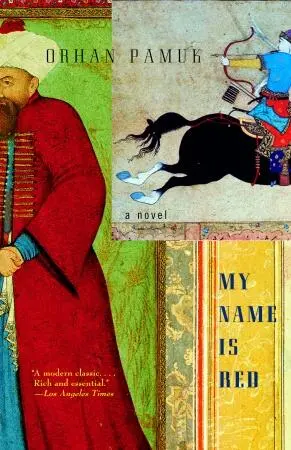
- Название:My Name is Red
- Автор:
- Жанр:
- Год:неизвестен
- ISBN:нет данных
- Рейтинг книги:5 / 5. Голосов: 1
-
Избранное:Добавить в избранное
- Отзывы:
-
Ваша оценка:
My Name is Red: краткое содержание, описание и аннотация
Предлагаем к чтению аннотацию, описание, краткое содержание или предисловие (зависит от того, что написал сам автор книги «My Name is Red»). Если вы не нашли необходимую информацию о книге — напишите в комментариях, мы постараемся отыскать её.
When the Sultan commissions a great book to celebrate his royal self and his extensive dominion, he directs Enishte Effendi to assemble a cadre of the most acclaimed artists in the land. Their task: to illuminate the work in the European style. But because figurative art can be deemed an affront to Islam, this commission is a dangerous proposition indeed, and no one in the elite circle can know the full scope or nature of the project.
Panic erupts when one of the chosen miniaturists disappears, and the Sultan demands answers within three days. The only clue to the mystery-or crime?-lies in the half-finished illuminations themselves. Has an avenging angel discovered the blasphemous work? Or is a jealous contender for the hand of Enishte’s ravishing daughter, the incomparable Shekure, somehow to blame?
Orhan Pamuk’s My Name Is Red is at once a fantasy and a philosophical puzzle, a kaleidoscopic journey to the intersection of art, religion, love, sex, and power.
"Pamuk is a novelist and a great one…My Name is Red is by far the grandest and most astonishing contest in his internal East-West war…It is chock-full of sublimity and sin…The story is told by each of a dozen characters, and now and then by a dog, a tree, a gold coin, several querulous corpses and the color crimson ('My Name is Red')…[Readers will] be lofted by the paradoxical lightness and gaiety of the writing, by the wonderfully winding talk perpetually about to turn a corner, and by the stubborn humanity in the characters' maneuvers to survive. It is a humanity whose lies and silences emerge as endearing and oddly bracing individual truths."- Richard Eder, New York Times Book Review
"A murder mystery set in sixteenth-century Istanbul [that] uses the art of miniature illumination, much as Mann's 'Doctor Faustus' did music, to explore a nation's soul… Erdag Goknar deserves praise for the cool, smooth English in which he has rendered Pamuk's finespun sentences, passionate art appreciations, sly pedantic debates, [and] eerie urban scenes."- John Updike, The New Yorker
"The interweaving of human and philosophical intrigue is very much as I remember it in The Name of the Rose, as is the slow, dense beginning and the relentless gathering of pace… But, in my view, his book is by far the better of the two. I would go so far as to say that Pamuk achieves the very thing his book implies is impossible… More than any other book I can think of, it captures not just Istanbul's past and present contradictions, but also its terrible, timeless beauty. It's almost perfect, in other words. All it needs is the Nobel Prize."-Maureen Freely, New Statesman (UK)
"A perfect example of Pamuk's method as a novelist, which is to combine literary trickery with page-turning readability… As a meditation on art, in particular, My Name is Red is exquisitely subtle, demanding and repaying the closest attention.. We in the West can only feel grateful that such a novelist as Pamuk exists, to act as a bridge between our culture and that of a heritage quite as rich as our own."-Tom Holland, Daily Telegraph (UK)
"Readers… will find themselves lured into a richly described and remarkable world… Reading the novel is like being in a magically exotic dream…Splendidly enjoyable and rewarding… A book in which you can thoroughly immerse yourself." -Allan Massie, The Scotsman (UK)
"A wonderful novel, dreamy, passionate and august, exotic in the most original and exciting way. Orhan Pamuk is indisputably a major novelist."-Philip Hensher, The Spectator (UK)
"[In this] magnificent new novel… Pamuk takes the reader into the strange and beautiful world of Islamic art,in which Western notions no longer make sense… In this world of forgeries, where some might be in danger of losing their faith in literature, Pamuk is the real thing, and this book might well be one of the few recent works of fiction that will be remembered at the end of this century."-Avkar Altinel, The Observer (UK)
My Name is Red — читать онлайн бесплатно полную книгу (весь текст) целиком
Ниже представлен текст книги, разбитый по страницам. Система сохранения места последней прочитанной страницы, позволяет с удобством читать онлайн бесплатно книгу «My Name is Red», без необходимости каждый раз заново искать на чём Вы остановились. Поставьте закладку, и сможете в любой момент перейти на страницу, на которой закончили чтение.
Интервал:
Закладка:
I grabbed my pen. With an inspiration that suddenly welled up within me, I elegantly connected the dots with quick and decisive strokes, such that as I was drawing the horse’s belly, graceful neck, nose and rump, I lovingly felt the horse within me. “There it is,” I said. “The world’s most beautiful horse. Not one of those fools could draw this.”
So the boy from the palace would believe this as well, and so he wouldn’t explain to Our Sultan how I’d been inspired to draw this picture, I gave him three more counterfeit coins. I implied that I would give him even more if I ended up winning the gold. Furthermore, he also imagined, I believe, that he might soon be able to catch sight of my wife once again, whom he’d leered at open-mouthed. There are many who believe you can tell a good miniaturist by the horse he draws; however, to be the best miniaturist, it’s not enough to make the best horse, you must also convince Our Sultan and His circle of sycophants that you are indeed the best miniaturist.
When I draw a magnificent horse, I am who I am, nothing more.
I WILL BE CALLED A MURDERER
Were you able to determine who I am from the way I sketched a horse?
As soon as I heard I was invited to make a horse, I knew this was no competition: They wanted to catch me through my illustration. I’m perfectly aware that the horse sketches I’d drawn on rough paper were found on poor Elegant Effendi’s body. But I have no fault or style by which they might discover me through the horses I’ve made. Though I was as certain of this as I could be, I was in a panic while rendering the horse. Had I done something incriminating when I made the horse for Enishte? I had to depict a new horse this time. I thought of completely different things. I “restrained” myself and became another.
But who am I? Am I an artist who would suppress the masterpieces I was capable of in order to fit the style of the workshop or an artist who would one day triumphantly depict the horse deep within himself?
Suddenly and with terror, I felt the existence of that triumphant miniaturist within me. It was as if I were being watched by another soul, and, in short, I was ashamed.
I quickly knew that I wouldn’t be able to remain at home, and bolting outside, I walked briskly down the darkened streets. As Sheikh Osman Baba wrote in his Lives of the Saints , in order for a genuine wandering dervish to escape the devil within, he must roam his entire life without remaining anywhere too long. After roaming from city to city for sixty-seven years, he tired of running and surrendered to the Devil. This is the age when master miniaturists attain blindness, or the darkness of Allah, the age when they involuntarily achieve a style, while freeing themselves of all intimations of style.
I wandered through the Chicken-Sellers Market in Bayazid, through the empty square of the slave market, amid the pleasant aromas of soup and pudding shops, as if searching. I passed the closed doors of barbershops, clothes pressers, an old bread baker who was counting his money and looking at me in surprise; I passed a grocer’s shop smelling of pickles and salted fish, and since my eyes were taken only by colors, I walked into a herbs and notions shop where something was being weighed, and in the light of a lamp, stared passionately, the way one looks at one’s beloved, at the sacks of coffee, ginger, saffron and cinnamon, the colorful cans of gum mastic, the aniseed whose scent wafted from the counter, and at mounds of brown and black cumin. Sometimes I want to put everything into my mouth; sometimes I want to fill a page with a picture of all creation.
I walked into the place where I’d filled my stomach twice before in the last week, which I’d personally named the “soup kitchen of the downtrodden”-actually, of the “miserable” would’ve been more appropriate. It was open until midnight to those who knew about it. Inside were a few unfortunates dressed like horse thieves or like men who’d escaped the gallows; a couple of pathetic characters whose sorrow and hopelessness caused their sights to slip from this world to distant paradises, as happens with opium addicts; two beggars who were at pains to follow even basic guild etiquette; and a young gentleman who’d seated himself in a corner at a distance from this crowd. I gave the Aleppan cook a graceful greeting. Heaping the meat-filled cabbage dolma into my bowl, I covered it with yogurt and topped it off with handfuls of hot red pepper flakes before taking a seat beside the young gentleman.
Every night a sorrow overwhelms me, a misery descends upon me. Oh, my brothers, my dear brothers, we’re being poisoned, we’re rotting, dying, we’re exhausting ourselves as we live, we’ve sunk up to our necks in misery…Some nights, I dream that he emerges from the well and comes after me, but I know we’ve buried him deeply beneath plenty of earth. He couldn’t possibly rise from the grave.
The gentleman, who I thought had buried his nose in his soup and forgotten the whole world, opened the door to a conversation. Was this a sign from Allah? “Yes,” I answered, “they’ve ground the meat to the right consistency, my stuffed cabbage is quite to my liking.” I asked about him: He’d recently graduated from a miserable twenty-coin college and been taken into Arifi Pasha’s patronage as a clerk. I didn’t ask him why, at this hour of the night, he wasn’t at the Pasha’s estate, at the mosque or at home in the arms of his beloved wife, but chose instead to be at this street kitchen teeming with unmarried thugs. He asked me where I’d come from and who I was. I thought for a moment.
“My name is Bihzad. I’ve come from Herat and Tabriz. I’ve painted the most magnificent pictures, the most incredible masterpieces. In Persia and Arabia, in every Muslim book arts workshop where illustrations are made, they’ve said this about me for hundreds of years: It looks real, just like the work of Bihzad.”
Of course, this isn’t the issue. My paintings reveal what the mind, not the eye, sees. But painting, as you know quite well, is a feast for the eyes. If you combine these two thoughts, my world will emerge. That is:
ALIF: Painting brings to life what the mind sees, as a feast for the eyes.
LAM: What the eye sees in the world enters the painting to the degree that it serves the mind.
MIM: Consequently, beauty is the eye discovering in our world what the mind already knows.
Did the graduate of the miserable college understand this logic, which I’d extracted with lightning inspiration from the depths of my soul? Not at all. Why? Because, though you’ve spent three years seated at the foot of a hoja who gives lessons in an out-of-the-way neighborhood religious school for twenty silver coins a day-today you can buy twenty loaves of bread with that amount-you still wouldn’t know who the hell Bihzad was. It was obvious that the twenty-coin Hoja Effendi didn’t know who Bihzad was either. All right then, let me explain. I said:
“I’ve painted everything, absolutely everything: Our Prophet at the mosque before the green prayer niche seated together with his four caliphs; in another book, the Apostle and Prophet of God ascending the seven heavens on the night of the Ascension; Alexander on his way to China banging on the drum of a seaside temple to scare off a monster stirring up the ocean with storms; a masturbating sultan spying on the beauties of his harem swimming naked in his pool while listening to a lute; a young wrestler sure of victory after learning all his mentor’s moves, only to be defeated in the presence of the Sultan at the hands of his mentor who had yet one last trick up his sleeve; Leyla and Mejnun as children kneeling in a schoolroom with exquisitely decorated walls, falling in love while reciting the Glorious Koran; the inability of lovers, from the most embarrassed to the most crass, to look at each other; the stone by stone construction of palaces; the punishment by torture of the guilty; the flight of eagles; playful rabbits; treacherous tigers; cypress and plane trees that held magpies; Death; competing poets; feasts to commemorate victory; and men like you who see nothing but the soup before them.”
Читать дальшеИнтервал:
Закладка:
Похожие книги на «My Name is Red»
Представляем Вашему вниманию похожие книги на «My Name is Red» списком для выбора. Мы отобрали схожую по названию и смыслу литературу в надежде предоставить читателям больше вариантов отыскать новые, интересные, ещё непрочитанные произведения.






Обсуждение, отзывы о книге «My Name is Red» и просто собственные мнения читателей. Оставьте ваши комментарии, напишите, что Вы думаете о произведении, его смысле или главных героях. Укажите что конкретно понравилось, а что нет, и почему Вы так считаете.