Orhan Pamuk - My Name is Red
Здесь есть возможность читать онлайн «Orhan Pamuk - My Name is Red» весь текст электронной книги совершенно бесплатно (целиком полную версию без сокращений). В некоторых случаях можно слушать аудио, скачать через торрент в формате fb2 и присутствует краткое содержание. Жанр: Современная проза, на английском языке. Описание произведения, (предисловие) а так же отзывы посетителей доступны на портале библиотеки ЛибКат.
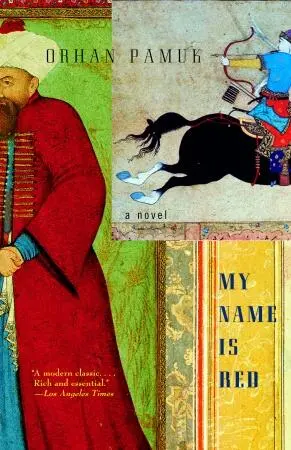
- Название:My Name is Red
- Автор:
- Жанр:
- Год:неизвестен
- ISBN:нет данных
- Рейтинг книги:5 / 5. Голосов: 1
-
Избранное:Добавить в избранное
- Отзывы:
-
Ваша оценка:
My Name is Red: краткое содержание, описание и аннотация
Предлагаем к чтению аннотацию, описание, краткое содержание или предисловие (зависит от того, что написал сам автор книги «My Name is Red»). Если вы не нашли необходимую информацию о книге — напишите в комментариях, мы постараемся отыскать её.
When the Sultan commissions a great book to celebrate his royal self and his extensive dominion, he directs Enishte Effendi to assemble a cadre of the most acclaimed artists in the land. Their task: to illuminate the work in the European style. But because figurative art can be deemed an affront to Islam, this commission is a dangerous proposition indeed, and no one in the elite circle can know the full scope or nature of the project.
Panic erupts when one of the chosen miniaturists disappears, and the Sultan demands answers within three days. The only clue to the mystery-or crime?-lies in the half-finished illuminations themselves. Has an avenging angel discovered the blasphemous work? Or is a jealous contender for the hand of Enishte’s ravishing daughter, the incomparable Shekure, somehow to blame?
Orhan Pamuk’s My Name Is Red is at once a fantasy and a philosophical puzzle, a kaleidoscopic journey to the intersection of art, religion, love, sex, and power.
"Pamuk is a novelist and a great one…My Name is Red is by far the grandest and most astonishing contest in his internal East-West war…It is chock-full of sublimity and sin…The story is told by each of a dozen characters, and now and then by a dog, a tree, a gold coin, several querulous corpses and the color crimson ('My Name is Red')…[Readers will] be lofted by the paradoxical lightness and gaiety of the writing, by the wonderfully winding talk perpetually about to turn a corner, and by the stubborn humanity in the characters' maneuvers to survive. It is a humanity whose lies and silences emerge as endearing and oddly bracing individual truths."- Richard Eder, New York Times Book Review
"A murder mystery set in sixteenth-century Istanbul [that] uses the art of miniature illumination, much as Mann's 'Doctor Faustus' did music, to explore a nation's soul… Erdag Goknar deserves praise for the cool, smooth English in which he has rendered Pamuk's finespun sentences, passionate art appreciations, sly pedantic debates, [and] eerie urban scenes."- John Updike, The New Yorker
"The interweaving of human and philosophical intrigue is very much as I remember it in The Name of the Rose, as is the slow, dense beginning and the relentless gathering of pace… But, in my view, his book is by far the better of the two. I would go so far as to say that Pamuk achieves the very thing his book implies is impossible… More than any other book I can think of, it captures not just Istanbul's past and present contradictions, but also its terrible, timeless beauty. It's almost perfect, in other words. All it needs is the Nobel Prize."-Maureen Freely, New Statesman (UK)
"A perfect example of Pamuk's method as a novelist, which is to combine literary trickery with page-turning readability… As a meditation on art, in particular, My Name is Red is exquisitely subtle, demanding and repaying the closest attention.. We in the West can only feel grateful that such a novelist as Pamuk exists, to act as a bridge between our culture and that of a heritage quite as rich as our own."-Tom Holland, Daily Telegraph (UK)
"Readers… will find themselves lured into a richly described and remarkable world… Reading the novel is like being in a magically exotic dream…Splendidly enjoyable and rewarding… A book in which you can thoroughly immerse yourself." -Allan Massie, The Scotsman (UK)
"A wonderful novel, dreamy, passionate and august, exotic in the most original and exciting way. Orhan Pamuk is indisputably a major novelist."-Philip Hensher, The Spectator (UK)
"[In this] magnificent new novel… Pamuk takes the reader into the strange and beautiful world of Islamic art,in which Western notions no longer make sense… In this world of forgeries, where some might be in danger of losing their faith in literature, Pamuk is the real thing, and this book might well be one of the few recent works of fiction that will be remembered at the end of this century."-Avkar Altinel, The Observer (UK)
My Name is Red — читать онлайн бесплатно полную книгу (весь текст) целиком
Ниже представлен текст книги, разбитый по страницам. Система сохранения места последней прочитанной страницы, позволяет с удобством читать онлайн бесплатно книгу «My Name is Red», без необходимости каждый раз заново искать на чём Вы остановились. Поставьте закладку, и сможете в любой момент перейти на страницу, на которой закончили чтение.
Интервал:
Закладка:
The reserved clerk was no longer afraid, he even found me entertaining and was smiling.
“Your Hoja Effendi must’ve had you read this, you’ll know it,” I continued. “There’s a story I love from Sadi’s Garden . You know the one, King Darius becomes separated from the crowd during a hunt and goes off to roam the hills. Unexpectedly, a dangerous-looking stranger with a goatee appears before him. The king falls into a panic and reaches for the bow on his horse, whereupon the man begs, ”My king, hold off from shooting your arrow. How is it that you haven’t recognized me? Am I not the loyal groom to whom you’ve entrusted a hundred horses and foals? How many times have we seen each other? I know each of your hundred horses by temperament and disposition, nay, by color even. So then, how is it you pay no attention to us, the servants under your command, even those like myself whom you encounter with such frequency?“”
When I depict this scene, I render the black, chestnut and white horses-so tenderly cared for by the groom in a heavenly green pasture covered with flowers of every imaginable color-with such happiness and calm that even the dullest of readers would understand the moral of Sadi’s story: The beauty and mystery of this world only emerges through affection, attention, interest and compassion; if you want to live in that paradise where happy mares and stallions live, open your eyes wide and actually see this world by attending to its colors, details and irony.
This progeny of the twenty-coin hoja was at once entertained and frightened by me. He wanted to drop his spoon and flee, but I didn’t give him the chance.
“This is how the master of masters Bihzad depicted the king, his groom and the horses in that picture,” I said. “For a hundred years miniaturists haven’t stopped imitating those horses. Each horse rendered out of Bihzad’s imagination and heart has become a model of form. Hundreds of miniaturists, including myself, can draw those horses from memory. Have you ever seen a picture of a horse?”
“I once saw a winged horse in an enchanting book that a great teacher, a scholar of scholars, had presented to my late hoja.”
I didn’t know whether I should push the head of this clown into his soup, who, along with his teacher, had taken Strange Creatures seriously, and drown him or leave him to describe in glowing terms the only horse picture he’d ever seen in his life-in who knows how poor a manuscript copy. I came up with a third alternative, and that was to drop my spoon and quit the shop. After walking for a long while I entered the abandoned dervish lodge, where I was overcome with a sense of peace. I tidied up and without doing anything else, I listened to the silence.
Later, I removed the mirror from where I kept it hidden and set it upon the low worktable. Next, I placed the two-page illustration and the drawing board on my lap. When I could see my face in the mirror from where I sat, I attempted to draw my portrait in charcoal. I drew for a long time, patiently. Much later, when I saw that once again the face on the page didn’t resemble my face in the mirror, I was filled with such misery that tears welled in my eyes. How did the Venetian painters that Enishte described with such flourish do it? I then imagined myself to be one of them, thinking that if I illustrated in that state of mind, I could perhaps make a convincing self-portrait.
Later still, I cursed the European painters and Enishte both, erased what I’d done and began looking into the mirror anew to begin another drawing.
Ultimately, I found myself wandering the streets again, and then, here, at this despicable coffeehouse. I wasn’t even sure how I happened to come here. As I entered, I felt such embarrassment about mingling with these miserable miniaturists and calligraphers that sweat accumulated on my forehead.
I sensed that they were watching me, alerting each other of my presence with their elbows, and laughing-all right, I could plainly see them doing it. I seated myself in the corner, trying to behave naturally. At the same time my eyes sought the other masters, my dear brethren with whom, at one time, I’d served as Master Osman’s apprentice. I was certain each of them was also asked to draw a horse this evening and that they’d each expended great desperate efforts, taking the contest arranged by these idiots quite seriously.
The storyteller effendi hadn’t yet begun his performance. The picture hadn’t even been hung up yet. I was forced to socialize with the coffeehouse crowd.
So be it then, let me be frank with you: Like everyone else I, too, made jokes, told indecent stories, kissed my companions on the cheeks with exaggerated gestures, spoke in double entendres, innuendos and puns, asked how the young assistant masters were doing, and like everybody else, mercilessly needled our common enemies; and after I really warmed up, I went so far as to roughhouse and kiss men on the neck. Yet, knowing that a part of my soul remained mercilessly silent when I involved myself in such behavior caused me unbearable torment.
Nonetheless, before long, I not only succeeded in using figurative language to compare my own cock, and those of others that were much-talked about, to brushes, reeds, coffeehouse pillars, flutes, newel posts, door knockers, leeks, minarets, lady fingers in heavy syrup, pine trees, and twice, to the world itself, I was equally successful in comparing the asses of much-discussed pretty boys to oranges, figs, small haycocklike pastries, pillows and also to tiny anthills. Meanwhile, the most conceited of the calligraphers my age was only able to compare his own tool-quite amateurishly and without any self-confidence I might add-to a ship’s mast and a porter’s pole. Furthermore, I made allusions to old miniaturists’ dicks that would no longer rise; the cherry-colored lips of new apprentices; master calligraphers who hoarded their money (as did I) in a certain place (“the most disgusting nook”); how perhaps opium had been put into the wine I was drinking instead of rose petals; the last great masters of Tabriz and Shiraz; the mixing of coffee and wine in Aleppo; and the calligraphers and beautiful boys to be found there.
At times it seemed that one of the two spirits within me had, in the end, emerged victorious, leaving the other behind, and that I’d finally forgotten that silent and loveless aspect of myself. At these times I remembered the holiday celebrations of my childhood during which I was able to be myself along with my kith and kin. Despite all these jokes, kisses and embraces, there was still a silence within me that left me suffering and isolated in the heart of the crowd.
Who had endowed me with this silent and merciless spirit-it was not a spirit but a jinn-which always chided me and cut me off from others? Satan? But the silence within me was eased, not by the crass mischief instigated by Satan, on the contrary, by the most pure and simple stories that drove into one’s soul. Under the influence of wine, I told two stories, hoping that this would grant me peace. A tall, pale, yet pinkish-complected calligrapher’s apprentice focused his green eyes onto mine and was listening to me with rapt attention.
Contrary to what is assumed, making drawings of horses by looking at actual horses wasn’t a discovery of European masters. The original idea belonged to the great master Jemalettin of Kazvin. After Tall Hasan, the Khan of the Whitesheep, conquered Kazvin, the old master Jemalettin was not content to simply join the book-arts workshop of the victorious khan; instead he headed out on campaign with him, claiming that he wanted to embellish the khan’s History with scenes of war he’d witnessed himself. So this great master, who for sixty-two years had made pictures of horses, cavalry charges and battles without ever having seen a battle, went to war for the first time. But before he could even see the thunderous and violent clash of sweating horses, he lost his hands and his eyesight to enemy cannon-fire. The old master, like all genuine virtuosos, had in any case been awaiting blindness as though it were Allah’s blessing, and neither did he treat the loss of his hands as a great deficiency. He maintained that the memory of a miniaturist was located not in the hand, as some insisted, but in the intellect and the heart, and furthermore, now that he was blind, he declared that he could see the true pictures, scenery and essential and flawless horses that Allah commanded be seen. To share these wonders with lovers of art, he hired a tall, pale-skinned, pink-complected, green-eyed calligrapher’s apprentice to whom he dictated exactly how to draw the marvelous horses that appeared to him in God’s divine darkness-as he would’ve drawn them had he been able to hold a brush in his hands. After the master’s death, his account of how to draw 303 horses beginning from the left foreleg was collected by the handsome calligrapher’s apprentice into three volumes respectively entitled The Depiction of Horses, The Flow of Horses and The Love of Horses , which were quite widely liked and sought after for a time in the regions where the Whitesheep ruled. Though they appeared in a variety of new editions and copies, were memorized by illustrators, apprentices and their students and were used as practice books, after Tall Hasan’s Whitesheep nation was obliterated and the Herat style of illustration overtook all of Persia, Jemalettin and his manuscripts were forgotten. Doubtless, the logic behind Kemalettin Rıza of Herat ’s violent criticism of these three volumes in his book The Blindman’s Horses , and his conclusion that they ought to be burned, had figured in this turn of events. Kemalettin Rıza claimed that none of the horses described by Jemalettin of Kazvin in his three volumes could be a horse of God’s vision-because none of them were “immaculate,” since the old master had described them after he’d witnessed an actual battle scene, no matter how briefly. Since the treasures of Tall Hasan of the Whitesheep had been plundered by Sultan Mehmet the Conqueror and brought to Istanbul, it should come as no surprise that occasionally certain of these 303 stories appear in other manuscripts in Istanbul and even that some horses are drawn as instructed therein.
Читать дальшеИнтервал:
Закладка:
Похожие книги на «My Name is Red»
Представляем Вашему вниманию похожие книги на «My Name is Red» списком для выбора. Мы отобрали схожую по названию и смыслу литературу в надежде предоставить читателям больше вариантов отыскать новые, интересные, ещё непрочитанные произведения.








Обсуждение, отзывы о книге «My Name is Red» и просто собственные мнения читателей. Оставьте ваши комментарии, напишите, что Вы думаете о произведении, его смысле или главных героях. Укажите что конкретно понравилось, а что нет, и почему Вы так считаете.