Orhan Pamuk - My Name is Red
Здесь есть возможность читать онлайн «Orhan Pamuk - My Name is Red» весь текст электронной книги совершенно бесплатно (целиком полную версию без сокращений). В некоторых случаях можно слушать аудио, скачать через торрент в формате fb2 и присутствует краткое содержание. Жанр: Современная проза, на английском языке. Описание произведения, (предисловие) а так же отзывы посетителей доступны на портале библиотеки ЛибКат.
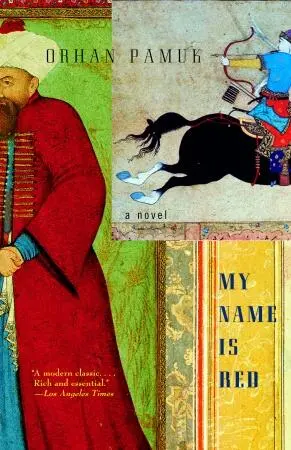
- Название:My Name is Red
- Автор:
- Жанр:
- Год:неизвестен
- ISBN:нет данных
- Рейтинг книги:5 / 5. Голосов: 1
-
Избранное:Добавить в избранное
- Отзывы:
-
Ваша оценка:
My Name is Red: краткое содержание, описание и аннотация
Предлагаем к чтению аннотацию, описание, краткое содержание или предисловие (зависит от того, что написал сам автор книги «My Name is Red»). Если вы не нашли необходимую информацию о книге — напишите в комментариях, мы постараемся отыскать её.
When the Sultan commissions a great book to celebrate his royal self and his extensive dominion, he directs Enishte Effendi to assemble a cadre of the most acclaimed artists in the land. Their task: to illuminate the work in the European style. But because figurative art can be deemed an affront to Islam, this commission is a dangerous proposition indeed, and no one in the elite circle can know the full scope or nature of the project.
Panic erupts when one of the chosen miniaturists disappears, and the Sultan demands answers within three days. The only clue to the mystery-or crime?-lies in the half-finished illuminations themselves. Has an avenging angel discovered the blasphemous work? Or is a jealous contender for the hand of Enishte’s ravishing daughter, the incomparable Shekure, somehow to blame?
Orhan Pamuk’s My Name Is Red is at once a fantasy and a philosophical puzzle, a kaleidoscopic journey to the intersection of art, religion, love, sex, and power.
"Pamuk is a novelist and a great one…My Name is Red is by far the grandest and most astonishing contest in his internal East-West war…It is chock-full of sublimity and sin…The story is told by each of a dozen characters, and now and then by a dog, a tree, a gold coin, several querulous corpses and the color crimson ('My Name is Red')…[Readers will] be lofted by the paradoxical lightness and gaiety of the writing, by the wonderfully winding talk perpetually about to turn a corner, and by the stubborn humanity in the characters' maneuvers to survive. It is a humanity whose lies and silences emerge as endearing and oddly bracing individual truths."- Richard Eder, New York Times Book Review
"A murder mystery set in sixteenth-century Istanbul [that] uses the art of miniature illumination, much as Mann's 'Doctor Faustus' did music, to explore a nation's soul… Erdag Goknar deserves praise for the cool, smooth English in which he has rendered Pamuk's finespun sentences, passionate art appreciations, sly pedantic debates, [and] eerie urban scenes."- John Updike, The New Yorker
"The interweaving of human and philosophical intrigue is very much as I remember it in The Name of the Rose, as is the slow, dense beginning and the relentless gathering of pace… But, in my view, his book is by far the better of the two. I would go so far as to say that Pamuk achieves the very thing his book implies is impossible… More than any other book I can think of, it captures not just Istanbul's past and present contradictions, but also its terrible, timeless beauty. It's almost perfect, in other words. All it needs is the Nobel Prize."-Maureen Freely, New Statesman (UK)
"A perfect example of Pamuk's method as a novelist, which is to combine literary trickery with page-turning readability… As a meditation on art, in particular, My Name is Red is exquisitely subtle, demanding and repaying the closest attention.. We in the West can only feel grateful that such a novelist as Pamuk exists, to act as a bridge between our culture and that of a heritage quite as rich as our own."-Tom Holland, Daily Telegraph (UK)
"Readers… will find themselves lured into a richly described and remarkable world… Reading the novel is like being in a magically exotic dream…Splendidly enjoyable and rewarding… A book in which you can thoroughly immerse yourself." -Allan Massie, The Scotsman (UK)
"A wonderful novel, dreamy, passionate and august, exotic in the most original and exciting way. Orhan Pamuk is indisputably a major novelist."-Philip Hensher, The Spectator (UK)
"[In this] magnificent new novel… Pamuk takes the reader into the strange and beautiful world of Islamic art,in which Western notions no longer make sense… In this world of forgeries, where some might be in danger of losing their faith in literature, Pamuk is the real thing, and this book might well be one of the few recent works of fiction that will be remembered at the end of this century."-Avkar Altinel, The Observer (UK)
My Name is Red — читать онлайн бесплатно полную книгу (весь текст) целиком
Ниже представлен текст книги, разбитый по страницам. Система сохранения места последней прочитанной страницы, позволяет с удобством читать онлайн бесплатно книгу «My Name is Red», без необходимости каждый раз заново искать на чём Вы остановились. Поставьте закладку, и сможете в любой момент перейти на страницу, на которой закончили чтение.
Интервал:
Закладка:
“How much I loved your Enishte, may he rest in peace,” He said. Yes, He was speaking to me. In my excitement, I missed some of what He was saying.
“…I was quite aggrieved. However, it’s quite a comfort to see that each of these pictures he made is a masterpiece. When the Venetian giaour sees these, he will be stunned and fear my wisdom. You shall determine who the accursed miniaturist is by this horse’s nose. Otherwise, however merciless, it’ll be necessary to torture all the master miniaturists.”
“Sovereign Refuge of the World Your Excellency My Sultan,” said Master Osman. “Perhaps we can better catch the man responsible for this slip of the brush, if my master miniaturists are forced to draw a horse on a blank sheet of paper, quickly, without any story in mind.”
“Only, of course, if this is really a slip of the brush and not an actual nose,” said Our Sultan shrewdly.
“My Sultan,” said Master Osman, “to this end, if a competition by express command of Your Highness were announced tonight; if a guard were to visit Your miniaturists, requesting them to draw a horse quickly on a blank sheet for this contest…”
Our Sultan looked at the Commander of the Imperial Guard with an expression that said, “Did you hear that?” Then he said, “Do you know which of the Poet Nizami’s stories of rivalry I like best of all?”
Some of us said, “We know.” Some said, “Which one?” Some, including myself, fell silent.
“I’m not fond of the contest of poets or the story about the contest between Chinese and Western painters and the mirror,” said the handsome Sultan. “I like best the contest of doctors who compete to the death.”
After He’d said this, He abruptly took leave of us for His evening prayers.
Later, as the evening azan was being called, in the half dark, after exiting the gates of the palace, I hurried toward my neighborhood happily imagining Shekure, the boys and our house, when I recalled with horror the story of the contest of doctors:
One of the two doctors competing in the presence of their sultan-the one often depicted in pink-made a poison green pill strong enough to fell an elephant, which he gave to the other doctor, the one in the navy-blue caftan. That doctor first swallowed the poisonous pill, and afterward, swallowed a navy-blue antidote that he’d just made. As could be understood from his gentle laughter, nothing at all happened to him. Furthermore, it was now his turn to give his rival a whiff of death. Moving ever so deliberately, savoring the pleasure of taking his turn, he plucked a pink rose from the garden, and bringing it to his lips, inaudibly whispered a mysterious poem into its petals. Next, with gestures that bespoke extreme confidence, he extended the rose to his rival so he might take in its bouquet. The force of the whispered poem so agitated the doctor in pink that upon bringing the flower to his nose, which bore nothing but its regular scent, he collapsed out of fear and died.
I AM CALLED “OLIVE”
Prior to the evening prayers, there came a knock at the door and I opened it without ceremony: It was one of the Commander’s men from the palace, a clean, handsome, cheerful and becoming youth. In addition to paper and a writing board, he carried an oil lamp in his hand, which cast shadows over his face rather than illuminating it. He quickly apprised me of the situation: Our Sultan had declared a contest among the master miniaturists to see who could draw the best horse in the shortest time. I was asked to sit on the floor, arrange paper on the board and the board on my knees and quickly depict the world’s most beautiful horse in the space indicated within the borders of the page.
I invited my guest inside. I ran and fetched my ink and the finest of my brushes made from hair clipped from a cat’s ear. I sat down on the floor and froze! Might this contest be a ruse or ploy that I’d end up paying for with my blood or my head? Perhaps! But hadn’t all the legendary illustrations by the old masters of Herat been drawn with fine lines that ran between death and beauty?
I was filled with the desire to illustrate, yet I was seemingly afraid to draw exactly like the old masters, and I restrained myself.
Looking at the blank sheet of paper, I paused so that my soul might rid itself of apprehension. I ought to have focused solely on the beautiful horse I was about to render; I ought to have mustered my strength and concentration.
All the horses I’d ever drawn and seen began to gallop before my eyes. Yet one was the most flawless of all. I was presently going to render this horse which nobody had been able to draw before. Decisively, I pictured it in my mind’s eye. The world faded away, as if I’d suddenly forgotten myself, forgotten that I was sitting here, and even that I was about to draw. My hand dipped the brush into the inkwell of its own accord, taking up just the right amount. Come now, my good hand, bring the wonderful horse of my imagination into this world! The horse and I had seemingly become one and we were about to appear.
Following my intuition, I searched for the appropriate place within the bordered blank page. I imagined the horse standing there, and suddenly:
Even before I was able to think, my hand set forth decisively of its own volition-see how gracefully-curling quickly from the hoof, it rendered that beautiful thin lower leg, and moved upward. As it curved with the same decisiveness past the knee and rose quickly to the base of the chest, I grew elated! Arching from here, it moved victoriously higher: How beautiful the animal’s chest was! The chest tapered to form the neck, exactly like that of the horse in my mind’s eye. Without lifting my brush, I came down from the cheek, reaching the powerful mouth, which I’d left open after a moment’s thought; I entered the mouth-this is how it’s going to be then, open your mouth wider now, horsey-and I brought out its tongue. I slowly turned out the nose-no room for indecision! Angling up steadily, I looked momentarily at the whole image, and when I saw that I’d made my line exactly as I’d imagined it, I forgot entirely what I was drawing, and the ears and the magnificent curve of the spectacular neck were rendered by my hand alone. As I drew the backside from memory, my hand stopped on its own to let the bristles of the brush sip from the inkwell. I was quite content while rendering the rump, and the forceful and protruding hindquarters; I was completely engrossed in the picture. I seemed to be standing beside the horse I was drawing as I joyously began the tail. This was a war steed, a racehorse; making a knot of its tail and winding it around, I exuberantly moved upward; as I was drawing the dock and buttocks I felt a pleasant coolness on my own ass and anus. Pleased by that feeling, I gleefully completed the splendid softness of the rump, the left hind leg that was slightly behind the right, and then the hooves. I was astonished by the horse I’d drawn and by my hand, which had rendered the elegant positioning of the left foreleg exactly as I had conceived it.
I lifted my hand from the page and quickly drew the fiery, sorrowful eyes; with but a moment’s hesitation, I made the nostrils and the saddle blanket. I hatched in the mane strand by strand, as if tenderly combing it with my fingers. I fitted the beast with stirrups, added a white blaze to his forehead and finished him off properly by eagerly, measuredly, yet in full proportion drawing his balls and cock.
When I draw a magnificent horse, I become that magnificent horse.
I AM CALLED “BUTTERFLY”
I believe it was about the time of the evening prayer. Someone was at the door. He explained that the Sultan had announced a competition. As you command, my dear Sultan; indeed, who could draw a more beautiful horse than I?
Читать дальшеИнтервал:
Закладка:
Похожие книги на «My Name is Red»
Представляем Вашему вниманию похожие книги на «My Name is Red» списком для выбора. Мы отобрали схожую по названию и смыслу литературу в надежде предоставить читателям больше вариантов отыскать новые, интересные, ещё непрочитанные произведения.




Обсуждение, отзывы о книге «My Name is Red» и просто собственные мнения читателей. Оставьте ваши комментарии, напишите, что Вы думаете о произведении, его смысле или главных героях. Укажите что конкретно понравилось, а что нет, и почему Вы так считаете.