Orhan Pamuk - My Name is Red
Здесь есть возможность читать онлайн «Orhan Pamuk - My Name is Red» весь текст электронной книги совершенно бесплатно (целиком полную версию без сокращений). В некоторых случаях можно слушать аудио, скачать через торрент в формате fb2 и присутствует краткое содержание. Жанр: Современная проза, на английском языке. Описание произведения, (предисловие) а так же отзывы посетителей доступны на портале библиотеки ЛибКат.
- Название:My Name is Red
- Автор:
- Жанр:
- Год:неизвестен
- ISBN:нет данных
- Рейтинг книги:5 / 5. Голосов: 1
-
Избранное:Добавить в избранное
- Отзывы:
-
Ваша оценка:
My Name is Red: краткое содержание, описание и аннотация
Предлагаем к чтению аннотацию, описание, краткое содержание или предисловие (зависит от того, что написал сам автор книги «My Name is Red»). Если вы не нашли необходимую информацию о книге — напишите в комментариях, мы постараемся отыскать её.
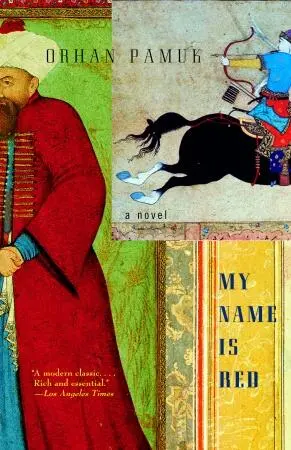
When the Sultan commissions a great book to celebrate his royal self and his extensive dominion, he directs Enishte Effendi to assemble a cadre of the most acclaimed artists in the land. Their task: to illuminate the work in the European style. But because figurative art can be deemed an affront to Islam, this commission is a dangerous proposition indeed, and no one in the elite circle can know the full scope or nature of the project.
Panic erupts when one of the chosen miniaturists disappears, and the Sultan demands answers within three days. The only clue to the mystery-or crime?-lies in the half-finished illuminations themselves. Has an avenging angel discovered the blasphemous work? Or is a jealous contender for the hand of Enishte’s ravishing daughter, the incomparable Shekure, somehow to blame?
Orhan Pamuk’s My Name Is Red is at once a fantasy and a philosophical puzzle, a kaleidoscopic journey to the intersection of art, religion, love, sex, and power.
"Pamuk is a novelist and a great one…My Name is Red is by far the grandest and most astonishing contest in his internal East-West war…It is chock-full of sublimity and sin…The story is told by each of a dozen characters, and now and then by a dog, a tree, a gold coin, several querulous corpses and the color crimson ('My Name is Red')…[Readers will] be lofted by the paradoxical lightness and gaiety of the writing, by the wonderfully winding talk perpetually about to turn a corner, and by the stubborn humanity in the characters' maneuvers to survive. It is a humanity whose lies and silences emerge as endearing and oddly bracing individual truths."- Richard Eder, New York Times Book Review
"A murder mystery set in sixteenth-century Istanbul [that] uses the art of miniature illumination, much as Mann's 'Doctor Faustus' did music, to explore a nation's soul… Erdag Goknar deserves praise for the cool, smooth English in which he has rendered Pamuk's finespun sentences, passionate art appreciations, sly pedantic debates, [and] eerie urban scenes."- John Updike, The New Yorker
"The interweaving of human and philosophical intrigue is very much as I remember it in The Name of the Rose, as is the slow, dense beginning and the relentless gathering of pace… But, in my view, his book is by far the better of the two. I would go so far as to say that Pamuk achieves the very thing his book implies is impossible… More than any other book I can think of, it captures not just Istanbul's past and present contradictions, but also its terrible, timeless beauty. It's almost perfect, in other words. All it needs is the Nobel Prize."-Maureen Freely, New Statesman (UK)
"A perfect example of Pamuk's method as a novelist, which is to combine literary trickery with page-turning readability… As a meditation on art, in particular, My Name is Red is exquisitely subtle, demanding and repaying the closest attention.. We in the West can only feel grateful that such a novelist as Pamuk exists, to act as a bridge between our culture and that of a heritage quite as rich as our own."-Tom Holland, Daily Telegraph (UK)
"Readers… will find themselves lured into a richly described and remarkable world… Reading the novel is like being in a magically exotic dream…Splendidly enjoyable and rewarding… A book in which you can thoroughly immerse yourself." -Allan Massie, The Scotsman (UK)
"A wonderful novel, dreamy, passionate and august, exotic in the most original and exciting way. Orhan Pamuk is indisputably a major novelist."-Philip Hensher, The Spectator (UK)
"[In this] magnificent new novel… Pamuk takes the reader into the strange and beautiful world of Islamic art,in which Western notions no longer make sense… In this world of forgeries, where some might be in danger of losing their faith in literature, Pamuk is the real thing, and this book might well be one of the few recent works of fiction that will be remembered at the end of this century."-Avkar Altinel, The Observer (UK)
My Name is Red — читать онлайн бесплатно полную книгу (весь текст) целиком
Ниже представлен текст книги, разбитый по страницам. Система сохранения места последней прочитанной страницы, позволяет с удобством читать онлайн бесплатно книгу «My Name is Red», без необходимости каждый раз заново искать на чём Вы остановились. Поставьте закладку, и сможете в любой момент перейти на страницу, на которой закончили чтение.
Интервал:
Закладка:
The more we deliberated over the horse, the more beautiful and precious it became in my eyes. His mouth was slightly open, his tongue visible from between his teeth. His eyes shone bright. His legs were strong and elegant. Did a painting become legendary for what it was or for what was said about it? Master Osman was ever so slowly moving the magnifying lens over the animal.
“What is it that this horse is trying to convey?” I said with naive enthusiasm. “Why does this horse exist? Why this horse! What about this horse? Why does this horse excite me?”
“The pictures as well as the books commissioned by sultans, shahs and pashas proclaim their power,” said Master Osman. “The patrons find these works beautiful, with their extensive gold leaf and lavish expenditures of labor and eyesight because they are proof of the ruler’s wealth. An illustration’s beauty is significant because it is proof that a miniaturist’s talent is rare and expensive just like the gold used in the picture’s creation. Others find the picture of a horse beautiful because it resembles a horse, is a horse of God’s vision or is a purely imaginary horse; the effect of verisimilitude is attributed to talent. As for us, beauty in illustration begins with subtlety and profusion of meaning. Of course, to discover that this horse reveals not merely itself, but the hand of the murderer, the mark of that devil, this would augment the meaning of the picture. Then there’s finding out that it’s not the image of the horse, but the horse itself that’s beautiful; that is, seeing the illustration of the horse not as an illustration, but as a true horse.”
“If you looked at this illustration as if you were looking at a horse, what would you see there?”
“Looking at the size of this horse, I could say that this wasn’t a pony but, judging from the length and curve of its neck, a good racehorse and that the flatness of its back would make it suitable for long trips. From its delicate legs we might infer that it was agile and clever like an Arabian, but its body is too long and large to be one. The elegance of its legs suggests what the Bukharan scholar Fadlan said of worthy horses in his Book of Equines , that were it to happen upon a river it’d easily jump it without being startled and spooked. I know by heart the wonderful things written about the choicest horses in the Book of Equines translated so beautifully by our royal veterinarian Fuyuzi, and I can tell you that every word applies to the chestnut horse before us: A good horse should have a pretty face and the eyes of a gazelle; its ears should be straight as reeds with a good distance between them; a good horse should have small teeth, a rounded forehead and slight eyebrows; it should be tall, long-haired, have a short waist, small nose, small shoulders and a broad flat back; it should be full-thighed, long-necked, broadchested, with a broad rump and meaty inner thighs. The beast should be proud and elegant and when it saunters, it should move as though it were greeting those on either side.”
“That’s our chestnut horse exactly,” I said, looking at the image of the horse in astonishment.
“We’ve discovered our horse,” said Master Osman with the same ironic smile, “but unfortunately this doesn’t do us any good when it comes to the identity of the miniaturist, because I know that no miniaturist in his right mind would depict a horse using a real horse as a model. My miniaturists, naturally, would draw a horse from memory in one motion. As proof, let me remind you that most of them begin drawing the outline of the horse from the tip of one of its hooves.”
“Isn’t this done so the horse can be depicted standing firmly on the ground?” I said apologetically.
“As Jemalettin of Kazvin wrote in his The Illustration of Horses , one can properly complete a picture of a horse beginning from its hoof only if he carries the entire horse in his memory. Obviously, to render a horse through excessive thought and recollection, or even more ridiculous, by repeatedly looking at a real horse, one would have to move from head to neck and then neck to body. I hear there are certain Venetian illustrators who are happy to sell tailors and butchers such pictures of your average street packhorse drawn indecisively by trial and error. Such an illustration has nothing whatsoever to do with the meaning of the world or with the beauty of God’s creation. But I’m convinced that even mediocre artists must know a genuine illustration isn’t drawn according to what the eye sees at any particular moment, but according to what the hand remembers and is accustomed to. The painter is always alone before the page. Solely for this reason he’s always dependent on memory. Now, there’s nothing left for us to do but use the ”courtesan method“ to uncover the hidden signature borne by our horse, which has been drawn from memory through the quick and skillful movement of the hand. Take a careful look here.”
He was ever so slowly moving the magnifying lens over the spectacular horse as if he were trying to discover the location of a treasure on an old map meticulously rendered on calfskin.
“Yes,” I said, like a disciple overcome by the pressure to make a quick and brilliant discovery that would impress his master. “We could compare the colors and embroidery of the saddle blanket to those in the other pictures.”
“My master miniaturists wouldn’t even deign to lower a brush to these designs. Apprentices draw the clothes, carpets and blankets in the pictures. Perhaps the late Elegant Effendi might’ve done them. Forget them.”
“What about the ears?” I said in a fluster. “The ears of the horses…”
“No. These ears haven’t changed form since the time of Tamerlane; they’re just like the leaves of reeds, which we well know.”
I was about to say, “What about the braiding of the mane and the depiction of every strand of its hair,” but I fell silent, not at all amused by this master-apprentice game. If I’m the apprentice, I ought to know my place.
“Take a look here,” said Master Osman with the distressed yet attentive air of a doctor pointing out a plague pustule to a colleague. “Do you see it?”
He’d moved the magnifying lens over the horse’s head and was slowly pulling it away from the surface of the picture. I lowered my head to better see what was being enlarged through the lens.
The horse’s nose was peculiar: its nostrils.
“Do you see it?” said Master Osman.
To be certain of what I saw, I thought I should center myself right behind the lens. When Master Osman did likewise, we met cheek to cheek just behind the lens that was now quite a distance from the picture. It momentarily alarmed me to feel the harshness of the master’s dry beard and the coolness of his cheek on my face.
A silence. It was as if something wondrous were happening within the picture a handspan away from my weary eyes, and we were witnessing it with respect and awe.
“What’s wrong with the nose?” I was able to whisper much later.
“He’s drawn the nose oddly,” said Master Osman without taking his eyes off the page.
“Did his hand slip, perhaps? Is this a mistake?”
We were still examining the peculiar, unique rendering of the nose.
“Is this the Venetian-inspired ”style“ everyone, the great masters of China included, has begun talking about?” asked Master Osman mockingly.
I succumbed to resentment, thinking that he was mocking my late Enishte: “My Enishte, may he rest in peace, used to say that any fault arising not from lack of ability or talent, but from the depths of the miniaturist’s soul, ought not be deemed fault but style.”
However it came about, whether by the miniaturist’s own hand or the horse itself, there was no clue other than this nose as to the identity of the blackguard who murdered my Enishte. For, let alone making out the nostrils, we were having difficulty identifying the noses of the smudged horses on the page found with poor Elegant Effendi.
Читать дальшеИнтервал:
Закладка:
Похожие книги на «My Name is Red»
Представляем Вашему вниманию похожие книги на «My Name is Red» списком для выбора. Мы отобрали схожую по названию и смыслу литературу в надежде предоставить читателям больше вариантов отыскать новые, интересные, ещё непрочитанные произведения.






Обсуждение, отзывы о книге «My Name is Red» и просто собственные мнения читателей. Оставьте ваши комментарии, напишите, что Вы думаете о произведении, его смысле или главных героях. Укажите что конкретно понравилось, а что нет, и почему Вы так считаете.