Orhan Pamuk - My Name is Red
Здесь есть возможность читать онлайн «Orhan Pamuk - My Name is Red» весь текст электронной книги совершенно бесплатно (целиком полную версию без сокращений). В некоторых случаях можно слушать аудио, скачать через торрент в формате fb2 и присутствует краткое содержание. Жанр: Современная проза, на английском языке. Описание произведения, (предисловие) а так же отзывы посетителей доступны на портале библиотеки ЛибКат.
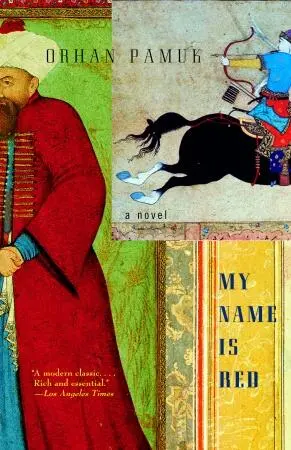
- Название:My Name is Red
- Автор:
- Жанр:
- Год:неизвестен
- ISBN:нет данных
- Рейтинг книги:5 / 5. Голосов: 1
-
Избранное:Добавить в избранное
- Отзывы:
-
Ваша оценка:
My Name is Red: краткое содержание, описание и аннотация
Предлагаем к чтению аннотацию, описание, краткое содержание или предисловие (зависит от того, что написал сам автор книги «My Name is Red»). Если вы не нашли необходимую информацию о книге — напишите в комментариях, мы постараемся отыскать её.
When the Sultan commissions a great book to celebrate his royal self and his extensive dominion, he directs Enishte Effendi to assemble a cadre of the most acclaimed artists in the land. Their task: to illuminate the work in the European style. But because figurative art can be deemed an affront to Islam, this commission is a dangerous proposition indeed, and no one in the elite circle can know the full scope or nature of the project.
Panic erupts when one of the chosen miniaturists disappears, and the Sultan demands answers within three days. The only clue to the mystery-or crime?-lies in the half-finished illuminations themselves. Has an avenging angel discovered the blasphemous work? Or is a jealous contender for the hand of Enishte’s ravishing daughter, the incomparable Shekure, somehow to blame?
Orhan Pamuk’s My Name Is Red is at once a fantasy and a philosophical puzzle, a kaleidoscopic journey to the intersection of art, religion, love, sex, and power.
"Pamuk is a novelist and a great one…My Name is Red is by far the grandest and most astonishing contest in his internal East-West war…It is chock-full of sublimity and sin…The story is told by each of a dozen characters, and now and then by a dog, a tree, a gold coin, several querulous corpses and the color crimson ('My Name is Red')…[Readers will] be lofted by the paradoxical lightness and gaiety of the writing, by the wonderfully winding talk perpetually about to turn a corner, and by the stubborn humanity in the characters' maneuvers to survive. It is a humanity whose lies and silences emerge as endearing and oddly bracing individual truths."- Richard Eder, New York Times Book Review
"A murder mystery set in sixteenth-century Istanbul [that] uses the art of miniature illumination, much as Mann's 'Doctor Faustus' did music, to explore a nation's soul… Erdag Goknar deserves praise for the cool, smooth English in which he has rendered Pamuk's finespun sentences, passionate art appreciations, sly pedantic debates, [and] eerie urban scenes."- John Updike, The New Yorker
"The interweaving of human and philosophical intrigue is very much as I remember it in The Name of the Rose, as is the slow, dense beginning and the relentless gathering of pace… But, in my view, his book is by far the better of the two. I would go so far as to say that Pamuk achieves the very thing his book implies is impossible… More than any other book I can think of, it captures not just Istanbul's past and present contradictions, but also its terrible, timeless beauty. It's almost perfect, in other words. All it needs is the Nobel Prize."-Maureen Freely, New Statesman (UK)
"A perfect example of Pamuk's method as a novelist, which is to combine literary trickery with page-turning readability… As a meditation on art, in particular, My Name is Red is exquisitely subtle, demanding and repaying the closest attention.. We in the West can only feel grateful that such a novelist as Pamuk exists, to act as a bridge between our culture and that of a heritage quite as rich as our own."-Tom Holland, Daily Telegraph (UK)
"Readers… will find themselves lured into a richly described and remarkable world… Reading the novel is like being in a magically exotic dream…Splendidly enjoyable and rewarding… A book in which you can thoroughly immerse yourself." -Allan Massie, The Scotsman (UK)
"A wonderful novel, dreamy, passionate and august, exotic in the most original and exciting way. Orhan Pamuk is indisputably a major novelist."-Philip Hensher, The Spectator (UK)
"[In this] magnificent new novel… Pamuk takes the reader into the strange and beautiful world of Islamic art,in which Western notions no longer make sense… In this world of forgeries, where some might be in danger of losing their faith in literature, Pamuk is the real thing, and this book might well be one of the few recent works of fiction that will be remembered at the end of this century."-Avkar Altinel, The Observer (UK)
My Name is Red — читать онлайн бесплатно полную книгу (весь текст) целиком
Ниже представлен текст книги, разбитый по страницам. Система сохранения места последней прочитанной страницы, позволяет с удобством читать онлайн бесплатно книгу «My Name is Red», без необходимости каждый раз заново искать на чём Вы остановились. Поставьте закладку, и сможете в любой момент перейти на страницу, на которой закончили чтение.
Интервал:
Закладка:
As with all of my miniaturists, I once paid an unannounced visit to his home. Unlike my work area and that of many other master miniaturists, his was a filthy confusion of paints, brushes, burnishing shells, his folding worktable and other objects. It was a mystery to me, but he wasn’t even embarrassed by it. He took no outside jobs to earn a few extra silver coins. After I related these facts, Black said it was Olive who showed the most enthusiasm for and the most ease with the styles of the Frankish masters admired by his late Enishte. I understood this to be praise from the deceased fool’s point of view, mistaken though it was. I can’t say whether Olive was more deeply and secretly bound to the Herat styles-which went back to his father’s mentor Siyavush and Siyavush’s mentor Muzaffer, back to the era of Bihzad and the old masters-than he appeared to be, but it always made me wonder whether Olive harbored other hidden tendencies. Of my miniaturists (I told myself spontaneously), he was the most quiet and sensitive, but also the most guilty and traitorous, and by far the most devious. When I thought about the Commander’s torture chambers, he was the first to come to mind. (I both wanted and didn’t want him to be tortured.) He had the eyes of a jinn; he noticed and took account of everything, including my own shortcomings; however, with the reserve of an exile able to accommodate himself to any situation, he’d rarely open his mouth to point out mistakes. He was wily, yes, but not in my opinion a murderer. (I didn’t tell Black this.) Olive didn’t believe in anything. He had no faith in money, but he’d nervously squirrel it away. Contrary to what is commonly believed, all murderers are men of extreme faith rather than unbelievers. Manuscript illumination leads to painting, and painting, in turn, leads to-God forbid-challenging Allah. Everybody knows this. Therefore, to judge by his lack of faith, Olive is a genuine artist. Nevertheless, I believe that his God-given gifts fall short of Butterfly’s, or even Stork’s. I would’ve wanted Olive to be my son. As I said this, I wanted to incur Black’s jealousy, but he only responded by opening his dark eyes and staring with childlike curiosity. Then I said Olive was magnificent when he worked in black ink, when he rendered, for pasting in albums, warriors, hunting scenes, Chinese-inspired landscapes full of storks and cranes, pretty boys gathered beneath a tree reciting verse and playing lutes, and when he depicted the sorrow of legendary lovers, the wrath of a sword-bearing, enraged shah, and a hero’s expression of fear as he dodged the attack of a dragon.
“Perhaps Enishte wanted Olive to do the last picture that would show in great detail, in the style of the Europeans, Our Sultan’s face and manner of sitting,” Black said.
Was he trying to confuse me?
“Supposing this were the case, after Olive killed Enishte, why would he abscond with a picture he was already familiar with?” I said. “Or, if you like, why would he murder Enishte in order to see that picture?”
We both pondered these questions for a while.
“Because there’s something missing in that painting,” said Black. “Or because he regrets something he did and is scared by it. Or even…” he thought for a while. “Or, having killed Enishte, he might’ve taken the painting to do further harm, for the sake of having a memento, or even for no reason at all. Olive is, after all, a great illustrator who’d naturally have a lot of respect for a beautiful painting.”
“We’ve already discussed in what ways Olive is a great illustrator,” I said, growing angry. “But none of Enishte’s illustrations is beautiful.”
“We haven’t yet seen the last painting,” Black said boldly.
The Attributes of Butterfly
He is known as Hasan Chelebi from the Gunpowder Factory district, but to me he’s always been “Butterfly.” This nickname always reminds me of the beauty of his boyhood and youth: He was so handsome that those who saw him didn’t believe their eyes and wanted a second look. I’ve always been astonished by the miracle of his being as talented as he is handsome. He’s a master of color and this is his greatest strength; he painted passionately, reeling with the pleasure of applying color. But I cautioned Black that Butterfly was flighty, aimless and indecisive. Anxious to be just, I added: He’s a genuine miniaturist who paints from the heart. If the arts of ornamentation are not meant to cater to intelligence, to speak to the animal within us, or to bolster the pride of the Sultan; that is, if this art is meant to be only a festival for the eyes, then Butterfly is indeed a true miniaturist. He makes wide, easy, blithe curves, as if he’d taken lessons from the masters of Kazvin forty years ago; he confidently applies his bright, pure colors, and there’s always a gentle circularity hidden in the arrangement of his paintings; but I’m the one who trained him, not those long-dead masters of Kazvin. Maybe it’s for this reason that I love him like a son, nay, more than a son-but I never felt any awe toward him. As with all of my apprentices, in his boyhood and adolescence, I beat him freely with brush handles, rulers and even pieces of wood, but this doesn’t mean I don’t respect him. Though I beat Stork frequently with rulers, I respect him too. In contrast to what the casual onlooker might assume, a master’s beating doesn’t rid the young apprentice of jinns of talent and the Devil, but only suppresses them temporarily. If it happens to be a good beating, and deserved, later on the jinns and the Devil will rise up and stimulate the developing miniaturist’s resolve to work. As for the beatings I administered to Butterfly, they shaped him into a content and obedient artist.
I at once felt the need to praise him to Black: “Butterfly’s artistry,” I said, “is solid proof that the picture of bliss, which the celebrated poet ponders in his masnawi, is only possible through a God-given gift for understanding and applying color. When I realized this, I also realized what Butterfly lacked: He hadn’t known that momentary loss of faith that Jami refers to in his poetry as ”the dark night of the soul.“ Like an illustrator painting in the great happiness of Heaven, he sets to his work with conviction and contentment, believing that he can make a blissful painting, which he does succeed in doing. Our armies besieging Doppio castle, the Hungarian ambassador kissing the feet of Our Sultan, Our Prophet ascending through the seven heavens, these are of course all inherently happy scenes, but rendered by Butterfly, they become flights of ecstasy springing from the page. In an illustration of mine, if the darkness of death or the seriousness of a government session weighs heavy, I’ll tell Butterfly to ”color it as you see fit,“ and thereupon, the outfits, leaves, flags and sea that lay there muted as if sprinkled with dirt meant to fill a grave begin to ripple in the breeze. There are times when I think Allah wants the world to be seen the way Butterfly illustrates it, that He wants life to be jubilation. Indeed, this is a realm where colors harmoniously recite magnificent ghazals to each other, where time stops, where the Devil never appears.”
However, even Butterfly knows this isn’t enough. Someone must have quite rightly-yes, in good measure-whispered to him that in his work everything was as joyous as a holiday, but devoid of depth. Child princes and senile old harem women on the verge of death enjoy his paintings, not men of the world forced to struggle with evil. Because Butterfly is well aware of these criticisms, poor man, he at times grows jealous of average miniaturists who though much less talented than he are possessed of demons and jinns. What he mistakenly believes to be devilry and the work of jinns is more often than not straightforward evil and envy.
Читать дальшеИнтервал:
Закладка:
Похожие книги на «My Name is Red»
Представляем Вашему вниманию похожие книги на «My Name is Red» списком для выбора. Мы отобрали схожую по названию и смыслу литературу в надежде предоставить читателям больше вариантов отыскать новые, интересные, ещё непрочитанные произведения.






Обсуждение, отзывы о книге «My Name is Red» и просто собственные мнения читателей. Оставьте ваши комментарии, напишите, что Вы думаете о произведении, его смысле или главных героях. Укажите что конкретно понравилось, а что нет, и почему Вы так считаете.