Orhan Pamuk - My Name is Red
Здесь есть возможность читать онлайн «Orhan Pamuk - My Name is Red» весь текст электронной книги совершенно бесплатно (целиком полную версию без сокращений). В некоторых случаях можно слушать аудио, скачать через торрент в формате fb2 и присутствует краткое содержание. Жанр: Современная проза, на английском языке. Описание произведения, (предисловие) а так же отзывы посетителей доступны на портале библиотеки ЛибКат.
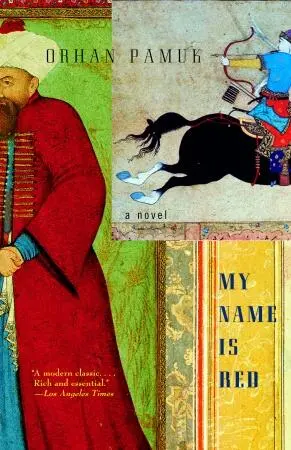
- Название:My Name is Red
- Автор:
- Жанр:
- Год:неизвестен
- ISBN:нет данных
- Рейтинг книги:5 / 5. Голосов: 1
-
Избранное:Добавить в избранное
- Отзывы:
-
Ваша оценка:
My Name is Red: краткое содержание, описание и аннотация
Предлагаем к чтению аннотацию, описание, краткое содержание или предисловие (зависит от того, что написал сам автор книги «My Name is Red»). Если вы не нашли необходимую информацию о книге — напишите в комментариях, мы постараемся отыскать её.
When the Sultan commissions a great book to celebrate his royal self and his extensive dominion, he directs Enishte Effendi to assemble a cadre of the most acclaimed artists in the land. Their task: to illuminate the work in the European style. But because figurative art can be deemed an affront to Islam, this commission is a dangerous proposition indeed, and no one in the elite circle can know the full scope or nature of the project.
Panic erupts when one of the chosen miniaturists disappears, and the Sultan demands answers within three days. The only clue to the mystery-or crime?-lies in the half-finished illuminations themselves. Has an avenging angel discovered the blasphemous work? Or is a jealous contender for the hand of Enishte’s ravishing daughter, the incomparable Shekure, somehow to blame?
Orhan Pamuk’s My Name Is Red is at once a fantasy and a philosophical puzzle, a kaleidoscopic journey to the intersection of art, religion, love, sex, and power.
"Pamuk is a novelist and a great one…My Name is Red is by far the grandest and most astonishing contest in his internal East-West war…It is chock-full of sublimity and sin…The story is told by each of a dozen characters, and now and then by a dog, a tree, a gold coin, several querulous corpses and the color crimson ('My Name is Red')…[Readers will] be lofted by the paradoxical lightness and gaiety of the writing, by the wonderfully winding talk perpetually about to turn a corner, and by the stubborn humanity in the characters' maneuvers to survive. It is a humanity whose lies and silences emerge as endearing and oddly bracing individual truths."- Richard Eder, New York Times Book Review
"A murder mystery set in sixteenth-century Istanbul [that] uses the art of miniature illumination, much as Mann's 'Doctor Faustus' did music, to explore a nation's soul… Erdag Goknar deserves praise for the cool, smooth English in which he has rendered Pamuk's finespun sentences, passionate art appreciations, sly pedantic debates, [and] eerie urban scenes."- John Updike, The New Yorker
"The interweaving of human and philosophical intrigue is very much as I remember it in The Name of the Rose, as is the slow, dense beginning and the relentless gathering of pace… But, in my view, his book is by far the better of the two. I would go so far as to say that Pamuk achieves the very thing his book implies is impossible… More than any other book I can think of, it captures not just Istanbul's past and present contradictions, but also its terrible, timeless beauty. It's almost perfect, in other words. All it needs is the Nobel Prize."-Maureen Freely, New Statesman (UK)
"A perfect example of Pamuk's method as a novelist, which is to combine literary trickery with page-turning readability… As a meditation on art, in particular, My Name is Red is exquisitely subtle, demanding and repaying the closest attention.. We in the West can only feel grateful that such a novelist as Pamuk exists, to act as a bridge between our culture and that of a heritage quite as rich as our own."-Tom Holland, Daily Telegraph (UK)
"Readers… will find themselves lured into a richly described and remarkable world… Reading the novel is like being in a magically exotic dream…Splendidly enjoyable and rewarding… A book in which you can thoroughly immerse yourself." -Allan Massie, The Scotsman (UK)
"A wonderful novel, dreamy, passionate and august, exotic in the most original and exciting way. Orhan Pamuk is indisputably a major novelist."-Philip Hensher, The Spectator (UK)
"[In this] magnificent new novel… Pamuk takes the reader into the strange and beautiful world of Islamic art,in which Western notions no longer make sense… In this world of forgeries, where some might be in danger of losing their faith in literature, Pamuk is the real thing, and this book might well be one of the few recent works of fiction that will be remembered at the end of this century."-Avkar Altinel, The Observer (UK)
My Name is Red — читать онлайн бесплатно полную книгу (весь текст) целиком
Ниже представлен текст книги, разбитый по страницам. Система сохранения места последней прочитанной страницы, позволяет с удобством читать онлайн бесплатно книгу «My Name is Red», без необходимости каждый раз заново искать на чём Вы остановились. Поставьте закладку, и сможете в любой момент перейти на страницу, на которой закончили чтение.
Интервал:
Закладка:
“Besides, ears are actually a human flaw,” I said, hoping Black would smile. “They’re at once distinct and common to everyone: a perfect manifestation of ugliness.”
“What happened to the miniaturist who’d been caught by the authorities through his style of painting ears?”
I refrained from saying, “He was blinded,” to keep Black from becoming even more downcast. Instead, I responded, “He married the shah’s daughter, and this method, which has been used to identify miniaturists ever since, is known by many khans, shahs and sultans who fund book-arts workshops as the ”courtesan method.“ Furthermore, it is kept secret so that if one of their miniaturists makes a forbidden figure or a small design that conceals some mischief and later denies having done so, they can quickly determine who was responsible-genuine artists have an instinctive desire to draw what’s forbidden! Sometimes their hands make mischief on their own. Uncovering these transgressions involves finding trivial, quickly drawn and repetitive details removed from the heart of the painting, such as ears, hands, grass, leaves, or even horses’ manes, legs or hooves. But beware, the method doesn’t work if the illustrator himself is mindful that this detail has become his own secret signature. Mustaches won’t work, for instance, because many artists are aware how freely they’re drawn as a sort of signature anyway. But eyebrows are a possibility: No one pays much attention to them. Come now, let’s see which young masters have brought their brushes and reed pens to bear upon late Enishte’s illustrations.”
Thus we brought together the pages of two illustrated manuscripts, one that was being completed secretly and the other openly, two books with different stories and subjects, illustrated in two distinct styles; that is, deceased Enishte’s book and the Book of Festivities recounting our prince’s circumcision ceremony, whose creation was under my control. Black and I looked intently wherever I moved my magnifying lens:
1. In the pages of the Book of Festivities , we first studied the open mouth of the fox whose pelt a master of the furrier’s guild, in a red caftan and purple sash, held on his lap as the guild passed before Our Sultan, watching the parade from a loge made specifically for the event. Unmistakably, Olive had made both the fox’s teeth, which were individually distinguishable, and the teeth in Enishte’s illustration of Satan, an ominous creature, half-demon and half-giant, that appeared to have come from Samarkand.
2. On a particularly joyous day of the festivities, below Our Sultan’s loge overlooking the Hippodrome, a division of impoverished frontier ghazis appeared in tattered clothes. One of their lot made a plea: “My Exalted Sultan, we, your heroic soldiers, fell captive as we fought the infidel in the name of our religion and were only able to gain our freedom by leaving a number of our brethren behind as hostages; that is, we were set free in order to amass ransom. However, when we arrived back in Istanbul, we found everything so expensive that we’ve been unable to collect the money to save our brethren who languish as prisoners of the kaffirs. We’re at the mercy of your aid. Please grant us gold or slaves that we might take back to exchange for their freedom.” Stork clearly made the nails of the lazy dog off to the side-glaring with one open eye at Our Sultan, at our poor, destitute ghazis and at the Persian and Tatar ambassadors in the Hippodrome-as well as the nails of the dog occupying a corner of the scene depicting the adventures of the Gold Coin in Enishte’s book.
3. Among the jugglers spinning eggs on pieces of wood and turning somersaults before Our Sultan was a bald man with bare calves wearing a purple vest, who played a tambourine as he sat off to one side on a red carpet; this man held the instrument exactly the same way the woman held a large brass serving tray in the illustration of Red in Enishte’s book: doubtless the work of Olive.
4. As the cooks’ guild pushed past Our Sultan, they were cooking stuffed cabbage with meat and onions in a cauldron resting on a stove in their cart. The master cooks accompanying the cart stood on pink earth resting their stew pots on blue stones; these stones were rendered by the same artist who made the red ones on dark-blue earth above which floated the half-ghostly creature in the illustration that Enishte called Death: the unmistakable work of Butterfly.
5. Mounted Tatar messengers brought word that the Persian Shah’s armies had begun to mobilize for another campaign against the Ottomans, who thereupon razed to the ground the exquisite observation kiosk of the Persian ambassador who’d repeatedly affirmed to Our Sultan, Refuge of the World, in a cascade of pleasantries, that the Shah was His friend and harbored nothing but brotherly affection for Him. During this episode of wrath and destruction, water bearers ran out to settle the dust raised in the Hippodrome, and a group of men appeared shouldering leather sacks full of linseed oil to pour over a mob ready to attack the ambassador, in hopes of pacifying it. The raised feet of the water bearers and of the men carrying sacks of linseed oil were made by the same artist who painted the raised feet of charging soldiers in the depiction of Red: also the work of Butterfly.
I wasn’t the one who made this last discovery as I directed our search for clues, moving the magnifying lens right and left, to that picture then this one; rather it was Black, who opened his eyes wide and scarcely blinked gripped by the fear of torture and the hope of returning to his wife who awaited him at home. Using the “courtesan method,” it took an entire afternoon to sort out which of our miniaturists worked on each of the nine pictures left by the late Enishte, and later, to interpret that information.
Black’s late Enishte didn’t limit any single page to the artistic talent of just one miniaturist; all three of my master miniaturists worked on most of the illustrations. This meant that the pictures were moved from house to house with great frequency. In addition to the work I recognized, I noticed the amateurish strokes of a fifth artist, but as I grew angry at the dearth of talent shown by this disgraceful murderer, Black determined from the cautious brush strokes that it was indeed the work of his Enishte-thereby saving us from following a false lead. If we discounted poor Elegant Effendi, who’d done almost the same gilding for Enishte’s book and our Book of Festivities (yes, this of course broke my heart) and who, I gathered, had occasionally lowered his brush to execute a few walls, leaves and clouds, it was evident that only my three most brilliant master miniaturists had contributed to these illustrations. They were the darlings I’d lovingly trained since their apprenticeships, my three beloved talents: Olive, Butterfly and Stork.
Discussing their talents, mastery and temperaments to the end of finding the clue we were looking for inevitably led to a discussion of my own life as well:
The Attributes of Olive
His given name was Velijan. If he had a nickname besides the one I’d given him, I don’t know it, because I never saw him sign any of his work. When he was an apprentice, he’d come get me from my home on Tuesday mornings. He was very proud, and so if he ever lowered himself to sign his work, he’d want this signature to be plain and recognizable; he wouldn’t try to conceal it anywhere. Allah had quite generously endowed him with excess ability. He could readily and easily do anything from gilding to ruling and his work was superb. He was the workshop’s most brilliant creator of trees, animals and the human face. Velijan’s father, who brought him to Istanbul when he was, I believe, ten years old, was trained by Siyavush, the famous illustrator specializing in faces in the Persian Shah’s Tabriz workshop. He hails from a long line of masters whose genealogy goes back to the Mongols, and just like the elderly masters who bore a Mongol-Chinese influence and settled in Samarkand, Bukhara and Herat 150 years ago, he rendered moon-faced young lovers as if they were Chinese. Neither during his apprenticeship nor during his time as a master was I able to lead this stubborn artist to other styles. How I would’ve liked him to transcend the styles and models of the Mongol, Chinese and Herat masters billeted deep in his soul, or even for him to forget about them entirely. When I told him this, he replied that like many miniaturists who’d moved from workshop to workshop and country to country, he’d forgotten these old styles, if he’d ever actually learned them. Though the value of many miniaturists resides precisely in the splendid models of form they’ve committed to memory, had Velijan truly forgotten them, he’d have become an even greater illustrator. Still, there were two benefits, of which he wasn’t even aware, to harboring the teachings of his mentors in the depths of his soul like a pair of unconfessed sins: 1. For such a gifted miniaturist, clinging to old forms inevitably stirred feelings of guilt and alienation that would spur his talent to maturity. 2. In a moment of difficulty, he could always recall what he claimed to have forgotten, and thus, he could successfully complete any new subject, history or scene by recourse to one of the old Herat models. With his keen eye, he knew how to harmonize what he’d learned from the old forms and Shah Tahmasp’s old masters in new pictures. Herat painting and Istanbul ornamentation happily merged in Olive.
Читать дальшеИнтервал:
Закладка:
Похожие книги на «My Name is Red»
Представляем Вашему вниманию похожие книги на «My Name is Red» списком для выбора. Мы отобрали схожую по названию и смыслу литературу в надежде предоставить читателям больше вариантов отыскать новые, интересные, ещё непрочитанные произведения.







Обсуждение, отзывы о книге «My Name is Red» и просто собственные мнения читателей. Оставьте ваши комментарии, напишите, что Вы думаете о произведении, его смысле или главных героях. Укажите что конкретно понравилось, а что нет, и почему Вы так считаете.