Orhan Pamuk - My Name is Red
Здесь есть возможность читать онлайн «Orhan Pamuk - My Name is Red» весь текст электронной книги совершенно бесплатно (целиком полную версию без сокращений). В некоторых случаях можно слушать аудио, скачать через торрент в формате fb2 и присутствует краткое содержание. Жанр: Современная проза, на английском языке. Описание произведения, (предисловие) а так же отзывы посетителей доступны на портале библиотеки ЛибКат.
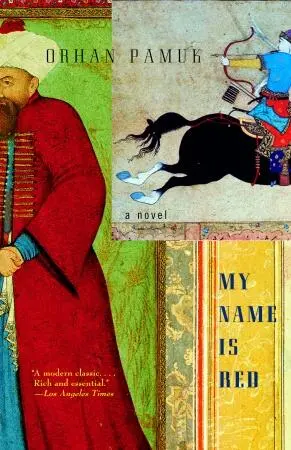
- Название:My Name is Red
- Автор:
- Жанр:
- Год:неизвестен
- ISBN:нет данных
- Рейтинг книги:5 / 5. Голосов: 1
-
Избранное:Добавить в избранное
- Отзывы:
-
Ваша оценка:
My Name is Red: краткое содержание, описание и аннотация
Предлагаем к чтению аннотацию, описание, краткое содержание или предисловие (зависит от того, что написал сам автор книги «My Name is Red»). Если вы не нашли необходимую информацию о книге — напишите в комментариях, мы постараемся отыскать её.
When the Sultan commissions a great book to celebrate his royal self and his extensive dominion, he directs Enishte Effendi to assemble a cadre of the most acclaimed artists in the land. Their task: to illuminate the work in the European style. But because figurative art can be deemed an affront to Islam, this commission is a dangerous proposition indeed, and no one in the elite circle can know the full scope or nature of the project.
Panic erupts when one of the chosen miniaturists disappears, and the Sultan demands answers within three days. The only clue to the mystery-or crime?-lies in the half-finished illuminations themselves. Has an avenging angel discovered the blasphemous work? Or is a jealous contender for the hand of Enishte’s ravishing daughter, the incomparable Shekure, somehow to blame?
Orhan Pamuk’s My Name Is Red is at once a fantasy and a philosophical puzzle, a kaleidoscopic journey to the intersection of art, religion, love, sex, and power.
"Pamuk is a novelist and a great one…My Name is Red is by far the grandest and most astonishing contest in his internal East-West war…It is chock-full of sublimity and sin…The story is told by each of a dozen characters, and now and then by a dog, a tree, a gold coin, several querulous corpses and the color crimson ('My Name is Red')…[Readers will] be lofted by the paradoxical lightness and gaiety of the writing, by the wonderfully winding talk perpetually about to turn a corner, and by the stubborn humanity in the characters' maneuvers to survive. It is a humanity whose lies and silences emerge as endearing and oddly bracing individual truths."- Richard Eder, New York Times Book Review
"A murder mystery set in sixteenth-century Istanbul [that] uses the art of miniature illumination, much as Mann's 'Doctor Faustus' did music, to explore a nation's soul… Erdag Goknar deserves praise for the cool, smooth English in which he has rendered Pamuk's finespun sentences, passionate art appreciations, sly pedantic debates, [and] eerie urban scenes."- John Updike, The New Yorker
"The interweaving of human and philosophical intrigue is very much as I remember it in The Name of the Rose, as is the slow, dense beginning and the relentless gathering of pace… But, in my view, his book is by far the better of the two. I would go so far as to say that Pamuk achieves the very thing his book implies is impossible… More than any other book I can think of, it captures not just Istanbul's past and present contradictions, but also its terrible, timeless beauty. It's almost perfect, in other words. All it needs is the Nobel Prize."-Maureen Freely, New Statesman (UK)
"A perfect example of Pamuk's method as a novelist, which is to combine literary trickery with page-turning readability… As a meditation on art, in particular, My Name is Red is exquisitely subtle, demanding and repaying the closest attention.. We in the West can only feel grateful that such a novelist as Pamuk exists, to act as a bridge between our culture and that of a heritage quite as rich as our own."-Tom Holland, Daily Telegraph (UK)
"Readers… will find themselves lured into a richly described and remarkable world… Reading the novel is like being in a magically exotic dream…Splendidly enjoyable and rewarding… A book in which you can thoroughly immerse yourself." -Allan Massie, The Scotsman (UK)
"A wonderful novel, dreamy, passionate and august, exotic in the most original and exciting way. Orhan Pamuk is indisputably a major novelist."-Philip Hensher, The Spectator (UK)
"[In this] magnificent new novel… Pamuk takes the reader into the strange and beautiful world of Islamic art,in which Western notions no longer make sense… In this world of forgeries, where some might be in danger of losing their faith in literature, Pamuk is the real thing, and this book might well be one of the few recent works of fiction that will be remembered at the end of this century."-Avkar Altinel, The Observer (UK)
My Name is Red — читать онлайн бесплатно полную книгу (весь текст) целиком
Ниже представлен текст книги, разбитый по страницам. Система сохранения места последней прочитанной страницы, позволяет с удобством читать онлайн бесплатно книгу «My Name is Red», без необходимости каждый раз заново искать на чём Вы остановились. Поставьте закладку, и сможете в любой момент перейти на страницу, на которой закончили чтение.
Интервал:
Закладка:
Since he paid equal attention to every odd detail, with no basis of discrimination except that it be visible, his aesthetic approach resembled that of the Venetian masters. But unlike them, my ambitious Stork neither saw nor depicted people’s faces as individual or distinct. I assume, since he either openly or secretly belittled everyone, that he didn’t consider faces important. I’m certain deceased Enishte didn’t appoint him to draw Our Sultan’s face.
Even when depicting a subject of the utmost importance, he couldn’t keep from situating a skeptical dog somewhere at some distance from the event, or drawing a disgraceful beggar whose misery demeaned the wealth and extravagance of a ceremony. He had enough self-confidence to mock whatever illustration he made, its subject and himself.
“Elegant Effendi’s murder resembles the way Joseph’s brothers tossed him into a well out of jealousy,” said Black. “And my Enishte’s death resembles the unforeseen murder of Hüsrev at the hands of his son who had his heart set on Hüsrev’s wife, Shirin. Everyone says that Stork loved to paint scenes of war and gruesome depictions of death.”
“Anyone who thinks an illuminator resembles the subject of the picture he paints doesn’t understand me or my master miniaturists. What exposes us is not the subject, which others have commissioned from us-these are always the same anyway-but the hidden sensibilities we include in the painting as we render that subject: A light that seems to radiate from within the picture, a palpable hesitancy or anger one notices in the composition of figures, horses and trees, the desire and sorrow emanating from a cypress as it reaches to the heavens, the pious resignation and patience that we introduce into the illustration when we ornament wall tiles with a fervor that tempts blindness…Yes, these are our hidden traces, not those identical horses all in a row. When a painter renders the fury and speed of a horse, he doesn’t paint his own fury and speed; by trying to make the perfect horse, he reveals his love for the richness of this world and its creator, displaying the colors of a passion for life-only that and nothing more.”
I AM CALLED BLACK
Various manuscript pages lay before me and the great Master Osman-some with calligraphed texts and ready to be bound, some not yet colored or otherwise unfinished for whatever reason-as we spent an entire afternoon evaluating the master miniaturists and the pages of my Enishte’s book, keeping charts of our assessments. We thought we’d seen the last of the Commander’s respectful but crude men, who’d brought us the pages collected from the miniaturists and calligraphers whose homes they raided and searched (some pieces had nothing whatsoever to do with either of our two books and some pages confirmed that the calligraphers, as well, were secretly accepting work from outside the palace for the sake of a few extra coins), when the most brash of them stepped over to the exalted master and removed a piece of paper from his sash.
I paid no mind at first, thinking it was one of those petitions from a father seeking an apprenticeship for his son by approaching as many division heads and group captains as possible. I could tell that the morning sun had vanished by the pale light that filtered inside. To rest my eyes, I was doing an exercise the old masters of Shiraz recommended miniaturists do to stave off premature blindness, that is, I was trying to look emptily into the distance without focusing. That’s when I recognized with a thrill the sweet color and heart-stopping folds of the paper which my master held and stared at with an expression of disbelief. This matched exactly the letters that Shekure had sent me via Esther. I was about to say, “What a coincidence” like an idiot, when I noticed that, like Shekure’s first letter, it was accompanied by a painting on coarse paper!
Master Osman kept the painting to himself. He handed me the letter that I just then embarrassingly realized was from Shekure.
My Dear Husband Black. I sent Esther to sound out late Elegant Effendi’s widow, Kalbiye. While there, Kalbiye showed Esther this illustrated page, which I’m sending to you. Later, I went to Kalbiye’s house, doing everything within my power to persuade her that it was in her best interest to give me the picture. This page was on poor Elegant Effendi’s body when he was removed from the well. Kalbiye swears that nobody had commissioned her husband, may he rest in divine light, to draw horses. So then, who made them? The Commander’s men searched the house. I’m sending this note because this matter must have significance to the investigation. The children kiss your hands respectfully. Your wife, Shekure.
I carefully read the last three words of this beautiful note thrice as if staring at three wondrous red roses in a garden. I leaned over the page that Master Osman was scrutinizing, magnifying lens in hand. I straightaway noticed that the shapes whose ink had bled were horses sketched in a single motion as the old masters would do to accustom the hand.
Master Osman, who read Shekure’s note without comment, voiced a question: “Who drew this?” He then answered himself, “Of course, the same miniaturist who drew the late Enishte’s horse.”
Could he be so certain? Moreover, we weren’t at all sure who’d drawn the horse for the book. We removed the horse from among the nine pages and began to examine it.
It was a handsome, simple, chestnut horse that you couldn’t take your eyes off of. Was I being truthful when I said this? I had plenty of time to look at this horse with my Enishte, and later, when I was left alone with these illustrations, but I hadn’t given it much thought then. It was a beautiful, but ordinary horse: It was so ordinary that we weren’t even able to determine who’d drawn it. It wasn’t a true chestnut, but more bay-colored; there was a faint hint of red in its coat as well. It was a horse that I’d seen so often in other books and other illustrations that I knew it’d been drawn by rote without the miniaturist’s stopping to give it any consideration at all.
We stared at the horse this way until we discovered it concealed a secret. Now, however, I could see a beauty in the horse that shimmered like heat rising before my eyes and within it a force that roused a zest for life, learning and embracing the world. I asked myself, “Who’s the miniaturist with the magic touch that depicted this horse the way Allah would see it?” as if having forgotten suddenly that he was also nothing but a base murderer. The horse stood before me as if it were a real horse, but somewhere in my mind I also knew it was an illustration; being caught between these two thoughts was enchanting and aroused in me a sense of wholeness and perfection.
For a time, we compared the blurred horses drawn for practice with the horse made for my Enishte’s book, determining finally that they’d been made by the same hand. The proud stances of those strong and elegant studs bespoke stillness rather than motion. I was in awe of the horse of Enishte’s book.
“This is such a spectacular horse,” I said, “it gives one the urge to pull out a piece of paper and copy it, and then to draw every last thing.”
“The greatest compliment you can pay a painter is to say that his work has stimulated your own enthusiasm to illustrate,” said Master Osman. “But now let’s forget about his talent and try to uncover this devil’s identity. Had Enishte Effendi, may he rest in peace, ever mentioned the kind of story this picture was meant to accompany?”
“No. According to him, this was one of the horses that lived in the lands that our powerful Sultan rules. It is a handsome horse: a horse of the Ottoman line. It is a symbol that would demonstrate to the Venetian Doge Our Sultan’s wealth and the regions under his control. But on the other hand, as with everything the Venetian masters depict, this horse was also to be more lifelike than a horse born of God’s vision, more like a horse that lived in a particular stable with a particular groom in Istanbul so that the Venetian Doge might say to himself, ”Just as the Ottoman miniaturists have come to see the world like us, so have the Ottomans themselves come to resemble us,“ in turn, accepting Our Sultan’s power and friendship. For if you begin to draw a horse differently, you begin to see the world differently. Despite its peculiarities, this horse was rendered in the manner of the old masters.”
Читать дальшеИнтервал:
Закладка:
Похожие книги на «My Name is Red»
Представляем Вашему вниманию похожие книги на «My Name is Red» списком для выбора. Мы отобрали схожую по названию и смыслу литературу в надежде предоставить читателям больше вариантов отыскать новые, интересные, ещё непрочитанные произведения.





Обсуждение, отзывы о книге «My Name is Red» и просто собственные мнения читателей. Оставьте ваши комментарии, напишите, что Вы думаете о произведении, его смысле или главных героях. Укажите что конкретно понравилось, а что нет, и почему Вы так считаете.