Orhan Pamuk - My Name is Red
Здесь есть возможность читать онлайн «Orhan Pamuk - My Name is Red» весь текст электронной книги совершенно бесплатно (целиком полную версию без сокращений). В некоторых случаях можно слушать аудио, скачать через торрент в формате fb2 и присутствует краткое содержание. Жанр: Современная проза, на английском языке. Описание произведения, (предисловие) а так же отзывы посетителей доступны на портале библиотеки ЛибКат.
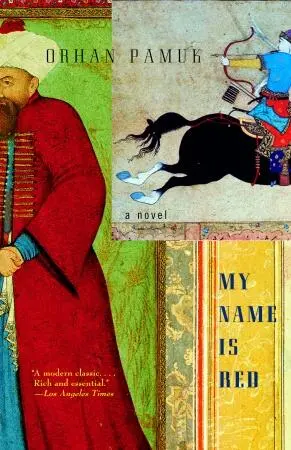
- Название:My Name is Red
- Автор:
- Жанр:
- Год:неизвестен
- ISBN:нет данных
- Рейтинг книги:5 / 5. Голосов: 1
-
Избранное:Добавить в избранное
- Отзывы:
-
Ваша оценка:
My Name is Red: краткое содержание, описание и аннотация
Предлагаем к чтению аннотацию, описание, краткое содержание или предисловие (зависит от того, что написал сам автор книги «My Name is Red»). Если вы не нашли необходимую информацию о книге — напишите в комментариях, мы постараемся отыскать её.
When the Sultan commissions a great book to celebrate his royal self and his extensive dominion, he directs Enishte Effendi to assemble a cadre of the most acclaimed artists in the land. Their task: to illuminate the work in the European style. But because figurative art can be deemed an affront to Islam, this commission is a dangerous proposition indeed, and no one in the elite circle can know the full scope or nature of the project.
Panic erupts when one of the chosen miniaturists disappears, and the Sultan demands answers within three days. The only clue to the mystery-or crime?-lies in the half-finished illuminations themselves. Has an avenging angel discovered the blasphemous work? Or is a jealous contender for the hand of Enishte’s ravishing daughter, the incomparable Shekure, somehow to blame?
Orhan Pamuk’s My Name Is Red is at once a fantasy and a philosophical puzzle, a kaleidoscopic journey to the intersection of art, religion, love, sex, and power.
"Pamuk is a novelist and a great one…My Name is Red is by far the grandest and most astonishing contest in his internal East-West war…It is chock-full of sublimity and sin…The story is told by each of a dozen characters, and now and then by a dog, a tree, a gold coin, several querulous corpses and the color crimson ('My Name is Red')…[Readers will] be lofted by the paradoxical lightness and gaiety of the writing, by the wonderfully winding talk perpetually about to turn a corner, and by the stubborn humanity in the characters' maneuvers to survive. It is a humanity whose lies and silences emerge as endearing and oddly bracing individual truths."- Richard Eder, New York Times Book Review
"A murder mystery set in sixteenth-century Istanbul [that] uses the art of miniature illumination, much as Mann's 'Doctor Faustus' did music, to explore a nation's soul… Erdag Goknar deserves praise for the cool, smooth English in which he has rendered Pamuk's finespun sentences, passionate art appreciations, sly pedantic debates, [and] eerie urban scenes."- John Updike, The New Yorker
"The interweaving of human and philosophical intrigue is very much as I remember it in The Name of the Rose, as is the slow, dense beginning and the relentless gathering of pace… But, in my view, his book is by far the better of the two. I would go so far as to say that Pamuk achieves the very thing his book implies is impossible… More than any other book I can think of, it captures not just Istanbul's past and present contradictions, but also its terrible, timeless beauty. It's almost perfect, in other words. All it needs is the Nobel Prize."-Maureen Freely, New Statesman (UK)
"A perfect example of Pamuk's method as a novelist, which is to combine literary trickery with page-turning readability… As a meditation on art, in particular, My Name is Red is exquisitely subtle, demanding and repaying the closest attention.. We in the West can only feel grateful that such a novelist as Pamuk exists, to act as a bridge between our culture and that of a heritage quite as rich as our own."-Tom Holland, Daily Telegraph (UK)
"Readers… will find themselves lured into a richly described and remarkable world… Reading the novel is like being in a magically exotic dream…Splendidly enjoyable and rewarding… A book in which you can thoroughly immerse yourself." -Allan Massie, The Scotsman (UK)
"A wonderful novel, dreamy, passionate and august, exotic in the most original and exciting way. Orhan Pamuk is indisputably a major novelist."-Philip Hensher, The Spectator (UK)
"[In this] magnificent new novel… Pamuk takes the reader into the strange and beautiful world of Islamic art,in which Western notions no longer make sense… In this world of forgeries, where some might be in danger of losing their faith in literature, Pamuk is the real thing, and this book might well be one of the few recent works of fiction that will be remembered at the end of this century."-Avkar Altinel, The Observer (UK)
My Name is Red — читать онлайн бесплатно полную книгу (весь текст) целиком
Ниже представлен текст книги, разбитый по страницам. Система сохранения места последней прочитанной страницы, позволяет с удобством читать онлайн бесплатно книгу «My Name is Red», без необходимости каждый раз заново искать на чём Вы остановились. Поставьте закладку, и сможете в любой момент перейти на страницу, на которой закончили чтение.
Интервал:
Закладка:
He aggravates me because when he paints, he doesn’t lose himself in that wondrous world, surrendering to its ecstasy, but only reaches that height when he imagines his work will please others. He aggravates me because he thinks about the money he’ll earn. It’s another of life’s ironies: There are many artists with much less talent yet more able than Butterfly to surrender themselves to their art.
In his need to make up for his shortcomings, Butterfly is preoccupied with proving that he has sacrificed himself to art. Like those birdbrained miniaturists who paint on fingernails and pieces of rice, pictures almost invisible to the naked eye, he’s engrossed with minute and delicate craftsmanship. I’d once asked him whether he gave himself over to this ambition, which has blinded many illustrators at an early age, because he was ashamed of the excessive talent Allah had granted him. Only inept miniaturists paint each leaf of a tree they’ve drawn on a grain of rice to make an easy name for themselves and to gain importance in the eyes of dense patrons.
Butterfly’s inclination to design and illustrate for other people’s pleasure rather than for his own, his uncontrollable need to please others, made him, more than any of the others, a slave to praise. And so it follows that an uncertain Butterfly wants to ensure his standing by becoming Head Illuminator. It was Black who had raised this subject.
“Yes,” I said, “I know he’s been scheming to succeed me after I die.”
“Do you think this would drive him to murder his miniaturist brethren?”
“It might. He’s a great master, but he’s not aware of this, and he can’t leave the world behind when he paints.”
I said this, whereupon I grasped that in truth I, too, wanted Butterfly to assume leadership of the workshop after me. I couldn’t trust Olive, and in the end Stork would unwittingly become slave to the Venetian style. Butterfly’s need to be admired-I was upset at the thought that he could take a life-would be vital in handling both the workshop and the Sultan. Only Butterfly’s sensitivity and faith in his own palette could resist the Venetian artistry that duped the viewer by trying to depict reality itself rather than its representation, in all its detail: pictures, shadows included, of cardinals, bridges, rowboats, candlesticks, churches and stables, oxen and carriage wheels, as if all of them were of the same importance to Allah.
“Was there ever a time when you visited him unannounced as you had with the others?”
“Whosoever looks upon Butterfly’s work will quickly sense that he understands the value of love as well as the meaning of heartfelt joy and sorrow. But as with all lovers of color, he gets carried away with his emotions and is fickle. Because I was so enamored of his God-given and miraculous talent, of his sensitivity to color, I paid close attention to him in his youth and know everything there is to know about him. Of course, in such situations, the other miniaturists quickly become jealous and the master-disciple relationship becomes strained and damaged. There were many moments of love during which Butterfly did not fear what others might say. Recently, since he married the neighborhood fruit seller’s pretty daughter, I’ve neither felt the desire to go see him, nor have I had the chance.”
“Rumor has it that he’s in league with the followers of the Hoja from Erzurum,” Black said. “They say he stands to gain a lot if the Hoja and his men declare certain works incompatible with religion, and thereby, outlaw our books-which depict battles, weapons, bloody scenes and routine ceremonies, not to mention parades including everyone from chefs to magicians, dervishes to boy dancers, and kebab makers to locksmiths-and confine us to the subjects and forms of the old Persian masters.”
“Even if we returned skillfully and victoriously to those wondrous paintings of Tamerlane’s time, even if we returned to that life and vocation in all its minutia-as bright Stork would best be able to do after me-in the final analysis, all of it’ll be forgotten,” I said mercilessly, “because everybody will want to paint like the Europeans.”
Did I actually believe these words of damnation?
“My Enishte believed the same,” Black confessed meekly, “yet it filled him with hope.”
The Attributes of Stork
I’ve seen him sign his name as the Sinning Painter Mustafa Chelebi. Without paying any mind to whether he had or ought to have a style, whether it should be identified with a signature or, like the old masters, remain anonymous, or whether or not a humble bearing required one to do so, he’d just sign his name with a smile and a victorious flourish.
He continued bravely down the path I’d set him on and committed to paper what none before him had been able to. Like myself, he too would watch master glassblowers turning their rods and blowing glass melted in ovens to make blue pitchers and green bottles; he saw the leather, needles and wooden molds of the shoemakers who bent with rapt attention over the shoes and boots they made; a horse swing tracing a graceful arc during a holiday festival; a press squeezing oil from seeds; the firing of our cannon at the enemy; and the screws and the barrels of our guns. He saw these things and painted them without objecting that the old masters of Tamerlane’s time, or the legendary illustrators of Tabriz and Kazvin, hadn’t lowered themselves to do so. He was the first Muslim miniaturist to go to war and return safe and sound, in preparation for the Book of Victories that he would later illustrate. He was the first to eagerly study enemy fortresses, cannon, armies, horses with bleeding wounds, injured soldiers struggling for their lives and corpses-all with the intent to paint.
I recognize his work from his subject matter more than his style and from his attention to obscure details more than his subject matter. I could entrust him with complete peace of mind to execute all aspects of a painting, from the arrangement of pages and their composition to the coloring of the most trivial details. In this regard, he has the right to succeed me as Head Illuminator. But he’s so ambitious and conceited, and so condescending toward the other illustrators that he could never manage so many men, and would end up losing them all. Actually, if it were left to him, with his incredible industriousness, he’d simply make all the illustrations in the workshop himself. If he put his mind to such a task, he could in fact succeed. He’s a great master. He knows his craft. He admires himself. How nice for him.
When I visited him unannounced once, I caught him at work. Resting upon folding worktables, desks and cushions were all the pages he was working on: illustrations for Our Sultan’s books, for me, for miserable costume books that he dashed off for foolish European travelers eager to belittle us, one page of a triptych he was making for a pasha who thought highly of himself, images to be pasted in albums, pages made for his own pleasure and even a vulgar rendition of coitus. Tall, thin Stork was flitting from one illustration to the next like a bee among flowers, singing folk songs, tweaking the cheek of his apprentice who was mixing paint and adding a comic twist to the painting he was working on before showing it to me with a smug chuckle. Unlike my other miniaturists, he didn’t stop working in a ceremonial show of respect when I arrived; on the contrary, he happily exhibited the swift exercise of his God-given talent and the skill he’d acquired through hard work (he could do the work of seven or eight miniaturists at the same time). Now, I catch myself secretly thinking that if the vile murderer is one of my three master miniaturists, I hope to God it’s Stork. During his apprenticeship, the sight of him at my door on Friday mornings didn’t excite me the way Butterfly did on his day.
Читать дальшеИнтервал:
Закладка:
Похожие книги на «My Name is Red»
Представляем Вашему вниманию похожие книги на «My Name is Red» списком для выбора. Мы отобрали схожую по названию и смыслу литературу в надежде предоставить читателям больше вариантов отыскать новые, интересные, ещё непрочитанные произведения.







Обсуждение, отзывы о книге «My Name is Red» и просто собственные мнения читателей. Оставьте ваши комментарии, напишите, что Вы думаете о произведении, его смысле или главных героях. Укажите что конкретно понравилось, а что нет, и почему Вы так считаете.