Orhan Pamuk - My Name is Red
Здесь есть возможность читать онлайн «Orhan Pamuk - My Name is Red» весь текст электронной книги совершенно бесплатно (целиком полную версию без сокращений). В некоторых случаях можно слушать аудио, скачать через торрент в формате fb2 и присутствует краткое содержание. Жанр: Современная проза, на английском языке. Описание произведения, (предисловие) а так же отзывы посетителей доступны на портале библиотеки ЛибКат.
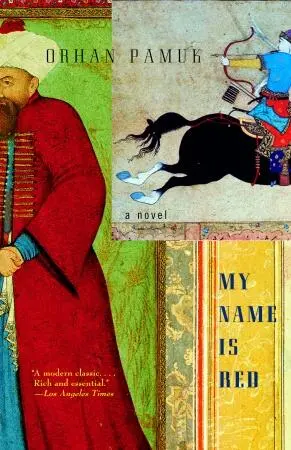
- Название:My Name is Red
- Автор:
- Жанр:
- Год:неизвестен
- ISBN:нет данных
- Рейтинг книги:5 / 5. Голосов: 1
-
Избранное:Добавить в избранное
- Отзывы:
-
Ваша оценка:
My Name is Red: краткое содержание, описание и аннотация
Предлагаем к чтению аннотацию, описание, краткое содержание или предисловие (зависит от того, что написал сам автор книги «My Name is Red»). Если вы не нашли необходимую информацию о книге — напишите в комментариях, мы постараемся отыскать её.
When the Sultan commissions a great book to celebrate his royal self and his extensive dominion, he directs Enishte Effendi to assemble a cadre of the most acclaimed artists in the land. Their task: to illuminate the work in the European style. But because figurative art can be deemed an affront to Islam, this commission is a dangerous proposition indeed, and no one in the elite circle can know the full scope or nature of the project.
Panic erupts when one of the chosen miniaturists disappears, and the Sultan demands answers within three days. The only clue to the mystery-or crime?-lies in the half-finished illuminations themselves. Has an avenging angel discovered the blasphemous work? Or is a jealous contender for the hand of Enishte’s ravishing daughter, the incomparable Shekure, somehow to blame?
Orhan Pamuk’s My Name Is Red is at once a fantasy and a philosophical puzzle, a kaleidoscopic journey to the intersection of art, religion, love, sex, and power.
"Pamuk is a novelist and a great one…My Name is Red is by far the grandest and most astonishing contest in his internal East-West war…It is chock-full of sublimity and sin…The story is told by each of a dozen characters, and now and then by a dog, a tree, a gold coin, several querulous corpses and the color crimson ('My Name is Red')…[Readers will] be lofted by the paradoxical lightness and gaiety of the writing, by the wonderfully winding talk perpetually about to turn a corner, and by the stubborn humanity in the characters' maneuvers to survive. It is a humanity whose lies and silences emerge as endearing and oddly bracing individual truths."- Richard Eder, New York Times Book Review
"A murder mystery set in sixteenth-century Istanbul [that] uses the art of miniature illumination, much as Mann's 'Doctor Faustus' did music, to explore a nation's soul… Erdag Goknar deserves praise for the cool, smooth English in which he has rendered Pamuk's finespun sentences, passionate art appreciations, sly pedantic debates, [and] eerie urban scenes."- John Updike, The New Yorker
"The interweaving of human and philosophical intrigue is very much as I remember it in The Name of the Rose, as is the slow, dense beginning and the relentless gathering of pace… But, in my view, his book is by far the better of the two. I would go so far as to say that Pamuk achieves the very thing his book implies is impossible… More than any other book I can think of, it captures not just Istanbul's past and present contradictions, but also its terrible, timeless beauty. It's almost perfect, in other words. All it needs is the Nobel Prize."-Maureen Freely, New Statesman (UK)
"A perfect example of Pamuk's method as a novelist, which is to combine literary trickery with page-turning readability… As a meditation on art, in particular, My Name is Red is exquisitely subtle, demanding and repaying the closest attention.. We in the West can only feel grateful that such a novelist as Pamuk exists, to act as a bridge between our culture and that of a heritage quite as rich as our own."-Tom Holland, Daily Telegraph (UK)
"Readers… will find themselves lured into a richly described and remarkable world… Reading the novel is like being in a magically exotic dream…Splendidly enjoyable and rewarding… A book in which you can thoroughly immerse yourself." -Allan Massie, The Scotsman (UK)
"A wonderful novel, dreamy, passionate and august, exotic in the most original and exciting way. Orhan Pamuk is indisputably a major novelist."-Philip Hensher, The Spectator (UK)
"[In this] magnificent new novel… Pamuk takes the reader into the strange and beautiful world of Islamic art,in which Western notions no longer make sense… In this world of forgeries, where some might be in danger of losing their faith in literature, Pamuk is the real thing, and this book might well be one of the few recent works of fiction that will be remembered at the end of this century."-Avkar Altinel, The Observer (UK)
My Name is Red — читать онлайн бесплатно полную книгу (весь текст) целиком
Ниже представлен текст книги, разбитый по страницам. Система сохранения места последней прочитанной страницы, позволяет с удобством читать онлайн бесплатно книгу «My Name is Red», без необходимости каждый раз заново искать на чём Вы остановились. Поставьте закладку, и сможете в любой момент перейти на страницу, на которой закончили чтение.
Интервал:
Закладка:
I felt the same way as I looked at the other pictures, at the perfect dream horse and the woman with the bowed head. The choice of subject matter also iritated me, whether it was the two wandering dervishes or Satan. It was obvious that my illustrators had coyly inserted these inferior pictures into Our Sultan’s illuminated manuscript. I felt renewed awe at exalted Allah’s judgment in taking Enishte’s life before the book had been finished. Needless to say, I had no desire whatsoever to complete this manuscript.
Who wouldn’t be annoyed by this dog, drawn from above but staring at me from just beneath my nose as if it were my brother? On the one hand, I was astounded by the plainness of the dog’s positioning, the beauty of its threatening sidelong glance, head lowered to the ground, and the violent whiteness of its teeth, in short, by the talent of the miniaturists who’d depicted it (I was on the verge of determining precisely who’d worked on the picture); on the other hand, I couldn’t forgive the way this talent had been harnessed by the absurd logic of an inscrutable will. Neither the desire to imitate the Europeans nor the excuse that the book Our Sultan had commissioned as a present for the Doge ought to make use of techniques familiar to the Venetians was adequate to explain the fawning pretension in these pictures.
I was terrified by the passion of red in one bustling picture, wherein I at once recognized the touch of each of my master miniaturists in each corner. An artist’s hand that I couldn’t identify had applied a peculiar red to the painting under the guidance of an arcane logic, and the entire world revealed by the illustration was slowly suffused by this color. I spent some time hunched over this crowded picture pointing out to Black which of my miniaturists had drawn the plane tree (Stork), the ships and houses (Olive), and the kite and flowers (Butterfly).
“Of course, a great master miniaturist like yourself, who’s been head of a book-arts division for years, could distinguish the craft of each of his illustrators, the disposition of their lines and the temperament of their brush strokes,” Black said. “But when an eccentric book lover like my Enishte forces these same illustrators to paint with new and untried techniques, how can you determine the artists responsible for each design with such certainty?”
I decided to answer with a parable: “Once upon a time there was a shah who ruled over Isfahan; he was a lover of book arts, and lived all alone in his castle. He was a strong and mighty, intelligent, but merciless shah, and he had love only for two things: the illustrated manuscripts he commissioned and his daughter. So devoted was this shah to his daughter that his enemies could hardly be faulted for claiming he was in love with her-for he was proud and jealous enough to declare war on neighboring princes and shahs in the event that one sent ambassadors to ask for her hand. Naturally, there was no husband worthy of his daughter, and he confined her to a room, accessible only through forty locked doors. In keeping with a commonly held belief in Isfahan, he thought that his daughter’s beauty would fade if other men laid eyes on her. One day, after an edition of Hüsrev and Shirin that he’d commissioned was inscribed and illustrated in the Herat style, a rumor began to circulate in Isfahan: The pale-faced beauty who appeared in one bustling picture was none other than the jealous shah’s daughter! Even before hearing the rumors, the shah, suspicious of this mysterious illustration, opened the pages of the book with trembling hands and in a flood of tears saw that his daughter’s beauty had indeed been captured on the page. As the story goes, it wasn’t actually the shah’s daughter, protected by forty locked doors, who emerged to be portrayed one night, but her beauty which escaped from her room like a ghost stifled by boredom, reflecting off a series of mirrors and passing beneath doors and through keyholes like a ray of light or wisp of smoke to reach the eyes of an illustrator working through the night. The masterful young miniaturist, unable to restrain himself, depicted the beauty, which he couldn’t bear to behold, in the illustration he was in the midst of completing. It was the scene that showed Shirin gazing upon a picture of Hüsrev and falling in love with him during the course of a countryside outing.”
“My beloved master, my good sir, this is quite a coincidence,” said Black. “I, too, am quite fond of that scene from Hüsrev and Shirin .”
“These aren’t fables, but events that actually happened,” I said. “Listen, the miniaturist didn’t depict the shah’s beautiful daughter as Shirin, but as a courtesan playing the lute or setting the table, because that was the figure he was in the midst of illustrating at the time. As a result, Shirin’s beauty paled beside the extraordinary beauty of the courtesan standing off to the side, thus disrupting the painting’s balance. After the shah saw his daughter in the painting, he wanted to locate the gifted miniaturist who’d depicted her. But the crafty miniaturist, fearing the shah’s wrath, had rendered both the courtesan and Shirin, not in his own style, but in a new way so as to conceal his identity. The skillful brush strokes of quite a few other miniaturists had gone into the work as well.”
“How had the shah discovered the identity of the miniaturist who portrayed his daughter?”
“From the ears!”
“Whose ears? The ears of the daughter or her picture?”
“Actually, neither. Following his intuition, he first laid out all the books, pages and illustrations that his own miniaturists had made and inspected all the ears therein. He saw what he’d known for years in a new light: Regardless of the level of talent, each of the miniaturists made ears in his own style. It didn’t matter if the face they depicted was the face of a sultan, a child, a warrior, or even, God forbid, the partially veiled face of Our Exalted Prophet, or even, God forbid again, the face of the Devil. Each miniaturist, in each case, always drew the ears the same way, as if this were a secret signature.”
“Why?”
“When the masters illustrated a face, they focused on approaching its exalted beauty, on the dictates of the old models of form, on the expression, or on whether it should resemble somebody real. But when it came time to make the ears, they neither stole from others, imitated a model nor studied a real ear. For the ears, they didn’t think, didn’t aspire to anything, didn’t even stop to consider what they were doing. They simply guided their brushes from memory.”
“But didn’t the great masters also create their masterpieces from memory without ever even looking at real horses, trees or people?” said Black.
“True,” I said, “but those are memories acquired after years of thought, contemplation and reflection. Having seen plenty of horses, illustrated and actual, over their lifetimes, they know that the last flesh-and-blood horse they see before them will only mar the perfect horse they hold in their thoughts. The horse that a master miniaturist has drawn tens of thousands of times eventually comes close to God’s vision of a horse, and the artist knows this through experience and deep in his soul. The horse that his hand draws quickly from memory is rendered with talent, great effort, and insight, and it is a horse that approaches Allah’s horse. However, the ear that is drawn before the hand has accumulated any knowledge, before the artist has weighed and considered what it is doing, or before paying attention to the ears of the shah’s daughter, will always be a flaw. Precisely because it is a flaw, or imperfection, it will vary from miniaturist to miniaturist. That is, it amounts to a signature.”
There was a commotion. The Commander’s men were bringing into the old workshop the pages they’d collected from the homes of the miniaturists and the calligraphers.
Читать дальшеИнтервал:
Закладка:
Похожие книги на «My Name is Red»
Представляем Вашему вниманию похожие книги на «My Name is Red» списком для выбора. Мы отобрали схожую по названию и смыслу литературу в надежде предоставить читателям больше вариантов отыскать новые, интересные, ещё непрочитанные произведения.








Обсуждение, отзывы о книге «My Name is Red» и просто собственные мнения читателей. Оставьте ваши комментарии, напишите, что Вы думаете о произведении, его смысле или главных героях. Укажите что конкретно понравилось, а что нет, и почему Вы так считаете.