Orhan Pamuk - My Name is Red
Здесь есть возможность читать онлайн «Orhan Pamuk - My Name is Red» весь текст электронной книги совершенно бесплатно (целиком полную версию без сокращений). В некоторых случаях можно слушать аудио, скачать через торрент в формате fb2 и присутствует краткое содержание. Жанр: Современная проза, на английском языке. Описание произведения, (предисловие) а так же отзывы посетителей доступны на портале библиотеки ЛибКат.
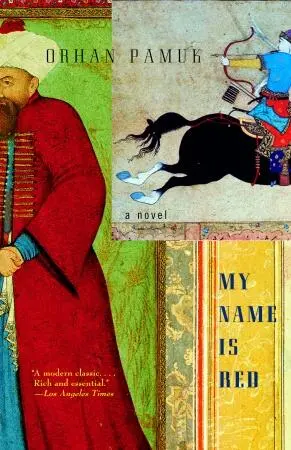
- Название:My Name is Red
- Автор:
- Жанр:
- Год:неизвестен
- ISBN:нет данных
- Рейтинг книги:5 / 5. Голосов: 1
-
Избранное:Добавить в избранное
- Отзывы:
-
Ваша оценка:
My Name is Red: краткое содержание, описание и аннотация
Предлагаем к чтению аннотацию, описание, краткое содержание или предисловие (зависит от того, что написал сам автор книги «My Name is Red»). Если вы не нашли необходимую информацию о книге — напишите в комментариях, мы постараемся отыскать её.
When the Sultan commissions a great book to celebrate his royal self and his extensive dominion, he directs Enishte Effendi to assemble a cadre of the most acclaimed artists in the land. Their task: to illuminate the work in the European style. But because figurative art can be deemed an affront to Islam, this commission is a dangerous proposition indeed, and no one in the elite circle can know the full scope or nature of the project.
Panic erupts when one of the chosen miniaturists disappears, and the Sultan demands answers within three days. The only clue to the mystery-or crime?-lies in the half-finished illuminations themselves. Has an avenging angel discovered the blasphemous work? Or is a jealous contender for the hand of Enishte’s ravishing daughter, the incomparable Shekure, somehow to blame?
Orhan Pamuk’s My Name Is Red is at once a fantasy and a philosophical puzzle, a kaleidoscopic journey to the intersection of art, religion, love, sex, and power.
"Pamuk is a novelist and a great one…My Name is Red is by far the grandest and most astonishing contest in his internal East-West war…It is chock-full of sublimity and sin…The story is told by each of a dozen characters, and now and then by a dog, a tree, a gold coin, several querulous corpses and the color crimson ('My Name is Red')…[Readers will] be lofted by the paradoxical lightness and gaiety of the writing, by the wonderfully winding talk perpetually about to turn a corner, and by the stubborn humanity in the characters' maneuvers to survive. It is a humanity whose lies and silences emerge as endearing and oddly bracing individual truths."- Richard Eder, New York Times Book Review
"A murder mystery set in sixteenth-century Istanbul [that] uses the art of miniature illumination, much as Mann's 'Doctor Faustus' did music, to explore a nation's soul… Erdag Goknar deserves praise for the cool, smooth English in which he has rendered Pamuk's finespun sentences, passionate art appreciations, sly pedantic debates, [and] eerie urban scenes."- John Updike, The New Yorker
"The interweaving of human and philosophical intrigue is very much as I remember it in The Name of the Rose, as is the slow, dense beginning and the relentless gathering of pace… But, in my view, his book is by far the better of the two. I would go so far as to say that Pamuk achieves the very thing his book implies is impossible… More than any other book I can think of, it captures not just Istanbul's past and present contradictions, but also its terrible, timeless beauty. It's almost perfect, in other words. All it needs is the Nobel Prize."-Maureen Freely, New Statesman (UK)
"A perfect example of Pamuk's method as a novelist, which is to combine literary trickery with page-turning readability… As a meditation on art, in particular, My Name is Red is exquisitely subtle, demanding and repaying the closest attention.. We in the West can only feel grateful that such a novelist as Pamuk exists, to act as a bridge between our culture and that of a heritage quite as rich as our own."-Tom Holland, Daily Telegraph (UK)
"Readers… will find themselves lured into a richly described and remarkable world… Reading the novel is like being in a magically exotic dream…Splendidly enjoyable and rewarding… A book in which you can thoroughly immerse yourself." -Allan Massie, The Scotsman (UK)
"A wonderful novel, dreamy, passionate and august, exotic in the most original and exciting way. Orhan Pamuk is indisputably a major novelist."-Philip Hensher, The Spectator (UK)
"[In this] magnificent new novel… Pamuk takes the reader into the strange and beautiful world of Islamic art,in which Western notions no longer make sense… In this world of forgeries, where some might be in danger of losing their faith in literature, Pamuk is the real thing, and this book might well be one of the few recent works of fiction that will be remembered at the end of this century."-Avkar Altinel, The Observer (UK)
My Name is Red — читать онлайн бесплатно полную книгу (весь текст) целиком
Ниже представлен текст книги, разбитый по страницам. Система сохранения места последней прочитанной страницы, позволяет с удобством читать онлайн бесплатно книгу «My Name is Red», без необходимости каждый раз заново искать на чём Вы остановились. Поставьте закладку, и сможете в любой момент перейти на страницу, на которой закончили чтение.
Интервал:
Закладка:
Arrogantly, Kalbiye confirmed that she hadn’t asked after Shekure’s well-being, hadn’t visited to express her condolences or mourn with her, nor could she bring herself to prepare and send any halva. Behind her pride, there also lurked a glee that she couldn’t conceal: The delight that her resentment had been recognized. It was from this point of entry that your sharp-witted Esther attempted to discover the reasons for and circumstances of Kalbiye’s anger.
It didn’t take long for Kalbiye to admit that she’d been upset with the late Enishte Effendi due to the illustrated manuscript he was preparing. She said her husband, may he rest in peace, hadn’t agreed to work on the book for the sake of a handful of extra silver coins, but because Enishte Effendi convinced him the project was authorized by the Sultan. However, when her late husband became aware that the illuminations Enishte Effendi hired him to gild were slowly evolving from simple ornamented pages into full-blown illustrations, pictures moreover that bore the marks of Frankish blasphemy, atheism and even heresy, he grew uneasy and began to lose sight of right and wrong. Being a much more reasonable and prudent person than Elegant Effendi, she cautiously added that all these doubts arose gradually rather than at once, and since poor Elegant Effendi never found anything that would be considered blatant sacrilege, he was able to dismiss his worries as unfounded. Besides, he comforted himself by never missing a sermon given by Nusret Hoja of Erzurum, and if he skipped one of his five daily prayers it unsettled him. Just as he knew that certain scoundrels at the workshop ridiculed his complete devotion to the faith, so he understood very well that their brazen jokes arose out of envy of his talent and artistry.
A large, glimmering tear slid from Kalbiye’s gleaming eye down her cheek, and at the first opportunity, your good-hearted Esther decided to find Kalbiye a better husband than the one she’d recently lost.
“My late husband didn’t often share these concerns of his with me,” Kalbiye said cautiously. “Based on whatever I could remember and piece together I’ve concluded that everything happened on account of the illustrations that took him to Enishte Effendi’s house on his very last night.”
This was some manner of apology. In response, I reminded her how her fate and Shekure’s, not to mention their enemies, were the same if one considered that Enishte Effendi had perhaps been killed by the same “scoundrel.” The two large-headed fatherless waifs staring at me from the corner suggested another similarity between the two women. But my merciless matchmaker’s logic quickly reminded me that Shekure’s situation was much more beautiful, rich and mysterious. I let Kalbiye know exactly what I felt:
“Shekure told me to tell you that if she has wronged you, she’s sorry,” I said. “She wants to say that she loves you as a sister and as a woman who shares her fate. She wants you to think about this and help her. When the late Elegant Effendi left here on his last night, did he mention he’d be seeing anyone besides Enishte Effendi? Did you ever consider that he might’ve been going to meet somebody else?”
“This was found on his person,” she said.
She removed a folded piece of paper from a lidded wicker box, which contained embroidery needles, pieces of cloth and a large walnut.
When I took up the crumpled piece of rough paper and examined it, I saw a variety of shapes drawn in ink that had run and smudged in the well water. I’d just determined what the forms were when Kalbiye voiced my thoughts.
“Horses,” she said. “But late Elegant Effendi only did gilding work. He never drew horses. And no one would’ve ever asked him to render a horse.”
Your elderly Esther was looking at the horses which had been quickly sketched, but she couldn’t quite make anything of them.
“If I were to take this piece of paper to Shekure, she’d be quite pleased,” I said.
“If Shekure desires to see these sketches, let her come get them herself,” said Kalbiye with no small hint of conceit.
I AM CALLED BLACK
Maybe you’ve understood by now that for men like myself, that is, melancholy men for whom love, agony, happiness and misery are just excuses for maintaining eternal loneliness, life offers neither great joy nor great sadness. I’m not saying we can’t relate to other souls overwhelmed by these feelings, on the contrary, we sympathize with them. What we cannot fathom is the odd disquiet our souls sink into at such times. This silent turmoil dims our intellects and dampens our hearts, usurping the place reserved for the true joy and sadness we ought to experience.
I had buried her father, thank God, hurried home from the funeral, and in a gesture of condolence, embraced my wife, Shekure; then suddenly, in a fit of tears she collapsed onto a large cushion with her children, who were glaring at me with spite, and I didn’t know what to do. Her misery coincided with my victory. In one fell swoop, I had wed the dream of my youth, freed myself from her father who belittled me, and become master of the house. Who would ever believe the sincerity of my tears? But believe me, it wasn’t like that. I truly wanted to grieve, but couldn’t: Enishte had always been more of a father to me than my real father. But since the meddlesome preacher who’d performed Enishte’s final ablution never stopped babbling, the rumor that my Enishte died under mysterious circumstances spread among the neighbors during the funeral-as I could sense standing in the courtyard of the mosque. I didn’t want my inability to cry to be interpreted negatively; I don’t have to tell you how real the fear of being branded “stonehearted” is.
You know how some sympathetic aunt will always attest that “he’s crying on the inside” to prevent someone like me from being banished from the group. I did in fact cry on the inside as I tried to hide in a corner from the busybody neighbors and distant relatives with their astonishing abilities to summon a downpour of tears; I thought about being the master of the house and whether I should somehow take charge of the situation, but just then there came a knock at the door. A moment of panic. Was it Hasan? Regardless, I wanted to save myself from this hell of whimpering at whatever cost.
It was a royal page, summoning me to the palace. I was stunned.
As I exited the courtyard, I found a mud-covered silver coin on the ground. Was I afraid to go to the palace? Yes, but I was also happy to be outside in the cold among the horses, dogs, trees and people. I thought I’d befriend the pageboy like those hopeless daydreamers who, believing they might sweeten the world’s cruelty before facing the executioner, attempt a lighthearted conversation with the dungeon guard about this and that, the beauties of life, the ducks afloat on the pond, or the strangeness of a cloud in the sky; but alas he disappointed me, proving a rather morose, pimply, tight-lipped youth. As I passed the Hagia Sophia, noticing with awe the slender cypresses delicately stretching into the hazy sky, it wasn’t the horror of dying right after marrying Shekure after all these years that made my hair stand on end. It was the injustice of dying at the hands of the palace torturers without having shared one good session of lovemaking with her.
We didn’t walk toward the terrifying spires of the Middle Gate, beyond which the torturers and the quick-handed executioners saw to their work, but toward the carpentry shops. As we headed between the granaries, a cat cleaning itself in the mud between the legs of a chestnut horse with steaming nostrils turned but didn’t look at us: The cat was preoccupied with its own filth, much as we were.
Behind the granaries, two figures, whose rank and affiliation I couldn’t determine from their green and purple uniforms, relieved the pageboy, and locked me into the dark room of a small house, which I could tell was new by the smell of fresh lumber. I knew locking a man up in a dark room was meant to arouse fear before torture; hoping they’d begin with the bastinado, I thought about the lies I could tell to save my hide. A crowd in the adjoining room seemed to be raising quite a ruckus.
Читать дальшеИнтервал:
Закладка:
Похожие книги на «My Name is Red»
Представляем Вашему вниманию похожие книги на «My Name is Red» списком для выбора. Мы отобрали схожую по названию и смыслу литературу в надежде предоставить читателям больше вариантов отыскать новые, интересные, ещё непрочитанные произведения.










Обсуждение, отзывы о книге «My Name is Red» и просто собственные мнения читателей. Оставьте ваши комментарии, напишите, что Вы думаете о произведении, его смысле или главных героях. Укажите что конкретно понравилось, а что нет, и почему Вы так считаете.