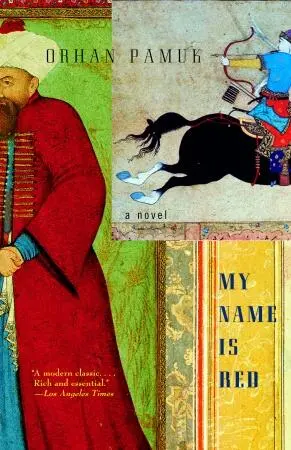
Orhan Pamuk - My Name is Red
Здесь есть возможность читать онлайн «Orhan Pamuk - My Name is Red» весь текст электронной книги совершенно бесплатно (целиком полную версию без сокращений). В некоторых случаях можно слушать аудио, скачать через торрент в формате fb2 и присутствует краткое содержание. Жанр: Современная проза, на английском языке. Описание произведения, (предисловие) а так же отзывы посетителей доступны на портале библиотеки ЛибКат.
- Название:My Name is Red
- Автор:
- Жанр:
- Год:неизвестен
- ISBN:нет данных
- Рейтинг книги:5 / 5. Голосов: 1
-
Избранное:Добавить в избранное
- Отзывы:
-
Ваша оценка:
My Name is Red: краткое содержание, описание и аннотация
Предлагаем к чтению аннотацию, описание, краткое содержание или предисловие (зависит от того, что написал сам автор книги «My Name is Red»). Если вы не нашли необходимую информацию о книге — напишите в комментариях, мы постараемся отыскать её.
When the Sultan commissions a great book to celebrate his royal self and his extensive dominion, he directs Enishte Effendi to assemble a cadre of the most acclaimed artists in the land. Their task: to illuminate the work in the European style. But because figurative art can be deemed an affront to Islam, this commission is a dangerous proposition indeed, and no one in the elite circle can know the full scope or nature of the project.
Panic erupts when one of the chosen miniaturists disappears, and the Sultan demands answers within three days. The only clue to the mystery-or crime?-lies in the half-finished illuminations themselves. Has an avenging angel discovered the blasphemous work? Or is a jealous contender for the hand of Enishte’s ravishing daughter, the incomparable Shekure, somehow to blame?
Orhan Pamuk’s My Name Is Red is at once a fantasy and a philosophical puzzle, a kaleidoscopic journey to the intersection of art, religion, love, sex, and power.
"Pamuk is a novelist and a great one…My Name is Red is by far the grandest and most astonishing contest in his internal East-West war…It is chock-full of sublimity and sin…The story is told by each of a dozen characters, and now and then by a dog, a tree, a gold coin, several querulous corpses and the color crimson ('My Name is Red')…[Readers will] be lofted by the paradoxical lightness and gaiety of the writing, by the wonderfully winding talk perpetually about to turn a corner, and by the stubborn humanity in the characters' maneuvers to survive. It is a humanity whose lies and silences emerge as endearing and oddly bracing individual truths."- Richard Eder, New York Times Book Review
"A murder mystery set in sixteenth-century Istanbul [that] uses the art of miniature illumination, much as Mann's 'Doctor Faustus' did music, to explore a nation's soul… Erdag Goknar deserves praise for the cool, smooth English in which he has rendered Pamuk's finespun sentences, passionate art appreciations, sly pedantic debates, [and] eerie urban scenes."- John Updike, The New Yorker
"The interweaving of human and philosophical intrigue is very much as I remember it in The Name of the Rose, as is the slow, dense beginning and the relentless gathering of pace… But, in my view, his book is by far the better of the two. I would go so far as to say that Pamuk achieves the very thing his book implies is impossible… More than any other book I can think of, it captures not just Istanbul's past and present contradictions, but also its terrible, timeless beauty. It's almost perfect, in other words. All it needs is the Nobel Prize."-Maureen Freely, New Statesman (UK)
"A perfect example of Pamuk's method as a novelist, which is to combine literary trickery with page-turning readability… As a meditation on art, in particular, My Name is Red is exquisitely subtle, demanding and repaying the closest attention.. We in the West can only feel grateful that such a novelist as Pamuk exists, to act as a bridge between our culture and that of a heritage quite as rich as our own."-Tom Holland, Daily Telegraph (UK)
"Readers… will find themselves lured into a richly described and remarkable world… Reading the novel is like being in a magically exotic dream…Splendidly enjoyable and rewarding… A book in which you can thoroughly immerse yourself." -Allan Massie, The Scotsman (UK)
"A wonderful novel, dreamy, passionate and august, exotic in the most original and exciting way. Orhan Pamuk is indisputably a major novelist."-Philip Hensher, The Spectator (UK)
"[In this] magnificent new novel… Pamuk takes the reader into the strange and beautiful world of Islamic art,in which Western notions no longer make sense… In this world of forgeries, where some might be in danger of losing their faith in literature, Pamuk is the real thing, and this book might well be one of the few recent works of fiction that will be remembered at the end of this century."-Avkar Altinel, The Observer (UK)
My Name is Red — читать онлайн бесплатно полную книгу (весь текст) целиком
Ниже представлен текст книги, разбитый по страницам. Система сохранения места последней прочитанной страницы, позволяет с удобством читать онлайн бесплатно книгу «My Name is Red», без необходимости каждый раз заново искать на чём Вы остановились. Поставьте закладку, и сможете в любой момент перейти на страницу, на которой закончили чтение.
Интервал:
Закладка:
“If their houses and workplaces are searched and the missing page turns up with one of my master miniaturists, Black’s innocence will be established at once,” I said. “Frankly, however, I can tell you that my dearest children, my divinely inspired miniaturists, whom I’ve known since they were apprentices, are incapable of taking the life of another man.”
“As for Olive, Stork and Butterfly,” said the Commander, mockingly using the nicknames I’d affectionately given to them, “we intend to comb their homes, haunts, places of work and, if applicable, shops, leaving no stone unturned. And that includes Black…” His expression bespoke resignation: “Given such troublesome circumstances, thank God, the judge has granted us permission to resort to torture if necessary during the interrogation of Black Effendi. Torture was deemed lawfully permissible because a second murder had been committed against someone with a link to the miniaturists guild, making suspects of them all, from apprentice to master.”
I mulled this over silently: 1. The phrase “lawfully permissible” made clear that Our Sultan wasn’t the one who’d granted the permission for torture. 2. Because all the miniaturists were under suspicion of double murder in the eyes of the judge, and because I, though Head Illuminator, had been unable to identify the criminal in our midst, I, too, was suspect. 3. I understood that they wanted my explicit or implicit approval to go ahead with the torture of my beloved Butterfly, Olive, Stork and the others, all of whom, in recent years, had betrayed me.
“Since Our Sultan desires both the satisfactory completion of the Book of Festivities and this book-which is evidently only half finished,” said the Head Treasurer, “we’re worried that torture might damage the masters’ hands and eyes, destroying their agility.” He faced me. “Isn’t this so?”
“There was similar worry over another incident recently,” said the Commander brusquely. “A goldsmith and a jeweler who did repairs fell sway to the Devil. They were childishly enchanted with a ruby-handled coffee cup belonging to Our Sultan’s younger sister Nejmiye Sultan, and ended up stealing it. Since the theft of the cup, which overwhelmed Our Sultan’s sister with grief-she was quite fond of the piece-occurred in the Üsküdar Palace, the Sovereign appointed me to investigate. It became apparent that both Our Sultan and Nejmiye Sultan wanted no harm to come to the eyes and fingers of the master gold- and jewelry smiths lest their skills be affected. So, I had all the master jewelry smiths stripped naked and thrown into the freezing pool in the yard among pieces of ice and frogs. Periodically, I’d have them taken out and lashed forcefully, taking care that their faces and hands remained unharmed. Within a short period, the jeweler who’d been duped by the Devil confessed and accepted his punishment. Despite the ice-cold water, the frozen air and all the lashings, no lasting injury came to the eyes and fingers of the master jewelers because they were pure of heart. Even the Sultan mentioned that His sister was quite pleased with my work and that the jewelers were working with more zeal now that the bad apple was out of the barrel.”
I was certain that the Commander would treat my master illustrators more severely than he had the jewelers. Though he had respect for Our Sultan’s enthusiasm for illuminated manuscripts, like many others, he deemed calligraphy the only respectable art form, belittling embellishment and illustration as flirtations with heresy, fit for women and deserving of nothing but rebuke. In order to provoke me, he said, “While you’ve been absorbed in your work, your beloved miniaturists have already begun scheming to see who’ll become Head Miniaturist upon your death.”
Was this gossip I hadn’t already heard? Had he informed me of something new? Restraining myself, I didn’t respond. The Head Treasurer was more than aware of the fury I felt toward him for commissioning a manuscript from that deceased half-wit behind my back, and toward my ingrate miniaturists, who’d secretly prepared these illustrations to curry favor and earn a few extra silver coins.
I caught myself pondering the methods of torture that might be inflicted. They wouldn’t resort to flaying during the interrogation, because that inevitably leads to death. They wouldn’t impale anyone, either, as they do with rebels, because that’s used as a deterrent. Cracking and splintering the fingers, arms or legs of these miniaturists was also out of the question. Of course, the removal of an eye-which I gathered was a measure of increasing frequency these days, to judge by the growing numbers of one-eyed people on the streets of Istanbul -would be inappropriate for master artists. So, as I imagined my dear miniaturists in a secluded corner of the Royal Private Garden, there in the ice-cold pool among the water lilies, shivering violently and glaring hatefully at one another, I had the passing urge to laugh. Nevertheless, it caused me agony to imagine how Olive would shriek when his hindquarters were branded with a hot iron and how dear Butterfly’s skin would pale when he was shackled. I couldn’t bear to conjure the scene of dear Butterfly-whose skill and love for illumination brought tears to my eyes-as he was given the bastinado like a common thieving apprentice. I just stood there dumbfounded and hollow.
My elderly mind was mute under the spell of its own internal silence. There was a time when we’d paint together with a passion that made us forget everything.
“These men are the most expert miniaturists serving Our Sultan,” I said. “Make certain no harm befalls them.”
Pleased, the Head Treasurer rose, grabbed a number of pages from the worktable at the other end of the room and arranged them in front of me. Next, as if the room were dark, he placed beside me two large candle holders whose portly tapers burned with bobbing and twittering flames so I could study the paintings in question.
How might I explain what I saw as I moved the magnifying lens over them? I felt like laughing-and not because they were humorous. I was incensed-it seemed that Enishte Effendi had instructed my masters as follows: “Don’t paint like yourselves, paint as if you were someone else.” He’d forced them to recall nonexistent memories, to conjure and paint a future, which they’d never want to live. What was even more incredible was that they were killing each other over this nonsense.
“By looking at these illustrations, can you tell me which miniaturist worked on which picture?” asked the Head Treasurer.
“Yes,” I said angrily. “Where did you find these paintings?”
“Black brought them of his own accord and left them with me,” said the Head Treasurer. “He’s bent on proving that he and his late Enishte are innocent.”
“During the interrogation, torture him,” I said. “That way we’ll learn what other secrets our late Enishte was harboring.”
“We’ve sent for him,” said the Commander of the Imperial Guard. “Afterward, we’ll thoroughly search the house of that newlywed.”
Both their faces were strangely illuminated, a flicker of fear and awe overcame them, and they snapped to their feet.
Without having to turn around I knew we were in the presence of His Excellency, Our Sultan, the Refuge of the World.
I AM ESTHER
Oh, how wonderful it is to cry along with the rest of them! While the men were at the funeral of my dear Shekure’s father, the women, kith and kin, spouses and friends, gathered in the house and shed their tears, and I, too, beat my chest in mourning and wept with them. Now wailing in unison with the pretty maiden beside me, leaning on her and swaying back and forth; now crying in a completely different frame of mind, I was deeply touched by my own woes and pitiful life. If I could cry like this just once a week, I thought, I might forget how I had to roam the streets all day just to make ends meet, forget being mocked for my weight and my Jewishness and be reborn an even more chattermouth Esther.
Читать дальшеИнтервал:
Закладка:
Похожие книги на «My Name is Red»
Представляем Вашему вниманию похожие книги на «My Name is Red» списком для выбора. Мы отобрали схожую по названию и смыслу литературу в надежде предоставить читателям больше вариантов отыскать новые, интересные, ещё непрочитанные произведения.









Обсуждение, отзывы о книге «My Name is Red» и просто собственные мнения читателей. Оставьте ваши комментарии, напишите, что Вы думаете о произведении, его смысле или главных героях. Укажите что конкретно понравилось, а что нет, и почему Вы так считаете.