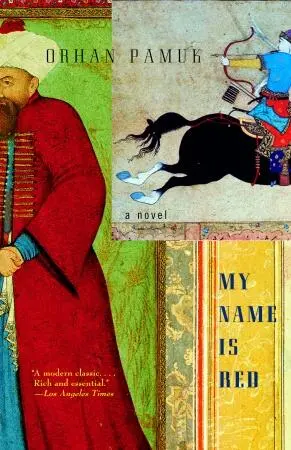
Orhan Pamuk - My Name is Red
Здесь есть возможность читать онлайн «Orhan Pamuk - My Name is Red» весь текст электронной книги совершенно бесплатно (целиком полную версию без сокращений). В некоторых случаях можно слушать аудио, скачать через торрент в формате fb2 и присутствует краткое содержание. Жанр: Современная проза, на английском языке. Описание произведения, (предисловие) а так же отзывы посетителей доступны на портале библиотеки ЛибКат.
- Название:My Name is Red
- Автор:
- Жанр:
- Год:неизвестен
- ISBN:нет данных
- Рейтинг книги:5 / 5. Голосов: 1
-
Избранное:Добавить в избранное
- Отзывы:
-
Ваша оценка:
My Name is Red: краткое содержание, описание и аннотация
Предлагаем к чтению аннотацию, описание, краткое содержание или предисловие (зависит от того, что написал сам автор книги «My Name is Red»). Если вы не нашли необходимую информацию о книге — напишите в комментариях, мы постараемся отыскать её.
When the Sultan commissions a great book to celebrate his royal self and his extensive dominion, he directs Enishte Effendi to assemble a cadre of the most acclaimed artists in the land. Their task: to illuminate the work in the European style. But because figurative art can be deemed an affront to Islam, this commission is a dangerous proposition indeed, and no one in the elite circle can know the full scope or nature of the project.
Panic erupts when one of the chosen miniaturists disappears, and the Sultan demands answers within three days. The only clue to the mystery-or crime?-lies in the half-finished illuminations themselves. Has an avenging angel discovered the blasphemous work? Or is a jealous contender for the hand of Enishte’s ravishing daughter, the incomparable Shekure, somehow to blame?
Orhan Pamuk’s My Name Is Red is at once a fantasy and a philosophical puzzle, a kaleidoscopic journey to the intersection of art, religion, love, sex, and power.
"Pamuk is a novelist and a great one…My Name is Red is by far the grandest and most astonishing contest in his internal East-West war…It is chock-full of sublimity and sin…The story is told by each of a dozen characters, and now and then by a dog, a tree, a gold coin, several querulous corpses and the color crimson ('My Name is Red')…[Readers will] be lofted by the paradoxical lightness and gaiety of the writing, by the wonderfully winding talk perpetually about to turn a corner, and by the stubborn humanity in the characters' maneuvers to survive. It is a humanity whose lies and silences emerge as endearing and oddly bracing individual truths."- Richard Eder, New York Times Book Review
"A murder mystery set in sixteenth-century Istanbul [that] uses the art of miniature illumination, much as Mann's 'Doctor Faustus' did music, to explore a nation's soul… Erdag Goknar deserves praise for the cool, smooth English in which he has rendered Pamuk's finespun sentences, passionate art appreciations, sly pedantic debates, [and] eerie urban scenes."- John Updike, The New Yorker
"The interweaving of human and philosophical intrigue is very much as I remember it in The Name of the Rose, as is the slow, dense beginning and the relentless gathering of pace… But, in my view, his book is by far the better of the two. I would go so far as to say that Pamuk achieves the very thing his book implies is impossible… More than any other book I can think of, it captures not just Istanbul's past and present contradictions, but also its terrible, timeless beauty. It's almost perfect, in other words. All it needs is the Nobel Prize."-Maureen Freely, New Statesman (UK)
"A perfect example of Pamuk's method as a novelist, which is to combine literary trickery with page-turning readability… As a meditation on art, in particular, My Name is Red is exquisitely subtle, demanding and repaying the closest attention.. We in the West can only feel grateful that such a novelist as Pamuk exists, to act as a bridge between our culture and that of a heritage quite as rich as our own."-Tom Holland, Daily Telegraph (UK)
"Readers… will find themselves lured into a richly described and remarkable world… Reading the novel is like being in a magically exotic dream…Splendidly enjoyable and rewarding… A book in which you can thoroughly immerse yourself." -Allan Massie, The Scotsman (UK)
"A wonderful novel, dreamy, passionate and august, exotic in the most original and exciting way. Orhan Pamuk is indisputably a major novelist."-Philip Hensher, The Spectator (UK)
"[In this] magnificent new novel… Pamuk takes the reader into the strange and beautiful world of Islamic art,in which Western notions no longer make sense… In this world of forgeries, where some might be in danger of losing their faith in literature, Pamuk is the real thing, and this book might well be one of the few recent works of fiction that will be remembered at the end of this century."-Avkar Altinel, The Observer (UK)
My Name is Red — читать онлайн бесплатно полную книгу (весь текст) целиком
Ниже представлен текст книги, разбитый по страницам. Система сохранения места последней прочитанной страницы, позволяет с удобством читать онлайн бесплатно книгу «My Name is Red», без необходимости каждый раз заново искать на чём Вы остановились. Поставьте закладку, и сможете в любой момент перейти на страницу, на которой закончили чтение.
Интервал:
Закладка:
3. Seeing the masterpieces of the old masters of Herat -this cannot be explained to the uninitiated.
The simple meaning of all of this: In Our Sultan’s workshop, which I direct, magnificent works of art can no longer be made as they once were-and the situation will only get worse, everything will dwindle and disappear. I am painfully aware that we quite rarely reach the sublime level of the old masters of Herat, despite having lovingly sacrificed our entire lives to this work. Humbly accepting this truth makes life easier. Indeed, it is precisely because it makes life easier that modesty is such a highly prized virtue in our part of the world.
With an air of such modesty I was touching up an illustration in the Book of Festivities , which described the circumcision ceremonies of our prince, wherein was depicted the Egyptian Governor-General’s presentation of the following gifts: a gold-chased sword decorated with rubies, emeralds, and turquoise on a swatch of red velvet and one of the Governor-General’s proud, lightning fast and spirited Arabian horses with a white blaze on its nose and a silvery, gleaming coat, fully appointed with a gold bit and reins, stirrups of pearl and greenish-yellow chrysoberyl, and a red velvet saddle embellished with silver thread and ruby rosettes. With a flick of my brush, here and there, I was touching up the illustration, whose composition I had arranged while delegating the rendering of the horse, the sword, the prince and the spectator-ambassadors to various apprentices. I applied purple to some of the leaves of the plane tree in the Hippodrome. I dabbed yellow upon the caftan-buttons of the Tatar Khan’s ambassador. As I was brushing a sparse amount of gold wash onto the horse’s reins, somebody knocked at the door. I quit what I was doing.
It was an imperial pageboy. The Head Treasurer had summoned me to the palace. My eyes ached ever so mildly. I placed my magnifying lens in my pocket, and left with the boy.
Oh, how nice it is to walk through the streets after having worked without a break for so long! At such times, the whole world strikes one as original and stunning, as if Allah had created it all the day before.
I noticed a dog, more meaningful than all the pictures of dogs I’d ever seen. I saw a horse, a lesser creation than what my master miniaturists might make. I spied a plane tree in the Hippodrome, the same tree whose leaves I’d just now accented with tones of purple.
Strolling through the Hippodrome, whose parades I’d illustrated over the last two years, was like stepping into my own painting. Let’s say we were to turn down a street: In a Frankish painting, this would result in our stepping outside both the frame and the painting; in a painting made following the example of the great masters of Herat, it’d bring us to the place from which Allah looks upon us; in a Chinese painting, we’d be trapped, because Chinese illustrations are infinite.
The pageboy, I discovered, wasn’t taking me to the Divan Chamber where I often met with the Head Treasurer to discuss one of the following: the manuscripts and ornamented ostrich eggs or other gifts my miniaturists were preparing for Our Sultan; the health of the illustrators or the Head Treasurer’s own constitution and peace of mind; the acquisition of paint, gold leaf or other materials; the usual complaints and requests; the desires, delights, demands and disposition of the Refuge of the World, Our Sultan; my eyesight, my looking glasses or my lumbago; or the Head Treasurer’s good-for-nothing son-in-law or the health of his tabby cat. Silently, we entered the Sultan’s Private Garden. As if committing a crime, but with great delicacy, we serenely descended toward the sea through the trees. “We’re nearing the Sea-Side Kiosk,” I thought, “this means I will see the Sultan. His Excellency must be here.” But we turned off the path. We walked ahead a few steps through the arched doorway of a stone building behind the rowboat and caïque sheds. I could smell the scent of baking bread wafting from the guard’s bakery before catching sight of the Imperial Guard themselves in their red uniforms.
The Head Treasurer and the Commander of the Imperial Guard were together in one room: Angel and Devil!
The Commander, who performed executions in the name of Our Sultan on the palace grounds-who tortured, interrogated, beat, blinded and administered the bastinado-smiled sweetly at me. It was as if some piddling lodger, with whom I was forced to share a caravansary cell, were going to recount a heart-warming story.
The Head Treasurer diffidently said, “Our Sultan, one year prior, charged me with having an illuminated manuscript prepared under conditions of the utmost privacy, a manuscript that would be included among the gifts meant for an ambassadorial delegation. In light of the secrecy of the book, His Excellency did not deem it appropriate that Master Lokman the Royal Historian be enlisted to write the manuscript. Similarly, He did not venture to involve you, whose artistry He quite admires. Indeed, He supposed that you were already fully engaged with the Book of Festivities .”
Upon entering this room I had abruptly assumed that some wretch had slandered me, claiming that I was committing heresy in such-and-such an illustration and that I’d lampooned the Sovereign in another; I imagined with horror that this tattler had been able to convince the Sovereign of my guilt and that I was about to be laid out for torture with no consideration for my age. And so to hear that the Head Treasurer was simply trying to make amends for Our Sultan’s having commissioned a manuscript from an outsider-these words were sweeter than honey indeed. Without learning anything new, I listened to an account of the manuscript, about which I was already well aware. I was privy to the rumors about Nusret Hoja of Erzurum, and naturally, to the intrigues within the workshop.
“Who is responsible for preparing the manuscript?” I asked.
“Enishte Effendi, as you know,” said the Head Treasurer. Fixing his gaze into my eyes, he added, “You were aware that he died an untimely death, that is to say, that he was murdered, weren’t you?”
“Nay,” I said simply, like a child, and fell quiet.
“Our Sultan is quite furious,” the Head Treasurer said.
That Enishte Effendi was a dunce. The master miniaturists always mocked him for being more pretentious than knowledgeable, more ambitious than intelligent. I knew something was rotten at the funeral anyway. How was he killed, I wondered?
The Head Treasurer explained exactly how. Appalling. Dear God protect us. Yet who could be responsible?
“The Sultan has decreed,” said the Head Treasurer, “that the book in question should be finished as soon as possible, as with the Book of Festivities manuscript…”
“He has also made a second decree,” said the Commander of the Imperial Guard. “If, indeed, this unspeakable murderer is one of the miniaturists, He wants the black-hearted devil found. He intends to sentence him to a punishment such as will stand as a deterrent to one and all.”
An expression of such excitement appeared on the face of the Commander as if to suggest he already knew the monstrous punishment Our Sultan had decreed.
I knew that Our Sultan had only recently charged these two men with this task, thereby forcing them to cooperate-on which account they couldn’t hide their distaste even now. Seeing this inspired in me a love for the Sultan that went beyond mere awe. A servant boy served coffee and we sat for a while.
I was told that Enishte Effendi had a nephew named Black Effendi whom he’d cultivated, a man trained in illumination and book arts. Had I met him? I remained silent. A short while ago, upon the invitation of his Enishte, Black had returned from the Persian front, where he was under Serhat Pasha’s command-the Commander shot me a look of suspicion. Here, in Istanbul, he worked himself into his Enishte’s good graces and learned the story of the book whose creation Enishte was overseeing. Black claimed that after Elegant Effendi was killed, Enishte suspected one of the master miniaturists who visited him at night to work on this manuscript. He’d seen the illustrations these masters had made and said that Enishte’s murderer-the selfsame painter who stole the Sultan’s illustration with the lion’s share of gold leaf-was one of them. For two days, this young Black Effendi had concealed the death of Enishte from the palace and the Head Treasurer. Within that very two-day period, he’d rushed ahead with a marriage to Enishte’s daughter, an ethically and religiously dubious affair, and settled into Enishte’s house; thus, both the men before me considered Black a suspect.
Читать дальшеИнтервал:
Закладка:
Похожие книги на «My Name is Red»
Представляем Вашему вниманию похожие книги на «My Name is Red» списком для выбора. Мы отобрали схожую по названию и смыслу литературу в надежде предоставить читателям больше вариантов отыскать новые, интересные, ещё непрочитанные произведения.







Обсуждение, отзывы о книге «My Name is Red» и просто собственные мнения читателей. Оставьте ваши комментарии, напишите, что Вы думаете о произведении, его смысле или главных героях. Укажите что конкретно понравилось, а что нет, и почему Вы так считаете.