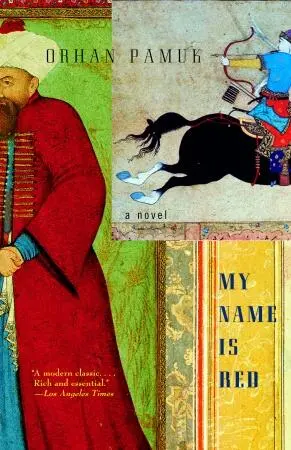
Orhan Pamuk - My Name is Red
Здесь есть возможность читать онлайн «Orhan Pamuk - My Name is Red» весь текст электронной книги совершенно бесплатно (целиком полную версию без сокращений). В некоторых случаях можно слушать аудио, скачать через торрент в формате fb2 и присутствует краткое содержание. Жанр: Современная проза, на английском языке. Описание произведения, (предисловие) а так же отзывы посетителей доступны на портале библиотеки ЛибКат.
- Название:My Name is Red
- Автор:
- Жанр:
- Год:неизвестен
- ISBN:нет данных
- Рейтинг книги:5 / 5. Голосов: 1
-
Избранное:Добавить в избранное
- Отзывы:
-
Ваша оценка:
My Name is Red: краткое содержание, описание и аннотация
Предлагаем к чтению аннотацию, описание, краткое содержание или предисловие (зависит от того, что написал сам автор книги «My Name is Red»). Если вы не нашли необходимую информацию о книге — напишите в комментариях, мы постараемся отыскать её.
When the Sultan commissions a great book to celebrate his royal self and his extensive dominion, he directs Enishte Effendi to assemble a cadre of the most acclaimed artists in the land. Their task: to illuminate the work in the European style. But because figurative art can be deemed an affront to Islam, this commission is a dangerous proposition indeed, and no one in the elite circle can know the full scope or nature of the project.
Panic erupts when one of the chosen miniaturists disappears, and the Sultan demands answers within three days. The only clue to the mystery-or crime?-lies in the half-finished illuminations themselves. Has an avenging angel discovered the blasphemous work? Or is a jealous contender for the hand of Enishte’s ravishing daughter, the incomparable Shekure, somehow to blame?
Orhan Pamuk’s My Name Is Red is at once a fantasy and a philosophical puzzle, a kaleidoscopic journey to the intersection of art, religion, love, sex, and power.
"Pamuk is a novelist and a great one…My Name is Red is by far the grandest and most astonishing contest in his internal East-West war…It is chock-full of sublimity and sin…The story is told by each of a dozen characters, and now and then by a dog, a tree, a gold coin, several querulous corpses and the color crimson ('My Name is Red')…[Readers will] be lofted by the paradoxical lightness and gaiety of the writing, by the wonderfully winding talk perpetually about to turn a corner, and by the stubborn humanity in the characters' maneuvers to survive. It is a humanity whose lies and silences emerge as endearing and oddly bracing individual truths."- Richard Eder, New York Times Book Review
"A murder mystery set in sixteenth-century Istanbul [that] uses the art of miniature illumination, much as Mann's 'Doctor Faustus' did music, to explore a nation's soul… Erdag Goknar deserves praise for the cool, smooth English in which he has rendered Pamuk's finespun sentences, passionate art appreciations, sly pedantic debates, [and] eerie urban scenes."- John Updike, The New Yorker
"The interweaving of human and philosophical intrigue is very much as I remember it in The Name of the Rose, as is the slow, dense beginning and the relentless gathering of pace… But, in my view, his book is by far the better of the two. I would go so far as to say that Pamuk achieves the very thing his book implies is impossible… More than any other book I can think of, it captures not just Istanbul's past and present contradictions, but also its terrible, timeless beauty. It's almost perfect, in other words. All it needs is the Nobel Prize."-Maureen Freely, New Statesman (UK)
"A perfect example of Pamuk's method as a novelist, which is to combine literary trickery with page-turning readability… As a meditation on art, in particular, My Name is Red is exquisitely subtle, demanding and repaying the closest attention.. We in the West can only feel grateful that such a novelist as Pamuk exists, to act as a bridge between our culture and that of a heritage quite as rich as our own."-Tom Holland, Daily Telegraph (UK)
"Readers… will find themselves lured into a richly described and remarkable world… Reading the novel is like being in a magically exotic dream…Splendidly enjoyable and rewarding… A book in which you can thoroughly immerse yourself." -Allan Massie, The Scotsman (UK)
"A wonderful novel, dreamy, passionate and august, exotic in the most original and exciting way. Orhan Pamuk is indisputably a major novelist."-Philip Hensher, The Spectator (UK)
"[In this] magnificent new novel… Pamuk takes the reader into the strange and beautiful world of Islamic art,in which Western notions no longer make sense… In this world of forgeries, where some might be in danger of losing their faith in literature, Pamuk is the real thing, and this book might well be one of the few recent works of fiction that will be remembered at the end of this century."-Avkar Altinel, The Observer (UK)
My Name is Red — читать онлайн бесплатно полную книгу (весь текст) целиком
Ниже представлен текст книги, разбитый по страницам. Система сохранения места последней прочитанной страницы, позволяет с удобством читать онлайн бесплатно книгу «My Name is Red», без необходимости каждый раз заново искать на чём Вы остановились. Поставьте закладку, и сможете в любой момент перейти на страницу, на которой закончили чтение.
Интервал:
Закладка:
Accompanied by a royal page who’d attached himself to us, we fearfully and silently, as in a dream, passed the Divan building and the Treasury; I felt that I’d seen this place before and knew it well.
We entered through a wide door into a room that was referred to as the Old Divan Chamber. Beneath its huge dome, I saw master artisans holding cloth, pieces of leather, silver scabbards and mother-of-pearl inlaid chests. I inferred that these men were from Our Sultan’s craftsmen’s guilds: mace makers, boot makers, silversmiths, master velvet makers, ivory engravers, and luthiers. They were all waiting outside the Head Treasurer’s door with various petitions concerning payments, the acquisition of materials and requests to enter the Sultan’s forbidden private quarters to take measurements. I was pleased to discover no illuminators among them.
We withdrew to one side and began to wait as well. Occasionally, we heard the raised voice of the treasurer’s clerk, suspecting an error in accounts, request clarification; this would be met by a polite response, from a locksmith, for example. Voices rarely rose above a whisper; the flutter of the courtyard pigeons echoing in the dome above us were louder than the petty requests of the humble artisans.
When my turn came, I entered the Head Treasurer’s small domed chamber to find it occupied by a single clerk. I quickly explained that there was an important matter to be submitted to the Head Treasurer’s attention: A book project that Our Sultan had commissioned and that was of utmost importance to Him. Intrigued by what I was holding, the clerk raised his eyes. I showed him the illustrations from my Enishte’s book. I noticed that the peculiarity of the pictures, their striking eccentricity, boggled his mind. I hastened to inform him of my Enishte’s name, his sobriquet and his vocation, adding that he’d died on account of these pictures. I spoke quickly, well aware that if I returned from the palace without reaching Our Sultan, I’d be accused of having put Enishte into that dreadful state myself.
When the clerk left to apprise the Head Treasurer, I broke into a cold sweat. Would the Head Treasurer, who, as my Enishte once informed me, never left Our Sultan’s side, who on occasion even spread out His prayer rug for Him, and who was frequently His confidant-would he ever leave the restricted Enderun quarters of the palace to see me? The fact that a messenger had been dispatched to the heart of the palace on my behalf was unbelievable enough. I wondered where Our Excellency the Sultan Himself might be: Had He retired to one of the kiosks near the shore? Was He in the harem? Was the Head Treasurer in His company?
Much later, I was summoned. Let me put it this way: I was taken so unawares I had no time to be afraid. Even so, I panicked when I saw the respect and astonishment in the expression of the master velvet maker standing at the door. I stepped inside and was at once terrified; I thought I’d be unable to speak. He wore the gold embroidered headdress that only he and the Grand Viziers wore; yes, I was in the presence of the Head Treasurer. He was gazing upon the illustrations that rested on a reading table where the clerk had placed them after taking them from me. I felt as if I were the one who’d made the paintings. I kissed the hem of his robe.
“My dear child,” he said. “I haven’t misunderstood, have I, your Enishte has passed away?”
I couldn’t answer out of excitement, or perhaps guilt, and simply nodded. At the same time the completely unexpected happened: There before the sympathetic and surprised gaze of the Head Treasurer, a teardrop slid ever so slowly down my cheek. I was at a loss; I was oddly affected by being in the palace, by the Head Treasurer having taken leave of Our Sultan to speak to me and by being so near to Him. Tears began to stream from my eyes, but I didn’t feel the slightest tinge of embarrassment.
“Cry to your heart’s content, my dear son,” said the Head Treasurer.
I sobbed and whimpered. Though I’d assumed the past twelve years had matured me, being this close to the Sultan, to the heart of the Empire, one fast realizes he is but a child. I cared not whether the silversmiths and velvet makers outside heard my sobbing. I knew I’d confess to the Head Treasurer.
Yes, I told him all, just as it came to me. As I once again saw my dead Enishte, my marriage to Shekure, Hasan’s threats, the difficulties relating my Enishte’s book and the secrets borne by the illustrations, I regained my composure. I felt certain that the only way to extricate myself from the trap I’d fallen into was to put myself at the mercy of the infinite justice and affection of Our Sultan, Refuge of the World, and so I withheld nothing. Before digesting all that I said and handing me over to the torturers and executioners, would the Head Treasurer convey my story directly to Our Sultan?
“Let Enishte Effendi’s death be announced in the workshop without delay,” said the Head Treasurer. “I want the entire artists’ guild to attend his funeral.”
He looked at me to ascertain whether I might have any objections. Emboldened by his interest, I expressed my concerns about the culprit, and the possible motive behind the deaths of my Enishte and the gilder Elegant Effendi. I hinted that the followers of the preacher from Erzurum and those who were targeting dervish houses where music was played and men danced might be involved. When I saw the doubtful expression of the Head Treasurer, I eagerly shared my other suspicions: I informed him that the monetary rewards and honor involved in being invited to illustrate and illuminate Enishte Effendi’s book had likely led to unavoidable competition and jealousy among the masters. The secrecy of the project alone could very well have instigated these hatreds, grudges and intrigues. As the words left my mouth, I sensed nervously that the Head Treasurer had somehow grown suspicious of me-the way you have as well. My dear Allah, let justice be done, that is all I ask, nothing more.
Within the ensuing silence, the Head Treasurer cast his glance away from me, as if embarrassed on my behalf for my words and my destiny, and fixed his attention on the pictures resting on the folding table.
“There are nine plates here,” he said. “The arrangement had been for a book with ten illustrations. Enishte Effendi took more gold leaf from us than has been used here.”
“That murdering heretic must have stolen the last illustration, upon which much of the gold was applied,” I said.
“You haven’t told us who the calligrapher-scribe might be.”
“My late Enishte hadn’t yet completed the book’s text. He was anticipating my help in its completion.”
“My dear child, you’ve just explained how you’re newly arrived in Istanbul.”
“It’s been one week. I arrived three days after Elegant Effendi was killed.”
“You mean to say that your Enishte Effendi has been illustrating an unwritten-a nonexistent-manuscript for an entire year?”
“Yes, sir.”
“Had he, then, revealed to you what the book was to recount?”
“Precisely what Our Sultan stated He wanted: A book that depicted the thousandth year of the Muslim calendar, which would strike terror into the heart of the Venetian Doge by showing the military strength and pride of Islam, together with the power and wealth of the Exalted House of Osman. This was intended to be a book recounting and depicting the most valuable, most vital aspects of our realm; and just as with the Treatises on Physiognomy , a portrait of Our Sultan would be situated at the heart of the book. Furthermore, since the illustrations were made in the Frankish style using Frankish methods, they would arouse the awe of the Venetian Doge and his desire for friendship.”
Читать дальшеИнтервал:
Закладка:
Похожие книги на «My Name is Red»
Представляем Вашему вниманию похожие книги на «My Name is Red» списком для выбора. Мы отобрали схожую по названию и смыслу литературу в надежде предоставить читателям больше вариантов отыскать новые, интересные, ещё непрочитанные произведения.









Обсуждение, отзывы о книге «My Name is Red» и просто собственные мнения читателей. Оставьте ваши комментарии, напишите, что Вы думаете о произведении, его смысле или главных героях. Укажите что конкретно понравилось, а что нет, и почему Вы так считаете.