Orhan Pamuk - My Name is Red
Здесь есть возможность читать онлайн «Orhan Pamuk - My Name is Red» весь текст электронной книги совершенно бесплатно (целиком полную версию без сокращений). В некоторых случаях можно слушать аудио, скачать через торрент в формате fb2 и присутствует краткое содержание. Жанр: Современная проза, на английском языке. Описание произведения, (предисловие) а так же отзывы посетителей доступны на портале библиотеки ЛибКат.
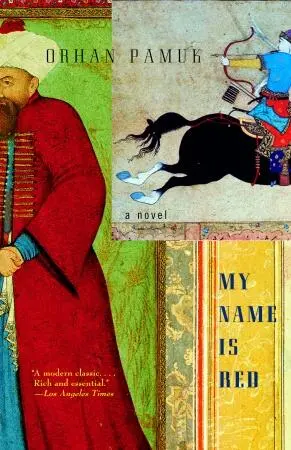
- Название:My Name is Red
- Автор:
- Жанр:
- Год:неизвестен
- ISBN:нет данных
- Рейтинг книги:5 / 5. Голосов: 1
-
Избранное:Добавить в избранное
- Отзывы:
-
Ваша оценка:
My Name is Red: краткое содержание, описание и аннотация
Предлагаем к чтению аннотацию, описание, краткое содержание или предисловие (зависит от того, что написал сам автор книги «My Name is Red»). Если вы не нашли необходимую информацию о книге — напишите в комментариях, мы постараемся отыскать её.
When the Sultan commissions a great book to celebrate his royal self and his extensive dominion, he directs Enishte Effendi to assemble a cadre of the most acclaimed artists in the land. Their task: to illuminate the work in the European style. But because figurative art can be deemed an affront to Islam, this commission is a dangerous proposition indeed, and no one in the elite circle can know the full scope or nature of the project.
Panic erupts when one of the chosen miniaturists disappears, and the Sultan demands answers within three days. The only clue to the mystery-or crime?-lies in the half-finished illuminations themselves. Has an avenging angel discovered the blasphemous work? Or is a jealous contender for the hand of Enishte’s ravishing daughter, the incomparable Shekure, somehow to blame?
Orhan Pamuk’s My Name Is Red is at once a fantasy and a philosophical puzzle, a kaleidoscopic journey to the intersection of art, religion, love, sex, and power.
"Pamuk is a novelist and a great one…My Name is Red is by far the grandest and most astonishing contest in his internal East-West war…It is chock-full of sublimity and sin…The story is told by each of a dozen characters, and now and then by a dog, a tree, a gold coin, several querulous corpses and the color crimson ('My Name is Red')…[Readers will] be lofted by the paradoxical lightness and gaiety of the writing, by the wonderfully winding talk perpetually about to turn a corner, and by the stubborn humanity in the characters' maneuvers to survive. It is a humanity whose lies and silences emerge as endearing and oddly bracing individual truths."- Richard Eder, New York Times Book Review
"A murder mystery set in sixteenth-century Istanbul [that] uses the art of miniature illumination, much as Mann's 'Doctor Faustus' did music, to explore a nation's soul… Erdag Goknar deserves praise for the cool, smooth English in which he has rendered Pamuk's finespun sentences, passionate art appreciations, sly pedantic debates, [and] eerie urban scenes."- John Updike, The New Yorker
"The interweaving of human and philosophical intrigue is very much as I remember it in The Name of the Rose, as is the slow, dense beginning and the relentless gathering of pace… But, in my view, his book is by far the better of the two. I would go so far as to say that Pamuk achieves the very thing his book implies is impossible… More than any other book I can think of, it captures not just Istanbul's past and present contradictions, but also its terrible, timeless beauty. It's almost perfect, in other words. All it needs is the Nobel Prize."-Maureen Freely, New Statesman (UK)
"A perfect example of Pamuk's method as a novelist, which is to combine literary trickery with page-turning readability… As a meditation on art, in particular, My Name is Red is exquisitely subtle, demanding and repaying the closest attention.. We in the West can only feel grateful that such a novelist as Pamuk exists, to act as a bridge between our culture and that of a heritage quite as rich as our own."-Tom Holland, Daily Telegraph (UK)
"Readers… will find themselves lured into a richly described and remarkable world… Reading the novel is like being in a magically exotic dream…Splendidly enjoyable and rewarding… A book in which you can thoroughly immerse yourself." -Allan Massie, The Scotsman (UK)
"A wonderful novel, dreamy, passionate and august, exotic in the most original and exciting way. Orhan Pamuk is indisputably a major novelist."-Philip Hensher, The Spectator (UK)
"[In this] magnificent new novel… Pamuk takes the reader into the strange and beautiful world of Islamic art,in which Western notions no longer make sense… In this world of forgeries, where some might be in danger of losing their faith in literature, Pamuk is the real thing, and this book might well be one of the few recent works of fiction that will be remembered at the end of this century."-Avkar Altinel, The Observer (UK)
My Name is Red — читать онлайн бесплатно полную книгу (весь текст) целиком
Ниже представлен текст книги, разбитый по страницам. Система сохранения места последней прочитанной страницы, позволяет с удобством читать онлайн бесплатно книгу «My Name is Red», без необходимости каждый раз заново искать на чём Вы остановились. Поставьте закладку, и сможете в любой момент перейти на страницу, на которой закончили чтение.
Интервал:
Закладка:
“Did you kill my grandfather?” shouted Shevket.
“If you’re going to upset your mother, don’t expect any affection from me!” I shouted back.
We didn’t shout at each other like stepfather and stepson, but like two men talking by the banks of a loud rushing river. Shekure stepped out into the hallway and was forcing the wooden slats of the window trying to throw open the shutters so her shouts could be better heard throughout the neighborhood.
I left the room to join her. We both tried to force the window. With a final combined effort, the shutters came loose and fell into the courtyard. Sunlight and cold struck our faces and we were stunned momentarily. Shekure screamed, crying her heart out.
Enishte Effendi’s death, once announced by her cries, turned into a much more tragic and agonizing pain. Whether sincere or feigned, my wife’s crying tormented me. Unexpectedly, I began to weep. I didn’t even know if I was crying sincerely out of grief or was merely pretending for fear of being held responsible for my Enishte’s death.
“He’s gone, gone, gone, my dear father’s gone!” cried Shekure.
My sobs and laments mimicked hers, though I didn’t exactly know what I was saying. I was worried about how I looked to the neighbors staring at us from their houses, from behind cracked doors and between shutter slats, and wondered how fitting my behavior was. As I cried, I felt purged of doubts about whether my agony was genuine, of apprehensions about being accused of murder and of the fear of Hasan and his men.
Shekure was mine and it was as if I were celebrating with shouts and tears. I drew my sobbing wife close to me, and without paying any heed to the tearful children approaching us, I lovingly kissed her cheek and inhaled the scent of the almond trees of our youth.
Together with the children, we walked back to where the body lay. I said, “ La ilahe illallah , there is no God but Allah” as though addressing not a reeking two-day-old corpse but a dying man whom I wanted to reaffirm the words of witness; I wanted my Enishte to go to Heaven with these words on his lips. We pretended that he’d repeated them, and smiled for a moment as we gazed at his nearly destroyed face and battered head. I opened my palms to Heaven and recited from the “Ya Sin” chapter while the others listened quietly. With a clean piece of gauze that Shekure brought into the room, we carefully bound my Enishte’s mouth shut, tenderly closed his ravaged eyes and gently rolled him over onto his right side, arranging his head so it faced Mecca. Shekure spread a clean white sheet over her father.
I was pleased that the children were watching everything so intensely and by the quiet that followed the wailing. I felt like somebody with a real wife and children, with a hearth and home.
One by one, I collected the pictures into a portfolio, donned my heavy caftan and hastily fled the house. I headed directly for the neighborhood mosque, pretending not to see one of the neighbors-an elderly woman with a snot-nosed grandchild who was clearly jubilant about all the sudden activity: They’d heard our cries and had eagerly come to enjoy our pain.
The tiny hole in the wall that the preacher called his “house” was embarrassingly small next to the ostentatious structure with its enormous domes and expansive courtyard, typical of the mosques that were being constructed lately. The preacher, in what I’d observed as a custom of increasing frequency, was extending the boundaries of his cold, little rat hole of a “home,” and had usurped the entire mosque, without the least concern over the faded and dingy wash his wife had hung between two chestnut trees at the edge of the courtyard. We avoided the attacks of two brutish dogs that had claimed the courtyard, just like the Imam Effendi and his family, and after the preacher’s sons chased the beasts away with sticks and excused themselves, the preacher and I retired to a private corner.
After yesterday’s divorce proceedings, and in light of the fact that we hadn’t asked him to perform the wedding ceremony, which I was certain had upset him, I could read a “For goodness sake, what brings you here now?” upon his face.
“Enishte Effendi passed away this morning.”
“May God have mercy upon him. May he find a home in Heaven!” he said benevolently. Why had I senselessly implicated myself by tacking the words “this morning” onto my statement? I dropped another gold piece into his hand, identical to the ones I’d given him yesterday. I requested that he recite the death prayer before the azan and appoint his brother as crier to go around announcing the death to the entire neighborhood.
“My brother has a dear friend who is half blind; together, we are expert at carrying out the final ablutions of the deceased,” he said.
What could be more suitable than having a blind man and a half-wit wash Enishte Effendi’s body? I explained to him that the ritual funeral prayer would be performed in the afternoon and that notables and crowds from the palace, the guilds and theological schools would be attending. I didn’t attempt to explain the state of Enishte Effendi’s face and battered head, having long decided that the matter needed to be addressed at a higher level.
Since Our Sultan had entrusted the balance of the funds for the book that He’d commissioned from my Enishte to the Head Treasurer, I had to report the death to him before anyone else. To this end, I sought out an upholsterer, a relative on my late father’s side, who’d worked in the tailors’ work stalls opposite Coldfountain Gate ever since I was a child. When I found him, I kissed his mottled hand and explained imploringly that I needed to see the Head Treasurer. He had me wait among his balding apprentices who were sewing curtains, doubled over the multicolored silk spread over their laps; then, he had me follow a head tailor’s assistant who, I learned, was going to the palace to take measurements. When we climbed up to the Parade Square through Coldfountain Gate I knew I’d be able to avoid passing the workshop opposite the Hagia Sophia; and thus, I was spared from announcing the crime to the other miniaturists.
The Parade Square seemed abustle now, whereas it usually seemed empty to me. Though there wasn’t a single person at the Petitioner’s Gate, before which petitioners would line up on days when the Divan convened, nor anyone in the vicinity of the granaries, it was as if I could hear a continuous din emanating from the windows of the sick house, from the carpenters’ workshop, the bakery, the stables, the grooms with their horses before the Second Gate (whose spires I looked upon with awe) and from among the cypresses. I attributed my sense of alarm to the fear of passing through the Gate of Salutation, or Second Gate, which I would soon be doing for the first time in my life.
At the gate, I could neither focus my attention on the spot where the executioners were said to be ever at the ready, nor could I hide my agitation from the keepers of the gate who glanced inquiringly at the bolt of upholstery cloth I carried as a prop so onlookers would assume I was assisting my tailor-cum-guide.
As soon as we entered the Divan Square, a deep silence enveloped us. I felt my heart pounding even in the veins of my forehead and neck. This area, so often described by my Enishte and others who visited the palace, lay before me like a heavenly garden of unequaled beauty. Yet, I didn’t feel the elation of a man who’d entered Heaven, just trepidation and pious reverence; I felt myself to be a simple servant of Our Sultan, who, as I now thoroughly understood, was indeed the foundation of this worldly realm. I stared at the peacocks roaming through the greenery, the gold cups chained to splashing fountains and the Grand Vizier’s heralds robed in silk (who seemed to move about without touching the ground), and I felt the thrill of serving my Sovereign. There was no doubt that I would complete Our Sultan’s secret book, whose unfinished illustrations I carried under my arm. Without knowing exactly what I was doing, I trailed behind the tailor, my eyes fixed on the Divan Tower, spellbound by fear more than awe now at its proximity.
Читать дальшеИнтервал:
Закладка:
Похожие книги на «My Name is Red»
Представляем Вашему вниманию похожие книги на «My Name is Red» списком для выбора. Мы отобрали схожую по названию и смыслу литературу в надежде предоставить читателям больше вариантов отыскать новые, интересные, ещё непрочитанные произведения.










Обсуждение, отзывы о книге «My Name is Red» и просто собственные мнения читателей. Оставьте ваши комментарии, напишите, что Вы думаете о произведении, его смысле или главных героях. Укажите что конкретно понравилось, а что нет, и почему Вы так считаете.