Orhan Pamuk - My Name is Red
Здесь есть возможность читать онлайн «Orhan Pamuk - My Name is Red» весь текст электронной книги совершенно бесплатно (целиком полную версию без сокращений). В некоторых случаях можно слушать аудио, скачать через торрент в формате fb2 и присутствует краткое содержание. Жанр: Современная проза, на английском языке. Описание произведения, (предисловие) а так же отзывы посетителей доступны на портале библиотеки ЛибКат.
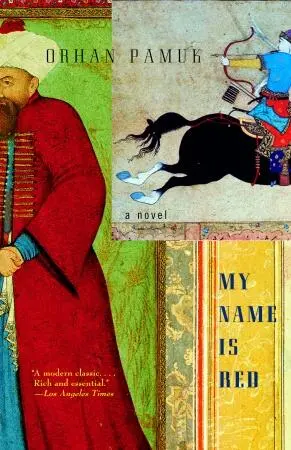
- Название:My Name is Red
- Автор:
- Жанр:
- Год:неизвестен
- ISBN:нет данных
- Рейтинг книги:5 / 5. Голосов: 1
-
Избранное:Добавить в избранное
- Отзывы:
-
Ваша оценка:
My Name is Red: краткое содержание, описание и аннотация
Предлагаем к чтению аннотацию, описание, краткое содержание или предисловие (зависит от того, что написал сам автор книги «My Name is Red»). Если вы не нашли необходимую информацию о книге — напишите в комментариях, мы постараемся отыскать её.
When the Sultan commissions a great book to celebrate his royal self and his extensive dominion, he directs Enishte Effendi to assemble a cadre of the most acclaimed artists in the land. Their task: to illuminate the work in the European style. But because figurative art can be deemed an affront to Islam, this commission is a dangerous proposition indeed, and no one in the elite circle can know the full scope or nature of the project.
Panic erupts when one of the chosen miniaturists disappears, and the Sultan demands answers within three days. The only clue to the mystery-or crime?-lies in the half-finished illuminations themselves. Has an avenging angel discovered the blasphemous work? Or is a jealous contender for the hand of Enishte’s ravishing daughter, the incomparable Shekure, somehow to blame?
Orhan Pamuk’s My Name Is Red is at once a fantasy and a philosophical puzzle, a kaleidoscopic journey to the intersection of art, religion, love, sex, and power.
"Pamuk is a novelist and a great one…My Name is Red is by far the grandest and most astonishing contest in his internal East-West war…It is chock-full of sublimity and sin…The story is told by each of a dozen characters, and now and then by a dog, a tree, a gold coin, several querulous corpses and the color crimson ('My Name is Red')…[Readers will] be lofted by the paradoxical lightness and gaiety of the writing, by the wonderfully winding talk perpetually about to turn a corner, and by the stubborn humanity in the characters' maneuvers to survive. It is a humanity whose lies and silences emerge as endearing and oddly bracing individual truths."- Richard Eder, New York Times Book Review
"A murder mystery set in sixteenth-century Istanbul [that] uses the art of miniature illumination, much as Mann's 'Doctor Faustus' did music, to explore a nation's soul… Erdag Goknar deserves praise for the cool, smooth English in which he has rendered Pamuk's finespun sentences, passionate art appreciations, sly pedantic debates, [and] eerie urban scenes."- John Updike, The New Yorker
"The interweaving of human and philosophical intrigue is very much as I remember it in The Name of the Rose, as is the slow, dense beginning and the relentless gathering of pace… But, in my view, his book is by far the better of the two. I would go so far as to say that Pamuk achieves the very thing his book implies is impossible… More than any other book I can think of, it captures not just Istanbul's past and present contradictions, but also its terrible, timeless beauty. It's almost perfect, in other words. All it needs is the Nobel Prize."-Maureen Freely, New Statesman (UK)
"A perfect example of Pamuk's method as a novelist, which is to combine literary trickery with page-turning readability… As a meditation on art, in particular, My Name is Red is exquisitely subtle, demanding and repaying the closest attention.. We in the West can only feel grateful that such a novelist as Pamuk exists, to act as a bridge between our culture and that of a heritage quite as rich as our own."-Tom Holland, Daily Telegraph (UK)
"Readers… will find themselves lured into a richly described and remarkable world… Reading the novel is like being in a magically exotic dream…Splendidly enjoyable and rewarding… A book in which you can thoroughly immerse yourself." -Allan Massie, The Scotsman (UK)
"A wonderful novel, dreamy, passionate and august, exotic in the most original and exciting way. Orhan Pamuk is indisputably a major novelist."-Philip Hensher, The Spectator (UK)
"[In this] magnificent new novel… Pamuk takes the reader into the strange and beautiful world of Islamic art,in which Western notions no longer make sense… In this world of forgeries, where some might be in danger of losing their faith in literature, Pamuk is the real thing, and this book might well be one of the few recent works of fiction that will be remembered at the end of this century."-Avkar Altinel, The Observer (UK)
My Name is Red — читать онлайн бесплатно полную книгу (весь текст) целиком
Ниже представлен текст книги, разбитый по страницам. Система сохранения места последней прочитанной страницы, позволяет с удобством читать онлайн бесплатно книгу «My Name is Red», без необходимости каждый раз заново искать на чём Вы остановились. Поставьте закладку, и сможете в любой момент перейти на страницу, на которой закончили чтение.
Интервал:
Закладка:
Take a close look, even a given stallion’s organ doesn’t resemble another’s. Don’t be afraid, you can examine it up close, and even take it in your hands: My God-given marvel has a shape and curve all its own.
Now then, all miniaturists illustrate all horses from memory in the same way, even though we’ve each been uniquely created by Allah, Greatest of all Creators. Why do they take pride in simply rendering thousands and tens of thousands of horses in the same way without ever truly looking at us? I’ll tell you why: Because they’re attempting to depict the world that God perceives, not the world that they see. Doesn’t that amount to challenging God’s unity, that is-Allah forbid-isn’t it saying that I could do the work of God? Artists who are discontent with what they see with their own eyes, artists who draw the same horse a thousand times asserting that what rests in their imagination is God’s horse, artists who claim that the best horse is what blind miniaturists draw from memory, aren’t they all committing the sin of competing with Allah?
The new styles of the Frankish masters aren’t blasphemous, quite the opposite, they’re the most in keeping with our faith. I pray that my Erzurumi brethren don’t misunderstand me. It displeases me that Frankish infidels parade their women around half naked, indifferent to pious modesties, that they don’t understand the pleasures of coffee and handsome boys, and that they roam about with clean-shaven faces, yet with hair as long as women’s, claiming that Jesus is also the Lord God-Allah protect us. I become so aggravated by these Franks that if I ever came across one, I’d give him a good mule kick.
Still, I’m sick of being incorrectly depicted by miniaturists who sit around the house like ladies and never go off to war. They’ll depict me at a gallop with both of my forelegs extended at the same time. There isn’t a horse in this world that runs like a rabbit. If one of my forelegs is forward, the other is aft. Contrary to what’s depicted in battle illustrations, there isn’t a horse in this world that extends one foreleg like a curious dog, leaving the other firmly planted on the ground. There is no spahi cavalry division in existence whose horses saunter in unison, as if traced with an identical stencil twenty times back to back. We horses scrounge for and eat the green grass at our feet when nobody is looking. We never assume a statuesque stance and wait around elegantly, the way we’re shown in paintings. Why is everybody so embarrassed about our eating, drinking, shitting and sleeping? Why are they afraid to depict this wondrous God-given and unique implement of mine? On the sly, women and children, in particular, love to stare at it, and what’s the harm in this? Is the Hoja from Erzurum against this as well?
They say that once upon a time there was a feeble and nervous shah in Shiraz. He was in mortal fear that his enemies would have him deposed so his son could assume the throne; rather than sending the prince to Isfahan as provincial governor, he imprisoned him in the most out of the way room of his palace. The prince grew up and lived in this makeshift cell, which looked onto neither courtyard nor garden, for thirty-one years. After his father’s allotted time on Earth ran out, the prince, who’d lived alone with his books, ascended the throne and declared: “I command that you bring me a horse. I’ve always seen pictures of them in books, and am curious about them.” They brought him the most beautiful gray steed in the palace, but when the new king saw that the horse had nostrils like mine-shafts, a shameless ass, a coat duller than in the illustrations and a brutish rump, he was so disenchanted that he had all the horses in his kingdom massacred. After this brutal slaughter, which lasted forty days, all the kingdom’s rivers flowed a somber red. But Exalted Allah did not refrain from meting out His justice: The king now had no cavalry whatsoever, and when faced with the army of his archenemy, the Turkmen Bey of the Blacksheep clan, he was routed and, in the end, hacked apart. Let there be no doubt: As all the histories will reveal, the nation of horses had taken its revenge.
I AM CALLED BLACK
Shekure shut herself into the room with the children, and I listened at length to the sounds within the house and to its incessant creaking. Shekure and Shevket began whispering to each other and she anxiously quieted them with an abrupt “shush!” I heard a rattling coming from the stone-paved area near the well, but it didn’t last. Later, my attention was caught by a squawking seagull that had alighted on the roof. Then it, too, fell silent along with everything else. Afterward, I heard a low moan from the other side of the hallway: Hayriye was crying in her sleep. Her moans dissolved into coughing which ended as suddenly as it had begun, giving way once again to that deep, dreadful silence. A while later, I imagined that an intruder was roaming around the room where my dead Enishte lay, and I froze completely.
During each span of silence, I examined the pictures before me, contemplating how the passionate Olive, the beautiful Butterfly and the deceased gilder had dabbed paint onto the page. I had the urge to confront each of the images by shouting “Satan!” or “Death!” as my Enishte used to do some nights, but fear restrained me. Besides, these illustrations had vexed me plenty because I couldn’t write an appropriate story to accompany them despite my Enishte’s insistence. Since I was slowly growing certain that his death was linked to these images, I felt fretful and impatient. I’d already scrutinized the illustrations endlessly while listening to Enishte’s stories, all for a chance to be near Shekure. Now that she was my lawfully wedded wife, why should I preoccupy myself with them? A merciless inner voice answered: “Because even after her children have fallen asleep, Shekure refuses to leave her bed and join you.” I waited for a long while gazing at the pictures by candlelight, hoping that my black-eyed beauty would come to me.
In the morning, stirred from my sleep by Hayriye’s shrieks, I grabbed the candle-holder and rushed into the hallway. I thought Hasan had raided the house with his men, and I considered hiding the illustrations, but quickly realized that Hayriye had begun screaming upon Shekure’s command, as a way to announce Enishte Effendi’s death to the children and neighbors.
When I met Shekure in the hall, we embraced fondly. The children, who’d leapt out of bed when they’d heard Hayriye’s shouts, stood motionless.
“Your grandfather has died,” Shekure said to them. “I don’t want you to enter that room anymore under any circumstances.”
She freed herself from my arms and, going to her father’s side, began to weep.
I herded the children back into their room. “Change out of your bedclothes, you’ll catch cold,” I said and sat on the edge of the bed.
“Grandfather didn’t die this morning. He died last night,” Shevket said.
A long loose strand of Shekure’s gorgeous hair had coiled into an Arabic script “vav” on her pillow. Her warmth hadn’t yet dissipated from beneath the quilt. We could hear her sobbing and wailing along with Hayriye. Her ability to shriek as though her father had actually died unexpectedly was so shockingly disingenuous that I felt as if I didn’t know Shekure at all, like she’d been possessed by a strange jinn.
“I’m frightened,” said Orhan with a glance that was also a request for permission to cry.
“Don’t be afraid,” I said. “Your mother is crying so the neighbors will know of your grandfather’s death and pay their respects.”
“What difference does it make if they come?” Shevket asked.
“If they come, they’ll be sad and mourn with us over his death. That way we can share the burden of our pain.”
Читать дальшеИнтервал:
Закладка:
Похожие книги на «My Name is Red»
Представляем Вашему вниманию похожие книги на «My Name is Red» списком для выбора. Мы отобрали схожую по названию и смыслу литературу в надежде предоставить читателям больше вариантов отыскать новые, интересные, ещё непрочитанные произведения.







Обсуждение, отзывы о книге «My Name is Red» и просто собственные мнения читателей. Оставьте ваши комментарии, напишите, что Вы думаете о произведении, его смысле или главных героях. Укажите что конкретно понравилось, а что нет, и почему Вы так считаете.