Orhan Pamuk - My Name is Red
Здесь есть возможность читать онлайн «Orhan Pamuk - My Name is Red» весь текст электронной книги совершенно бесплатно (целиком полную версию без сокращений). В некоторых случаях можно слушать аудио, скачать через торрент в формате fb2 и присутствует краткое содержание. Жанр: Современная проза, на английском языке. Описание произведения, (предисловие) а так же отзывы посетителей доступны на портале библиотеки ЛибКат.
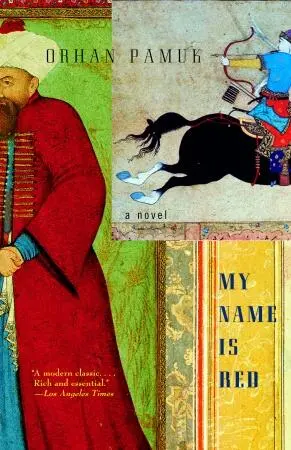
- Название:My Name is Red
- Автор:
- Жанр:
- Год:неизвестен
- ISBN:нет данных
- Рейтинг книги:5 / 5. Голосов: 1
-
Избранное:Добавить в избранное
- Отзывы:
-
Ваша оценка:
My Name is Red: краткое содержание, описание и аннотация
Предлагаем к чтению аннотацию, описание, краткое содержание или предисловие (зависит от того, что написал сам автор книги «My Name is Red»). Если вы не нашли необходимую информацию о книге — напишите в комментариях, мы постараемся отыскать её.
When the Sultan commissions a great book to celebrate his royal self and his extensive dominion, he directs Enishte Effendi to assemble a cadre of the most acclaimed artists in the land. Their task: to illuminate the work in the European style. But because figurative art can be deemed an affront to Islam, this commission is a dangerous proposition indeed, and no one in the elite circle can know the full scope or nature of the project.
Panic erupts when one of the chosen miniaturists disappears, and the Sultan demands answers within three days. The only clue to the mystery-or crime?-lies in the half-finished illuminations themselves. Has an avenging angel discovered the blasphemous work? Or is a jealous contender for the hand of Enishte’s ravishing daughter, the incomparable Shekure, somehow to blame?
Orhan Pamuk’s My Name Is Red is at once a fantasy and a philosophical puzzle, a kaleidoscopic journey to the intersection of art, religion, love, sex, and power.
"Pamuk is a novelist and a great one…My Name is Red is by far the grandest and most astonishing contest in his internal East-West war…It is chock-full of sublimity and sin…The story is told by each of a dozen characters, and now and then by a dog, a tree, a gold coin, several querulous corpses and the color crimson ('My Name is Red')…[Readers will] be lofted by the paradoxical lightness and gaiety of the writing, by the wonderfully winding talk perpetually about to turn a corner, and by the stubborn humanity in the characters' maneuvers to survive. It is a humanity whose lies and silences emerge as endearing and oddly bracing individual truths."- Richard Eder, New York Times Book Review
"A murder mystery set in sixteenth-century Istanbul [that] uses the art of miniature illumination, much as Mann's 'Doctor Faustus' did music, to explore a nation's soul… Erdag Goknar deserves praise for the cool, smooth English in which he has rendered Pamuk's finespun sentences, passionate art appreciations, sly pedantic debates, [and] eerie urban scenes."- John Updike, The New Yorker
"The interweaving of human and philosophical intrigue is very much as I remember it in The Name of the Rose, as is the slow, dense beginning and the relentless gathering of pace… But, in my view, his book is by far the better of the two. I would go so far as to say that Pamuk achieves the very thing his book implies is impossible… More than any other book I can think of, it captures not just Istanbul's past and present contradictions, but also its terrible, timeless beauty. It's almost perfect, in other words. All it needs is the Nobel Prize."-Maureen Freely, New Statesman (UK)
"A perfect example of Pamuk's method as a novelist, which is to combine literary trickery with page-turning readability… As a meditation on art, in particular, My Name is Red is exquisitely subtle, demanding and repaying the closest attention.. We in the West can only feel grateful that such a novelist as Pamuk exists, to act as a bridge between our culture and that of a heritage quite as rich as our own."-Tom Holland, Daily Telegraph (UK)
"Readers… will find themselves lured into a richly described and remarkable world… Reading the novel is like being in a magically exotic dream…Splendidly enjoyable and rewarding… A book in which you can thoroughly immerse yourself." -Allan Massie, The Scotsman (UK)
"A wonderful novel, dreamy, passionate and august, exotic in the most original and exciting way. Orhan Pamuk is indisputably a major novelist."-Philip Hensher, The Spectator (UK)
"[In this] magnificent new novel… Pamuk takes the reader into the strange and beautiful world of Islamic art,in which Western notions no longer make sense… In this world of forgeries, where some might be in danger of losing their faith in literature, Pamuk is the real thing, and this book might well be one of the few recent works of fiction that will be remembered at the end of this century."-Avkar Altinel, The Observer (UK)
My Name is Red — читать онлайн бесплатно полную книгу (весь текст) целиком
Ниже представлен текст книги, разбитый по страницам. Система сохранения места последней прочитанной страницы, позволяет с удобством читать онлайн бесплатно книгу «My Name is Red», без необходимости каждый раз заново искать на чём Вы остановились. Поставьте закладку, и сможете в любой момент перейти на страницу, на которой закончили чтение.
Интервал:
Закладка:
“Do you understand?” he called out from among the trees.
I couldn’t determine exactly where he was in the blackness. My dear God, come to our aid, to us, Your sinning servants.
“Because you won’t be able to live under the same roof with the man who killed your father, Shekure. This I know.”
I momentarily thought that he could’ve been the one who killed my father, and that he was now mocking us, perhaps. This Hasan was the Devil incarnate. But I couldn’t be certain of anything.
“Listen to me, Hasan Effendi,” Black called out to the darkness. “My father-in-law was murdered, this much is true. The most despicable of men killed him.”
“He’d been murdered before the wedding, isn’t that so?” said Hasan. “You two killed him because he opposed this marriage sham, this fake divorce, the false witnesses and all your deceits. If he’d considered Black to be appropriate, he’d have given his daughter to him years ago.”
Having lived for years with my late husband, with us, Hasan knew our past as well as we ourselves did. And with the passion of a spurned lover, he remembered every last detail of everything I’d discussed with my husband at home, but had subsequently forgotten, or now wanted to forget. Over the years, we’d shared so many memories-he, his brother and I-that I worried how strange, new and distant Black would seem to me if Hasan were to begin recounting the past.
“We suspect that you were the one who killed him,” Black said.
“On the contrary, you were the ones who killed him so you could marry. This is evident. As for me, I have no motive.”
“You killed him so we wouldn’t get married,” said Black. “When you learned that he’d permitted Shekure’s divorce and our marriage, you lost your mind. Besides, you were furious with Enishte Effendi because he’d encouraged Shekure to return home to live with him. You wanted revenge. As long as he remained alive, you knew you’d never get your hands on Shekure.”
“Be done with your stalling,” Hasan said decisively. “I refuse to listen to this prattle. It’s very cold here. I froze out here trying to get your attention with the rocks-didn’t you hear them?”
“Black had lost himself in my father’s illustrations,” I said.
Had I done wrong in saying this?
Hasan spoke in precisely the same false tone that I sometimes resorted to with Black: “Shekure, as you are my brother’s wife, your best course of action is to return now with your children to the house of the hero spahi cavalryman to whom you’re still wed according to the Koran.”
“I refuse,” I said, as if hissing into the heart of the night. “I refuse, Hasan. No.”
“Then, my responsibility and devotion to my brother forces me to alert the judge first thing tomorrow morning of what I’ve heard here. Otherwise, they’ll call me to account.”
“They’re going to call you to account anyway,” said Black. “The moment you go to the judge, I’ll reveal that you’re the one who murdered Our Sultan’s cherished servant, Enishte Effendi. This very morning.”
“Very well,” said Hasan calmly. “Make that revelation.”
I shrieked. “They’ll torture the both of you!” I shouted. “Don’t go to the judge. Wait. Everything will become clear.”
“I have no fear of torture,” Hasan said. “I’ve been tortured twice before, and both times I understood it was the only way the guilty could be culled from the innocent. Let the slanderers fear torture. I’m going to tell the judge, the captain of the Janissaries, the Sheikhulislam, everybody about poor Enishte Effendi’s book and its illustrations. Everybody is talking about those illustrations. What is it about them? What’s in those pictures?”
“There’s nothing in them,” Black said.
“Which means you examined them at the first opportunity.”
“Enishte Effendi wants me to finish the book.”
“Very well. I hope, God willing, that they’ll torture the both of us.”
The two of them fell silent. Next, Black and I heard footsteps in the empty yard. Were they leaving or approaching us? We could neither see Hasan nor tell what he was doing. It would’ve been senseless for him to push through the thorns, shrubs and brambles lining the far end of the garden in the pitch-blackness. He could’ve easily left without being seen, had he passed through the trees and wound his way before us, but we didn’t hear any footsteps nearing us. I boldly shouted, “Hasan!” There was no response.
“Hush,” said Black.
We were both trembling from the cold. Without hesitating too long, we closed the gate and the doors tightly behind us. Before entering my bed warmed by the children, I checked on my father again. Meanwhile, Black once again seated himself before the pictures.
I AM A HORSE
Ignore the fact that I’m standing here placid and still; if truth be told, I’ve been galloping for centuries; I’ve passed over plains, fought in battles, carried off the melancholy daughters of shahs to be wed; I’ve galloped tirelessly page by page from story to history, from history to legend and from book to book; I’ve appeared in countless stories, fables, books and battles; I’ve accompanied invincible heroes, legendary lovers and fantastic armies; I’ve galloped from campaign to campaign with our victorious sultans, and as a result, I’ve appeared in countless illustrations.
How does it feel, you ask, to be painted so often?
Of course, I’m proud of myself. Yet, I also question whether, indeed, it is I being depicted in all cases. It is evident from these pictures that I’m perceived differently by everyone. Still, I have the strong sense that there’s a commonality, a unity to the illustrations.
My miniaturist friends were recounting a story recently, and from it, I learned the following: The king of the Frankish infidels was considering marriage to the daughter of the Venetian Doge. He was considering it, but then he was plagued with the thought, “What if this Venetian is poor and his daughter ugly?” To reassure himself, he ordered his best artist to paint the Venetian Doge’s daughter, possessions, property and belongings. The Venetians could care less about gross indecency: They’ll expose not only their daughters to the prying eyes of the artist, but their horses and palazzos, as well. The gifted infidel artist could depict a maiden or a horse in such a way that you’d be able to pick either out of a crowd. Back in his courtyard, as the Frankish king examined the pictures from Venice, pondering whether he should take the maiden as his wife, his stallion, suddenly aroused, attempted to mount the attractive mare in the painting, and the horse grooms were hard pressed to bring the ferocious animal under control before he destroyed the picture and its frame with his huge member.
They say that it wasn’t the beauty of the Venetian mare that had aroused the Frankish stallion-though she was indeed striking-but the act of taking a particular mare and painting a picture in her exact likeness. Now, the question arises: Is it sinful to be depicted as that mare had been, that is, like a real mare? In my case, as you can see, there is very little difference between my image and other pictures of horses.
Actually, those of you who pay particular attention to the grace of my midsection, the length of my legs and the pride of my bearing will understand that I am indeed unique. But these excellent features point to the uniqueness of the miniaturist who illustrated me, not to my uniqueness as a horse. Everyone knows that there’s no horse exactly like me. I’m simply the rendering of a horse that exists in a miniaturist’s imagination.
Looking at me, observers frequently say, “Good God, what a gorgeous horse!” But they’re actually praising the artist, not me. All horses are in fact distinct, and the miniaturist, above all, ought to know this.
Читать дальшеИнтервал:
Закладка:
Похожие книги на «My Name is Red»
Представляем Вашему вниманию похожие книги на «My Name is Red» списком для выбора. Мы отобрали схожую по названию и смыслу литературу в надежде предоставить читателям больше вариантов отыскать новые, интересные, ещё непрочитанные произведения.







Обсуждение, отзывы о книге «My Name is Red» и просто собственные мнения читателей. Оставьте ваши комментарии, напишите, что Вы думаете о произведении, его смысле или главных героях. Укажите что конкретно понравилось, а что нет, и почему Вы так считаете.