Orhan Pamuk - My Name is Red
Здесь есть возможность читать онлайн «Orhan Pamuk - My Name is Red» весь текст электронной книги совершенно бесплатно (целиком полную версию без сокращений). В некоторых случаях можно слушать аудио, скачать через торрент в формате fb2 и присутствует краткое содержание. Жанр: Современная проза, на английском языке. Описание произведения, (предисловие) а так же отзывы посетителей доступны на портале библиотеки ЛибКат.
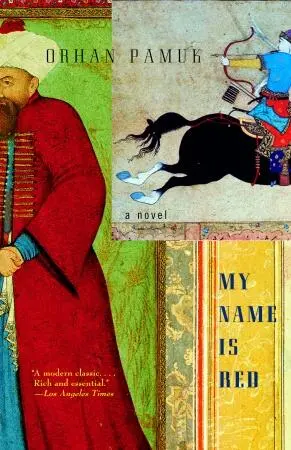
- Название:My Name is Red
- Автор:
- Жанр:
- Год:неизвестен
- ISBN:нет данных
- Рейтинг книги:5 / 5. Голосов: 1
-
Избранное:Добавить в избранное
- Отзывы:
-
Ваша оценка:
My Name is Red: краткое содержание, описание и аннотация
Предлагаем к чтению аннотацию, описание, краткое содержание или предисловие (зависит от того, что написал сам автор книги «My Name is Red»). Если вы не нашли необходимую информацию о книге — напишите в комментариях, мы постараемся отыскать её.
When the Sultan commissions a great book to celebrate his royal self and his extensive dominion, he directs Enishte Effendi to assemble a cadre of the most acclaimed artists in the land. Their task: to illuminate the work in the European style. But because figurative art can be deemed an affront to Islam, this commission is a dangerous proposition indeed, and no one in the elite circle can know the full scope or nature of the project.
Panic erupts when one of the chosen miniaturists disappears, and the Sultan demands answers within three days. The only clue to the mystery-or crime?-lies in the half-finished illuminations themselves. Has an avenging angel discovered the blasphemous work? Or is a jealous contender for the hand of Enishte’s ravishing daughter, the incomparable Shekure, somehow to blame?
Orhan Pamuk’s My Name Is Red is at once a fantasy and a philosophical puzzle, a kaleidoscopic journey to the intersection of art, religion, love, sex, and power.
"Pamuk is a novelist and a great one…My Name is Red is by far the grandest and most astonishing contest in his internal East-West war…It is chock-full of sublimity and sin…The story is told by each of a dozen characters, and now and then by a dog, a tree, a gold coin, several querulous corpses and the color crimson ('My Name is Red')…[Readers will] be lofted by the paradoxical lightness and gaiety of the writing, by the wonderfully winding talk perpetually about to turn a corner, and by the stubborn humanity in the characters' maneuvers to survive. It is a humanity whose lies and silences emerge as endearing and oddly bracing individual truths."- Richard Eder, New York Times Book Review
"A murder mystery set in sixteenth-century Istanbul [that] uses the art of miniature illumination, much as Mann's 'Doctor Faustus' did music, to explore a nation's soul… Erdag Goknar deserves praise for the cool, smooth English in which he has rendered Pamuk's finespun sentences, passionate art appreciations, sly pedantic debates, [and] eerie urban scenes."- John Updike, The New Yorker
"The interweaving of human and philosophical intrigue is very much as I remember it in The Name of the Rose, as is the slow, dense beginning and the relentless gathering of pace… But, in my view, his book is by far the better of the two. I would go so far as to say that Pamuk achieves the very thing his book implies is impossible… More than any other book I can think of, it captures not just Istanbul's past and present contradictions, but also its terrible, timeless beauty. It's almost perfect, in other words. All it needs is the Nobel Prize."-Maureen Freely, New Statesman (UK)
"A perfect example of Pamuk's method as a novelist, which is to combine literary trickery with page-turning readability… As a meditation on art, in particular, My Name is Red is exquisitely subtle, demanding and repaying the closest attention.. We in the West can only feel grateful that such a novelist as Pamuk exists, to act as a bridge between our culture and that of a heritage quite as rich as our own."-Tom Holland, Daily Telegraph (UK)
"Readers… will find themselves lured into a richly described and remarkable world… Reading the novel is like being in a magically exotic dream…Splendidly enjoyable and rewarding… A book in which you can thoroughly immerse yourself." -Allan Massie, The Scotsman (UK)
"A wonderful novel, dreamy, passionate and august, exotic in the most original and exciting way. Orhan Pamuk is indisputably a major novelist."-Philip Hensher, The Spectator (UK)
"[In this] magnificent new novel… Pamuk takes the reader into the strange and beautiful world of Islamic art,in which Western notions no longer make sense… In this world of forgeries, where some might be in danger of losing their faith in literature, Pamuk is the real thing, and this book might well be one of the few recent works of fiction that will be remembered at the end of this century."-Avkar Altinel, The Observer (UK)
My Name is Red — читать онлайн бесплатно полную книгу (весь текст) целиком
Ниже представлен текст книги, разбитый по страницам. Система сохранения места последней прочитанной страницы, позволяет с удобством читать онлайн бесплатно книгу «My Name is Red», без необходимости каждый раз заново искать на чём Вы остановились. Поставьте закладку, и сможете в любой момент перейти на страницу, на которой закончили чтение.
Интервал:
Закладка:
My mounting joy and flowing tears were abruptly poisoned by a nagging doubt. Guilt-ridden and impatient in my uncertainty, I asked Him:
“Over the last twenty years of my life, I’ve been influenced by the infidel illustrations that I saw in Venice. There was even a time when I wanted my own portrait painted in that method and style, but I was afraid. Instead, I later had Your World, Your Subjects and Our Sultan, Your Shadow on Earth, depicted in the manner of the infidel Franks.”
I didn’t remember His voice, but I recalled the answer He gave me in my thoughts.
“East and West belong to me.”
I could barely contain my excitement.
“All right then, what is the meaning of it all, of this…of this world?”
“Mystery,” I heard in my thoughts, or perhaps, “mercy,” but I wasn’t certain of either.
By the way the angels had come near me, I knew some sort of decision had been made about me at this height of the heavens, but I’d have to wait in the divine balance of Berzah with the mass of other souls who’d died over the last tens of thousands of years until the Day of Judgment, when the final decision about us would be made. That everything transpired the way it was recorded in books pleased me. I recalled from my readings as I descended that I’d be reunited with my body during my burial.
But I quickly understood that the phenomenon of “reentering my lifeless body” was just a figure of speech, thank goodness. Despite their sorrow, the dignified funeral congregation that filled me with pride was astonishingly organized as it shouldered my coffin after the prayers and descended into the little Hillock Cemetery beside the mosque. From above, the procession appeared like a thin and delicate length of string.
Let me clarify my situation: As might be inferred from the well-known legend of Our Prophet-which states “The soul of the faithful is a bird that feeds from the trees of Heaven”-after death, the soul roams the firmament. As claimed by Abu Ömer bin Abdülber, the interpretation of this legend doesn’t mean that the soul will possess a bird or even become a bird itself, but as the learned El Jevziyye aptly clarifies, it means that the soul can be found where birds gather. The spot from which I was observing things, what the Venetian masters who love perspective would call my “point of view,” confirmed El Jevziyye’s interpretation.
From where I was, for example, I could both see the threadlike funeral procession entering the cemetery, and with the pleasure of analyzing a painting, watch a sailboat gaining speed, its sails gorging on wind as it tacked toward Palace Point, where the Golden Horn met the Bosphorus. Looking down from the height of a minaret, the whole world resembled a magnificent book whose pages I was examining one by one.
Still, I could see much more than a man who’d simply ascended to such heights without his soul having left his body, and furthermore, I could see it all at once: On the other side of the Bosphorus, beyond Üsküdar, among gravestones in an empty yard, children playing leapfrog; the graceful progression of the Vizier of Diplomatic Affair’s caïque propelled by seven pairs of oarsmen twelve years and seven months ago, when we accompanied the Venetian ambassador from his seaside mansion to be received by the Grand Vizier, Bald Ragip Pasha; a portly woman in the new Langa bazaar holding a huge head of cabbage like a child she was about to nurse; my elation when the Divan Herald Ramazan Effendi died, opening the way for my own advancement; how I stared as a child from my grandmother’s lap at red shirts while my mother hung the laundry to dry in the courtyard; how I ran to distant neighborhoods in search of the midwife when Shekure’s mother, may she rest in peace, had gone into labor; the location of the red belt I’d lost over forty years ago (I know now that Vasfi stole it); the splendid garden in the distance that I’d dreamed about once twenty-one years ago, which I pray Allah will one day confirm is Heaven; the severed heads, noses, and ears sent to Istanbul by Ali Bey, the Governor-General of Georgia, who suppressed the rebels in the fortress of Gori; and my beautiful, dear Shekure, who separated herself from the neighborhood women mourning over me in the house and stared into the flames of the brick stove in our courtyard.
As is recorded in books and confirmed by scholars, the soul dwells in four realms: 1. the womb; 2. the terrestrial world; 3. Berzah, or divine limbo, where I now await Judgment Day; and 4. Heaven or Hell, where I will arrive after the Judgment.
From the intermediate state of Berzah, past and present time appear at once, and as long as the soul remains within its memories, limitations of place do not obtain. Only when one escapes the dungeons of time and space does it becomes evident that life is a straitjacket. However blissful it is being a soul without a body in the realm of the dead, so too is being a body without a soul among the living; what a pity nobody realizes this before dying. Therefore, during my lovely funeral, as I grievously watched my dear Shekure wear herself out weeping in vain, I begged of Exalted Allah to grant us souls-without-bodies in Heaven and bodies-without-souls in life.
IT IS I, MASTER OSMAN
You know about those ornery old men who’ve charitably devoted their lives to art. They’ll attack anyone who gets in their way. They’re usually gaunt, bony and tall. They’ll want the dwindling number of days before them to be just like the long period they’ve left behind. They’re short-tempered, and they complain about everything. They’ll try to grab the reins in all situations, causing everyone around them to throw up their hands in frustration; they don’t like anyone or anything. I know, because I’m one of them.
The master of masters Nurullah Selim Chelebi, with whom I had the honor of making illustrations knee to knee in the same workshop, was this way in his eighties, when I was but a sixteen-year-old apprentice (though he wasn’t as peevish as I am now). Blond Ali, the last of the great masters, laid to rest thirty years ago, was also this way (though he wasn’t as thin and tall as I am). Since the arrows of criticism aimed at these legendary masters, who directed the workshops of their day now frequently strike me in the back, I want you to know that the hackneyed accusations leveled at us are entirely unfounded. These are the facts:
1. The reason we don’t like anything innovative is that there is truly nothing new worth liking.
2. We treat most men like morons because, indeed, most men are morons, not because we’re poisoned by anger, unhappiness or some other flaw in character. (Granted, treating these people better would be more refined and sensible.)
3. The reason I forget and confuse so many names and faces-except those of the miniaturists I’ve loved and trained since their apprenticeships-is not senility, but because these names and faces are so lackluster and colorless as to be hardly worth remembering.
During the funeral of Enishte, whose soul was prematurely taken by God because of his own foolishness, I tried to forget that the deceased had at one time caused me unmentionable agony by forcing me to imitate the European masters. On the way back, I had the following thoughts: blindness and death, those gifts bestowed by God, are not so far from me now. Of course, I will be remembered only so long as my illustrations and manuscripts cause your eyes to prance and flowers of bliss to bloom in your hearts. But after my death let it be known that in my old age, at the very end of my life, there was still plenty that made me smile. For instance:
1. Children-They represent what is vital in the world.
2. Sweet memories of handsome boys, beautiful women, painting well and friendships.
Читать дальшеИнтервал:
Закладка:
Похожие книги на «My Name is Red»
Представляем Вашему вниманию похожие книги на «My Name is Red» списком для выбора. Мы отобрали схожую по названию и смыслу литературу в надежде предоставить читателям больше вариантов отыскать новые, интересные, ещё непрочитанные произведения.









Обсуждение, отзывы о книге «My Name is Red» и просто собственные мнения читателей. Оставьте ваши комментарии, напишите, что Вы думаете о произведении, его смысле или главных героях. Укажите что конкретно понравилось, а что нет, и почему Вы так считаете.