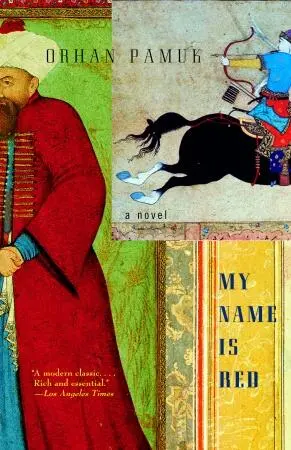
Orhan Pamuk - My Name is Red
Здесь есть возможность читать онлайн «Orhan Pamuk - My Name is Red» весь текст электронной книги совершенно бесплатно (целиком полную версию без сокращений). В некоторых случаях можно слушать аудио, скачать через торрент в формате fb2 и присутствует краткое содержание. Жанр: Современная проза, на английском языке. Описание произведения, (предисловие) а так же отзывы посетителей доступны на портале библиотеки ЛибКат.
- Название:My Name is Red
- Автор:
- Жанр:
- Год:неизвестен
- ISBN:нет данных
- Рейтинг книги:5 / 5. Голосов: 1
-
Избранное:Добавить в избранное
- Отзывы:
-
Ваша оценка:
My Name is Red: краткое содержание, описание и аннотация
Предлагаем к чтению аннотацию, описание, краткое содержание или предисловие (зависит от того, что написал сам автор книги «My Name is Red»). Если вы не нашли необходимую информацию о книге — напишите в комментариях, мы постараемся отыскать её.
When the Sultan commissions a great book to celebrate his royal self and his extensive dominion, he directs Enishte Effendi to assemble a cadre of the most acclaimed artists in the land. Their task: to illuminate the work in the European style. But because figurative art can be deemed an affront to Islam, this commission is a dangerous proposition indeed, and no one in the elite circle can know the full scope or nature of the project.
Panic erupts when one of the chosen miniaturists disappears, and the Sultan demands answers within three days. The only clue to the mystery-or crime?-lies in the half-finished illuminations themselves. Has an avenging angel discovered the blasphemous work? Or is a jealous contender for the hand of Enishte’s ravishing daughter, the incomparable Shekure, somehow to blame?
Orhan Pamuk’s My Name Is Red is at once a fantasy and a philosophical puzzle, a kaleidoscopic journey to the intersection of art, religion, love, sex, and power.
"Pamuk is a novelist and a great one…My Name is Red is by far the grandest and most astonishing contest in his internal East-West war…It is chock-full of sublimity and sin…The story is told by each of a dozen characters, and now and then by a dog, a tree, a gold coin, several querulous corpses and the color crimson ('My Name is Red')…[Readers will] be lofted by the paradoxical lightness and gaiety of the writing, by the wonderfully winding talk perpetually about to turn a corner, and by the stubborn humanity in the characters' maneuvers to survive. It is a humanity whose lies and silences emerge as endearing and oddly bracing individual truths."- Richard Eder, New York Times Book Review
"A murder mystery set in sixteenth-century Istanbul [that] uses the art of miniature illumination, much as Mann's 'Doctor Faustus' did music, to explore a nation's soul… Erdag Goknar deserves praise for the cool, smooth English in which he has rendered Pamuk's finespun sentences, passionate art appreciations, sly pedantic debates, [and] eerie urban scenes."- John Updike, The New Yorker
"The interweaving of human and philosophical intrigue is very much as I remember it in The Name of the Rose, as is the slow, dense beginning and the relentless gathering of pace… But, in my view, his book is by far the better of the two. I would go so far as to say that Pamuk achieves the very thing his book implies is impossible… More than any other book I can think of, it captures not just Istanbul's past and present contradictions, but also its terrible, timeless beauty. It's almost perfect, in other words. All it needs is the Nobel Prize."-Maureen Freely, New Statesman (UK)
"A perfect example of Pamuk's method as a novelist, which is to combine literary trickery with page-turning readability… As a meditation on art, in particular, My Name is Red is exquisitely subtle, demanding and repaying the closest attention.. We in the West can only feel grateful that such a novelist as Pamuk exists, to act as a bridge between our culture and that of a heritage quite as rich as our own."-Tom Holland, Daily Telegraph (UK)
"Readers… will find themselves lured into a richly described and remarkable world… Reading the novel is like being in a magically exotic dream…Splendidly enjoyable and rewarding… A book in which you can thoroughly immerse yourself." -Allan Massie, The Scotsman (UK)
"A wonderful novel, dreamy, passionate and august, exotic in the most original and exciting way. Orhan Pamuk is indisputably a major novelist."-Philip Hensher, The Spectator (UK)
"[In this] magnificent new novel… Pamuk takes the reader into the strange and beautiful world of Islamic art,in which Western notions no longer make sense… In this world of forgeries, where some might be in danger of losing their faith in literature, Pamuk is the real thing, and this book might well be one of the few recent works of fiction that will be remembered at the end of this century."-Avkar Altinel, The Observer (UK)
My Name is Red — читать онлайн бесплатно полную книгу (весь текст) целиком
Ниже представлен текст книги, разбитый по страницам. Система сохранения места последней прочитанной страницы, позволяет с удобством читать онлайн бесплатно книгу «My Name is Red», без необходимости каждый раз заново искать на чём Вы остановились. Поставьте закладку, и сможете в любой момент перейти на страницу, на которой закончили чтение.
Интервал:
Закладка:
We spent much time searching for horse pictures that Master Osman’s beloved miniaturists had made for various books in recent years, looking for the same irregularity in the horse’s nostrils. Because the Book of Festivities , still being completed, depicted the societies and guilds marching on foot before Our Sultan, there were few horses among its 250 illustrations. Men were dispatched to the book-arts workshop, where certain figure books, some notebooks of standard forms and newly finished volumes were stored, as well as to the private rooms of the Sultan, and the harem so that they could bring back any books that hadn’t been securely locked up and hidden in the palace treasury, all of this, naturally, with the permission of Our Sultan.
In a double-leaf illustration from a Book of Victories found in the quarters of a young prince, which showed the funeral ceremonies of Sultan Süleyman the Magnificent who’d died during the siege of Szegetvar, we first examined the chestnut horse with a white blaze, the gazelle-eyed gray pulling the funeral carriage and the other melancholy horses fitted with spectacular saddle blankets and gold embroidered saddles. Butterfly, Olive and Stork had illustrated all these horses. Whether the horses were pulling the large-wheeled funeral carriage or standing at attention with watery eyes trained on their master’s body covered with a red cloth, all stood with the same elegant stance borrowed from the old masters of Herat, that is, with one foreleg proudly extended and the other firmly planted on the ground beside it. All their necks were long and curved, their tails bound up and their manes trimmed and combed, but none of the noses had the peculiarity we sought. Neither was this peculiarity evident in any of the hundreds of horses that bore commanders, scholars and hojas, who’d participated in the funeral ceremony and now stood at attention on the surrounding hilltops in honor of the late Sultan Süleyman.
Something of the sadness of this melancholy funeral passed to us as well. It upset us to see that this illustrated manuscript, upon which Master Osman and his miniaturists labored so much, had been ill-treated, and that women of the harem, playing games with princes, had scribbled and marked various places on the pages. Beside a tree under which Our Sultan’s grandfather hunted, written in a bad hand were the words, “My Exalted Effendi, I love you and am waiting for you with the patience of this tree.” So, it was with our hearts full of defeat and sorrow that we pored over the legendary books, whose creation I’d heard about, but none of which I’d ever seen.
In the second volume of the Book of Skills , which had seen the brush strokes of all three master miniaturists, we saw, behind the roaring cannon and the foot soldiers, hundreds of horses of every hue including chestnuts, grays and blues, clattering along in mail and full panoply, bearing their glorious scimitar-wielding spahi cavalrymen, as they crossed over pink hilltops in an orderly advance, but none of their noses was flawed. “And what is a flaw after all!” Master Osman said later, while examining a page in the same book, which depicted the Royal Outer Gate and the parade ground where we happened to be at that very moment. We also failed to discover the mark we were searching for on the noses of the horses of various hues mounted by guards, heralds and Secretaries of the Divan Council of State in this illustration, which depicted the hospital off to the right, the Sultan’s Royal Audience Hall, and the trees in the courtyard on a scale small enough to fit into the frame yet grand enough to match their importance in our minds. We watched Our Sultan’s great-grandfather Sultan Selim the Grim, during the time he declared war on the ruler of the Dhulkadirids, erect the imperial tent along the banks of the Küskün river and hunt scurrying red-tailed black greyhounds, gazelle fawns with rumps in the air and frightened rabbits, before leaving a leopard lying in a pool of red blood, its spots blooming like flowers. Neither the Sultan’s chestnut horse with the white blaze nor the horses upon which the falconers waited, their birds at the ready on their forearms, had the mark we were looking for.
Till dusk, we pored over hundreds of horses that had issued from the brushes of Olive, Butterfly and Stork over the last four or five years: the Crimean Khan Mehmet Giray’s elegant-eared chestnut palomino; black and golden horses; pinkish and gray-colored horses whose heads and necks alone could be seen behind a hilltop during battle; the horses of Haydar Pasha who recaptured the Halkul-Vad fortress from the Spanish infidels in Tunisia and the Spaniards’ reddish-chestnut and pistachio-green horses, one of which had tumbled headlong, as they fled from him; a black horse that caused Master Osman to remark, “I overlooked this one. I wonder who did such careless work?”; a red horse who politely turned his ears to the lute that a royal pageboy was strumming under a tree; Shirin’s horse, Shebdiz, as bashful and elegant as she, waiting for her while she bathed in a lake by moonlight; the lively horses used in javelin jousts; the tempestlike horse and its beautiful groom that for some reason caused Master Osman to remark, “I loved him dearly in my youth, I’m very tired”; the sun-colored, golden, winged horse which Allah sent to the prophet Elijah to protect him from an attack by the pagans-whose wings had been mistakenly drawn on Elijah; Sultan Süleyman the Magnificent’s gray thoroughbred with the small head and large body, which stared sorrowfully at the young and lovable prince; enraged horses; horses at full gallop; weary horses; beautiful horses; horses that nobody noticed; horses that would never leave these pages; and horses that leapt over gilded borders escaping their confinement.
Not one of them bore the signature we were looking for.
Even so, we were able to maintain a persistent excitement in the face of the weariness and melancholy that descended upon us: A couple of times we forgot about the horse and lost ourselves to the beauty of a picture, to colors that forced a momentary surrender. Master Osman always looked at the pictures-most of which he himself had created, supervised or ornamented-more out of nostalgic enthusiasm than wonder. “These are by Kasım from the Kasım Pasha district!” he said once, pointing out the little purple flowers at the base of the red war tent of Our Sultan’s grandfather Sultan Süleyman. “He was by no means a master, but for forty years he filled the dead space of pictures with these five-leaf, single-blossom flowers, before he unexpectedly died two years ago. I always assigned him to draw this small flower because he could do it better than anyone.” He fell silent for a moment, then exclaimed, “It’s a pity, a pity!” With all my soul, I sensed that these words signified the end of an era.
Darkness had nearly overtaken us, when a light flooded the room. There was a commotion. My heart, which had begun to beat like a drum, comprehended immediately: The Ruler of the World, His Excellency Our Sultan had abruptly entered. I threw myself at His feet. I kissed the hem of His robe. My head spun. I couldn’t look Him in the eye.
He’d long since begun speaking with Head Illuminator Master Osman anyway. It filled me with fiery pride to witness Him speak to the man with whom I’d only moments ago been sitting knee to knee looking at pictures. Unbelievable; His Excellency Our Sultan was now sitting where I’d been earlier and He was listening attentively to what my master was explaining, as I had done. The Head Treasurer, who was at his side and the Agha of the Falconers and a few others whose identities I couldn’t make out were keeping close guard over Him and gazing at the open pages of books with rapt attention. I gathered all my courage and looked at length at the face and eyes of the Sovereign Ruler of the World, albeit with a sidelong glance. How handsome He was! How upright and proper! My heart no longer beat excitedly. At that moment, our eyes met.
Читать дальшеИнтервал:
Закладка:
Похожие книги на «My Name is Red»
Представляем Вашему вниманию похожие книги на «My Name is Red» списком для выбора. Мы отобрали схожую по названию и смыслу литературу в надежде предоставить читателям больше вариантов отыскать новые, интересные, ещё непрочитанные произведения.








Обсуждение, отзывы о книге «My Name is Red» и просто собственные мнения читателей. Оставьте ваши комментарии, напишите, что Вы думаете о произведении, его смысле или главных героях. Укажите что конкретно понравилось, а что нет, и почему Вы так считаете.