Orhan Pamuk - My Name is Red
Здесь есть возможность читать онлайн «Orhan Pamuk - My Name is Red» весь текст электронной книги совершенно бесплатно (целиком полную версию без сокращений). В некоторых случаях можно слушать аудио, скачать через торрент в формате fb2 и присутствует краткое содержание. Жанр: Современная проза, на английском языке. Описание произведения, (предисловие) а так же отзывы посетителей доступны на портале библиотеки ЛибКат.
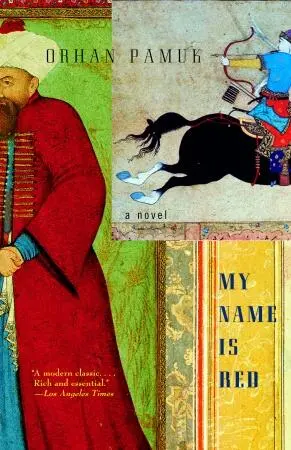
- Название:My Name is Red
- Автор:
- Жанр:
- Год:неизвестен
- ISBN:нет данных
- Рейтинг книги:5 / 5. Голосов: 1
-
Избранное:Добавить в избранное
- Отзывы:
-
Ваша оценка:
My Name is Red: краткое содержание, описание и аннотация
Предлагаем к чтению аннотацию, описание, краткое содержание или предисловие (зависит от того, что написал сам автор книги «My Name is Red»). Если вы не нашли необходимую информацию о книге — напишите в комментариях, мы постараемся отыскать её.
When the Sultan commissions a great book to celebrate his royal self and his extensive dominion, he directs Enishte Effendi to assemble a cadre of the most acclaimed artists in the land. Their task: to illuminate the work in the European style. But because figurative art can be deemed an affront to Islam, this commission is a dangerous proposition indeed, and no one in the elite circle can know the full scope or nature of the project.
Panic erupts when one of the chosen miniaturists disappears, and the Sultan demands answers within three days. The only clue to the mystery-or crime?-lies in the half-finished illuminations themselves. Has an avenging angel discovered the blasphemous work? Or is a jealous contender for the hand of Enishte’s ravishing daughter, the incomparable Shekure, somehow to blame?
Orhan Pamuk’s My Name Is Red is at once a fantasy and a philosophical puzzle, a kaleidoscopic journey to the intersection of art, religion, love, sex, and power.
"Pamuk is a novelist and a great one…My Name is Red is by far the grandest and most astonishing contest in his internal East-West war…It is chock-full of sublimity and sin…The story is told by each of a dozen characters, and now and then by a dog, a tree, a gold coin, several querulous corpses and the color crimson ('My Name is Red')…[Readers will] be lofted by the paradoxical lightness and gaiety of the writing, by the wonderfully winding talk perpetually about to turn a corner, and by the stubborn humanity in the characters' maneuvers to survive. It is a humanity whose lies and silences emerge as endearing and oddly bracing individual truths."- Richard Eder, New York Times Book Review
"A murder mystery set in sixteenth-century Istanbul [that] uses the art of miniature illumination, much as Mann's 'Doctor Faustus' did music, to explore a nation's soul… Erdag Goknar deserves praise for the cool, smooth English in which he has rendered Pamuk's finespun sentences, passionate art appreciations, sly pedantic debates, [and] eerie urban scenes."- John Updike, The New Yorker
"The interweaving of human and philosophical intrigue is very much as I remember it in The Name of the Rose, as is the slow, dense beginning and the relentless gathering of pace… But, in my view, his book is by far the better of the two. I would go so far as to say that Pamuk achieves the very thing his book implies is impossible… More than any other book I can think of, it captures not just Istanbul's past and present contradictions, but also its terrible, timeless beauty. It's almost perfect, in other words. All it needs is the Nobel Prize."-Maureen Freely, New Statesman (UK)
"A perfect example of Pamuk's method as a novelist, which is to combine literary trickery with page-turning readability… As a meditation on art, in particular, My Name is Red is exquisitely subtle, demanding and repaying the closest attention.. We in the West can only feel grateful that such a novelist as Pamuk exists, to act as a bridge between our culture and that of a heritage quite as rich as our own."-Tom Holland, Daily Telegraph (UK)
"Readers… will find themselves lured into a richly described and remarkable world… Reading the novel is like being in a magically exotic dream…Splendidly enjoyable and rewarding… A book in which you can thoroughly immerse yourself." -Allan Massie, The Scotsman (UK)
"A wonderful novel, dreamy, passionate and august, exotic in the most original and exciting way. Orhan Pamuk is indisputably a major novelist."-Philip Hensher, The Spectator (UK)
"[In this] magnificent new novel… Pamuk takes the reader into the strange and beautiful world of Islamic art,in which Western notions no longer make sense… In this world of forgeries, where some might be in danger of losing their faith in literature, Pamuk is the real thing, and this book might well be one of the few recent works of fiction that will be remembered at the end of this century."-Avkar Altinel, The Observer (UK)
My Name is Red — читать онлайн бесплатно полную книгу (весь текст) целиком
Ниже представлен текст книги, разбитый по страницам. Система сохранения места последней прочитанной страницы, позволяет с удобством читать онлайн бесплатно книгу «My Name is Red», без необходимости каждый раз заново искать на чём Вы остановились. Поставьте закладку, и сможете в любой момент перейти на страницу, на которой закончили чтение.
Интервал:
Закладка:
“Nothing is pure,” said Enishte Effendi. “In the realm of book arts, whenever a masterpiece is made, whenever a splendid picture makes my eyes water out of joy and causes a chill to run down my spine, I can be certain of the following: Two styles heretofore never brought together have come together to create something new and wondrous. We owe Bihzad and the splendor of Persian painting to the meeting of an Arabic illustrating sensibility and Mongol-Chinese painting. Shah Tahmasp’s best paintings marry Persian style with Turkmen subtleties. Today, if men cannot adequately praise the book-arts workshops of Akbar Khan in Hindustan, it’s because he urged his miniaturists to adopt the styles of the Frankish masters. To God belongs the East and the West. May He protect us from the will of the pure and unadulterated.”
However soft and bright his face might have appeared by candlelight, his shadow, cast on the wall, was equally as black and frightening. Despite finding what he said to be exceedingly reasonable and sound, I didn’t believe him. I assumed he was suspicious of me, and thus, I grew suspicious of him; I sensed that he was listening at times for the courtyard gate below, that he was hoping someone would deliver him from my presence.
“You yourself told me how Sheikh Muhammad the Master of Isfahan burned down the great library containing the paintings he had renounced, and how he also immolated himself in a fit of bad conscience,” he said. “Now let me tell you another story related to that legend that you don’t know. It’s true, he’d spent the last thirty years of his life hunting down his own works. However, in the books he perused, he increasingly discovered imitations inspired by him rather than his original work. In later years, he came to realize that two generations of artists had adopted as models of form the illustrations he himself had renounced, that they’d ingrained his pictures in their minds-or more accurately, had made them a part of their souls. As Sheikh Muhammad attempted to find his own pictures and destroy them, he discovered that young miniaturists had, with reverence, reproduced them in countless books, had relied on them in illustrating other stories, had caused them to be memorized by all and had spread them over the world. Over long years, as we gaze at book after book and illustration after illustration, we come to learn the following: A great painter does not content himself by affecting us with his masterpieces; ultimately, he succeeds in changing the landscape of our minds. Once a miniaturist’s artistry enters our souls this way, it becomes the criterion for the beauty of our world. At the end of his life, as the Master of Isfahan burned his own art, he not only witnessed the fact that his work, instead of disappearing, actually proliferated and increased; he understood that everybody now saw the world the way he had seen it. Those things which did not resemble the paintings he made in his youth were now considered ugly.”
Unable to rein in the awe stirring within me and to control my desire to please Enishte Effendi, I fell before his knees. As I kissed his hand, my eyes filled with tears and I felt I had relinquished to him the place in my soul that had always been reserved for Master Osman.
“A miniaturist,” said Enishte Effendi in the tone of a self-satisfied man, “creates his art by heeding his conscience and by obeying the principles in which he believes, fearing nothing. He pays no attention to what his enemies, the zealots and those who envy him have to say.”
But it occurred to me that Enishte Effendi wasn’t even a miniaturist as I kissed his aged and mottled hand through my tears. I was embarrassed by my thought. It was as if another had forced this devilish, shameless notion into my head. Even so, you too know how true this statement is.
“I’m not afraid of them,” Enishte said, “because I’m not afraid of death.”
Who were “they”? I nodded as if I understood. Yet annoyance began to mount within me. I noticed that the old volume immediately beside Enishte was El-Jevziyye’s Book of the Soul . All dotards who seek death share a love for this book that recounts the adventures that await the soul. Since I’d been here last, I saw only one new item among the objects collected in trays, resting on the chest, among the pen cases, penknives, nib-cutting boards, inkwells and brushes: a bronze inkpot.
“Let’s establish, once and for all, that we do not fear them ,” I said boldly. “Take out the last illustration. Let’s show it to them.”
“But wouldn’t this prove that we minded their slander, at least enough to take it seriously? We’ve done nothing of which we ought to be afraid. What could justify your being so frightened?”
He stroked my hair like a father. I was afraid that I might burst into tears again; I embraced him.
“I know why that unfortunate gilder Elegant Effendi was killed,” I said excitedly. “By slandering you, your book and us, Elegant Effendi was planning to set Nusret Hoja of Erzurum ’s men upon us. He was convinced that we’d fallen sway to the Devil. He’d begun spreading such rumors, trying to incite the other miniaturists working on your book to rebel against you. I don’t know why he suddenly began to do this. Perhaps out of jealousy, perhaps he’d come under Satan’s influence. And the other miniaturists also heard how determined Elegant Effendi was to destroy us all. You can imagine how each of them grew frightened and succumbed to suspicions as I myself had. Because one of their lot was cornered, in the middle of the night, by Elegant Effendi-who had incited him against you, us, our book, as well as against illustrating, painting and all else we believe in-that artist fell into a panic, killing that scoundrel and tossing his body into a well.”
“Scoundrel?”
“Elegant Effendi was an ill-natured, ill-bred traitor. Villain!” I shouted as if he were before me in the room.
Silence. Did he fear me? I was afraid of myself. It was as if I’d succumbed to somebody else’s will and thoughts; yet, this was not wholly unpleasant.
“Who was this miniaturist who fell into a panic like you and the illustrator from Isfahan? Who killed him?”
“I don’t know,” I said.
Yet I wanted him to infer from my expression that I was lying. I realized that I’d made a grave error in coming here, but I wasn’t going to succumb to feelings of guilt and regret. I could see that Enishte Effendi was growing suspicious of me and this pleased and fortified me. If he became convinced that I was a murderer and this knowledge struck terror throughout his soul, then he wouldn’t dare refuse to show me the final painting. I was so curious about that picture, not because of any sin I’d committed on its account-I genuinely wanted to see how it’d turned out.
“Is it important who killed that miscreant?” I said. “Is it not possible that whoever rid us of him has done a good deed?”
I was encouraged when I saw he could no longer look me directly in the eye. Magnanimous men, who think themselves better and morally superior to others, cannot look you in the eye when they are embarrassed on your behalf, perhaps because they are contemplating reporting you and abandoning you to a fate of torture and execution.
Outside, just in front of the courtyard gate, the dogs began a frenzied howling.
“It’s begun to snow again,” I said. “Where has everyone gone at this late hour? Why have they left you here all alone? They haven’t even lit a candle for you.”
“It’s quite strange, indeed,” he said. “I don’t understand it myself.”
He was so sincere that I believed him completely, and despite ridiculing him just as the other miniaturists did, I once again knew that I actually loved him profoundly. But how had he so quickly sensed my sudden and great flood of respect and affection, to which he responded by stroking my hair with irresistible fatherly concern? I began to see that Master Osman’s style of painting, and the legacy of the old masters of Herat, had no future whatsoever. And this abominable thought frightened me yet again. After some tragedy, we all feel the same way: In one last desperate hope, and without caring how comic and foolish we might appear, we pray that everything might continue as it always has.
Читать дальшеИнтервал:
Закладка:
Похожие книги на «My Name is Red»
Представляем Вашему вниманию похожие книги на «My Name is Red» списком для выбора. Мы отобрали схожую по названию и смыслу литературу в надежде предоставить читателям больше вариантов отыскать новые, интересные, ещё непрочитанные произведения.








Обсуждение, отзывы о книге «My Name is Red» и просто собственные мнения читателей. Оставьте ваши комментарии, напишите, что Вы думаете о произведении, его смысле или главных героях. Укажите что конкретно понравилось, а что нет, и почему Вы так считаете.