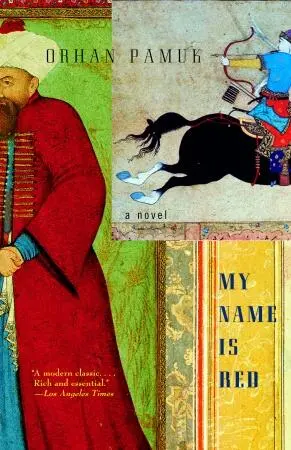
Orhan Pamuk - My Name is Red
Здесь есть возможность читать онлайн «Orhan Pamuk - My Name is Red» весь текст электронной книги совершенно бесплатно (целиком полную версию без сокращений). В некоторых случаях можно слушать аудио, скачать через торрент в формате fb2 и присутствует краткое содержание. Жанр: Современная проза, на английском языке. Описание произведения, (предисловие) а так же отзывы посетителей доступны на портале библиотеки ЛибКат.
- Название:My Name is Red
- Автор:
- Жанр:
- Год:неизвестен
- ISBN:нет данных
- Рейтинг книги:5 / 5. Голосов: 1
-
Избранное:Добавить в избранное
- Отзывы:
-
Ваша оценка:
My Name is Red: краткое содержание, описание и аннотация
Предлагаем к чтению аннотацию, описание, краткое содержание или предисловие (зависит от того, что написал сам автор книги «My Name is Red»). Если вы не нашли необходимую информацию о книге — напишите в комментариях, мы постараемся отыскать её.
When the Sultan commissions a great book to celebrate his royal self and his extensive dominion, he directs Enishte Effendi to assemble a cadre of the most acclaimed artists in the land. Their task: to illuminate the work in the European style. But because figurative art can be deemed an affront to Islam, this commission is a dangerous proposition indeed, and no one in the elite circle can know the full scope or nature of the project.
Panic erupts when one of the chosen miniaturists disappears, and the Sultan demands answers within three days. The only clue to the mystery-or crime?-lies in the half-finished illuminations themselves. Has an avenging angel discovered the blasphemous work? Or is a jealous contender for the hand of Enishte’s ravishing daughter, the incomparable Shekure, somehow to blame?
Orhan Pamuk’s My Name Is Red is at once a fantasy and a philosophical puzzle, a kaleidoscopic journey to the intersection of art, religion, love, sex, and power.
"Pamuk is a novelist and a great one…My Name is Red is by far the grandest and most astonishing contest in his internal East-West war…It is chock-full of sublimity and sin…The story is told by each of a dozen characters, and now and then by a dog, a tree, a gold coin, several querulous corpses and the color crimson ('My Name is Red')…[Readers will] be lofted by the paradoxical lightness and gaiety of the writing, by the wonderfully winding talk perpetually about to turn a corner, and by the stubborn humanity in the characters' maneuvers to survive. It is a humanity whose lies and silences emerge as endearing and oddly bracing individual truths."- Richard Eder, New York Times Book Review
"A murder mystery set in sixteenth-century Istanbul [that] uses the art of miniature illumination, much as Mann's 'Doctor Faustus' did music, to explore a nation's soul… Erdag Goknar deserves praise for the cool, smooth English in which he has rendered Pamuk's finespun sentences, passionate art appreciations, sly pedantic debates, [and] eerie urban scenes."- John Updike, The New Yorker
"The interweaving of human and philosophical intrigue is very much as I remember it in The Name of the Rose, as is the slow, dense beginning and the relentless gathering of pace… But, in my view, his book is by far the better of the two. I would go so far as to say that Pamuk achieves the very thing his book implies is impossible… More than any other book I can think of, it captures not just Istanbul's past and present contradictions, but also its terrible, timeless beauty. It's almost perfect, in other words. All it needs is the Nobel Prize."-Maureen Freely, New Statesman (UK)
"A perfect example of Pamuk's method as a novelist, which is to combine literary trickery with page-turning readability… As a meditation on art, in particular, My Name is Red is exquisitely subtle, demanding and repaying the closest attention.. We in the West can only feel grateful that such a novelist as Pamuk exists, to act as a bridge between our culture and that of a heritage quite as rich as our own."-Tom Holland, Daily Telegraph (UK)
"Readers… will find themselves lured into a richly described and remarkable world… Reading the novel is like being in a magically exotic dream…Splendidly enjoyable and rewarding… A book in which you can thoroughly immerse yourself." -Allan Massie, The Scotsman (UK)
"A wonderful novel, dreamy, passionate and august, exotic in the most original and exciting way. Orhan Pamuk is indisputably a major novelist."-Philip Hensher, The Spectator (UK)
"[In this] magnificent new novel… Pamuk takes the reader into the strange and beautiful world of Islamic art,in which Western notions no longer make sense… In this world of forgeries, where some might be in danger of losing their faith in literature, Pamuk is the real thing, and this book might well be one of the few recent works of fiction that will be remembered at the end of this century."-Avkar Altinel, The Observer (UK)
My Name is Red — читать онлайн бесплатно полную книгу (весь текст) целиком
Ниже представлен текст книги, разбитый по страницам. Система сохранения места последней прочитанной страницы, позволяет с удобством читать онлайн бесплатно книгу «My Name is Red», без необходимости каждый раз заново искать на чём Вы остановились. Поставьте закладку, и сможете в любой момент перейти на страницу, на которой закончили чтение.
Интервал:
Закладка:
“What are we to do now?”
“I don’t know,” she said, minding the rules of “love chess.” Walking through the old garden, she left delicate footprints in the snow-certain to be erased by the whiteness-and disappeared quietly.
I WILL BE CALLED A MURDERER
Doubtless, you too have experienced what I’m about to describe: At times, while walking through the infinite and winding streets of Istanbul, while spooning a bite of vegetable stew into my mouth at a public kitchen or squinting with fixed attention on the curved design of a reed-style border illumination, I feel I’m living the present as if it were the past. That is, when I’m walking down a street whitewashed with snow, I’ll have the urge to say that I was walking down it.
The extraordinary events I will relate occurred at once in the present and in the past. It was evening, the twilight gave way to blackness and a very faint snow fell as I walked down the street where Enishte Effendi lived.
Unlike other evenings, I’d come here knowing precisely what I wanted. On other evenings, my legs would take me here as I absentmindedly thought about other things: how I’d told my mother I earned seven hundred silver pieces for a single book, about the covers of Herat volumes with ungilded ornamental rosettes dating from the time of Tamerlane, about the continued shock of learning that others still painted under my name or about my tomfoolery and transgressions. This time, however, I’d come here with forethought and intent.
The large courtyard gate-that I feared no one would open for me-opened on its own when I went to knock, reassuring me that Allah was with me. The shiny stone-paved portion of the courtyard that I walked through on those nights when I came to add new illustrations to Enishte Effendi’s magnificent book was empty. To the right beside the well rested the bucket, and perched on it a sparrow apparently oblivious to the cold; a bit farther on sat the open-air stone stove, which for some reason wasn’t lit even at this late hour; and to the left, the stable for visitors’ horses which made up part of the house’s ground floor. Everything was as I expected it to be. I entered through the unlocked door beside the stable, and as an uninvited guest might do to avoid happening upon an inappropriate scene, I stamped my feet and coughed as I climbed the wooden staircase to the living quarters.
My coughing elicited no response. Nor did the noise of stamping my muddy shoes, which I removed and left next to those lined up at the entrance of the wide hall which was also used as an anteroom. As had become my custom whenever I visited, I searched for what I assumed to be Shekure’s elegant green pair among the others, but for naught, and the possibility that no one was home crossed my mind.
I walked to the right into the room-there was one in each corner of the second floor-where I imagined Shekure slept cuddled with her children. I groped for beds and mattresses, and opened a chest in the corner and a tall armoire with a very light door. While I thought the delicate almond scent in the room must be the scent of Shekure’s skin, a pillow, which had been stuffed into the cabinet, fell onto my dim-witted head and then onto a copper pitcher and cups. You hear a noise and suddenly realize the room is dark; well, I realized it was cold.
“Hayriye?” Enishte Effendi called from within another room, “Shekure? Which of you is it?”
I swiftly exited the room, walking diagonally across the wide hall, and entered the room with the blue door where I had labored with Enishte Effendi on his book this past winter.
“It’s me, Enishte Effendi,” I said. “Me.”
“Who might you be?”
At that instant, I understood that the workshop names Enishte Effendi had selected had less to do with secrecy then with his subtle mockery of us. As a haughty scribe might write in the colophon on the last leaf of a magnificently illustrated manuscript, I slowly pronounced the syllables of my full name, which included my father’s name, my place of birth and the phrase “your poor sinful servant.”
“Hah?” he said at first, then added, “Hah!”
Just like the old man who meets Death in the Assyrian fable I heard as a child, Enishte Effendi sank into a very brief silence that lasted forever. If there are those among you who believe, since I’ve just now mentioned “Death,” that I’ve come here to involve myself in such an affair, you’ve completely misunderstood the book you’re holding. Would someone with such designs knock on the gate? Take off his shoes? Come without a knife?
“So, you’ve come,” he said, again like the old man in the fable. But then he assumed an entirely different tone: “Welcome, my child. Tell me then, what is it that you want?”
It had grown quite dark by now. Enough light entered through the narrow beeswax-dipped cloth windowpane-which, when removed in springtime, revealed a pomegranate and plane tree-to distinguish the outlines of objects within the room, enough light to please a humble Chinese illustrator. I could not fully see Enishte Effendi’s face as he sat, as usual, before a low, folding reading desk, so that the light fell to his left side. I tried desperately to recapture the intimacy between us when we’d painted miniatures together, gently and quietly discussing them all night by candlelight amid these burnishing stones, reed pens, inkwells and brushes. I’m not sure if it was out of this sense of alienation or out of embarrassment, but I was ashamed and held back from openly confessing my misgivings; at that moment, I decided to explain myself through a story.
Perhaps you’ve also heard of the artist Sheikh Muhammad of Isfahan? There was no painter who could surpass him in choice of color, in his sense of symmetry, in depicting human figures, animals and faces, in painting with an effusiveness bespeaking poetry, and in the application of an arcane logic reserved for geometry. After achieving the status of master painter at a young age, this virtuoso with a divine touch spent a full thirty years in pursuit of the most fearless innovation of subject matter, composition and style. Working in the Chinese black-ink style-brought to us by the Mongols-with skill and an elegant sense of symmetry, he was the one who introduced the terrifying demons, horned jinns, horses with large testicles, half-human monsters and giants into the devilishly subtle and sensitive Herat style of painting; he was the first to take an interest in and be influenced by the portraiture that had come by Western ships from Portugal and Flanders; he reintroduced forgotten techniques dating back to the time of Genghis Khan and hidden in decaying old volumes; before anybody else, he dared to paint cock-raising scenes like Alexander’s peeping at naked beauties swimming on the island of women and Shirin bathing by moonlight; he depicted Our Glorious Prophet ascending on the back of his winged steed Burak, shahs scratching themselves, dogs copulating and sheikhs drunk with wine and made them acceptable to the entire community of book lovers. He’d done it, at times secretly, at times openly, drinking large quantities of wine and taking opium, with an enthusiasm that lasted for thirty years. Later, in his old age, he became the disciple of a pious sheikh, and within a short time, changed completely. Coming to the conclusion that every painting he’d made over the previous thirty years was profane and ungodly, he rejected them all. What’s more, he devoted the remaining thirty years of his life to going from palace to palace, from city to city, searching through the libraries and the treasuries of sultans and kings, in order to find and destroy the manuscripts he’d illuminated. In whichever shah’s, prince’s or nobleman’s library he found a painting he’d made in previous years, he’d stop at nothing to destroy it; gaining access by flattery or by ruse, and precisely when no one was paying attention, he’d either tear out the page on which his illustration appeared, or, seizing an opportunity, he’d spill water on the piece, ruining it. I recounted this tale as an example of how a miniaturist could suffer great agony for unwittingly forsaking his faith under the spell of his art. This was why I mentioned how Sheikh Muhammad had burned down Prince Ismail Mirza’s immense library containing hundreds of books that the sheikh himself had illustrated; so many books that he couldn’t cull his own from the others. With great exaggeration, as if I’d experienced it myself, I told how the painter, in profound sorrow and regret, had burned to death in that terrible conflagration.
Читать дальшеИнтервал:
Закладка:
Похожие книги на «My Name is Red»
Представляем Вашему вниманию похожие книги на «My Name is Red» списком для выбора. Мы отобрали схожую по названию и смыслу литературу в надежде предоставить читателям больше вариантов отыскать новые, интересные, ещё непрочитанные произведения.









Обсуждение, отзывы о книге «My Name is Red» и просто собственные мнения читателей. Оставьте ваши комментарии, напишите, что Вы думаете о произведении, его смысле или главных героях. Укажите что конкретно понравилось, а что нет, и почему Вы так считаете.