Orhan Pamuk - My Name is Red
Здесь есть возможность читать онлайн «Orhan Pamuk - My Name is Red» весь текст электронной книги совершенно бесплатно (целиком полную версию без сокращений). В некоторых случаях можно слушать аудио, скачать через торрент в формате fb2 и присутствует краткое содержание. Жанр: Современная проза, на английском языке. Описание произведения, (предисловие) а так же отзывы посетителей доступны на портале библиотеки ЛибКат.
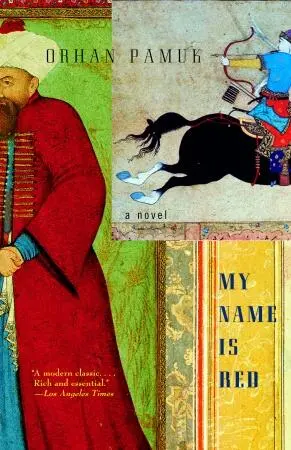
- Название:My Name is Red
- Автор:
- Жанр:
- Год:неизвестен
- ISBN:нет данных
- Рейтинг книги:5 / 5. Голосов: 1
-
Избранное:Добавить в избранное
- Отзывы:
-
Ваша оценка:
My Name is Red: краткое содержание, описание и аннотация
Предлагаем к чтению аннотацию, описание, краткое содержание или предисловие (зависит от того, что написал сам автор книги «My Name is Red»). Если вы не нашли необходимую информацию о книге — напишите в комментариях, мы постараемся отыскать её.
When the Sultan commissions a great book to celebrate his royal self and his extensive dominion, he directs Enishte Effendi to assemble a cadre of the most acclaimed artists in the land. Their task: to illuminate the work in the European style. But because figurative art can be deemed an affront to Islam, this commission is a dangerous proposition indeed, and no one in the elite circle can know the full scope or nature of the project.
Panic erupts when one of the chosen miniaturists disappears, and the Sultan demands answers within three days. The only clue to the mystery-or crime?-lies in the half-finished illuminations themselves. Has an avenging angel discovered the blasphemous work? Or is a jealous contender for the hand of Enishte’s ravishing daughter, the incomparable Shekure, somehow to blame?
Orhan Pamuk’s My Name Is Red is at once a fantasy and a philosophical puzzle, a kaleidoscopic journey to the intersection of art, religion, love, sex, and power.
"Pamuk is a novelist and a great one…My Name is Red is by far the grandest and most astonishing contest in his internal East-West war…It is chock-full of sublimity and sin…The story is told by each of a dozen characters, and now and then by a dog, a tree, a gold coin, several querulous corpses and the color crimson ('My Name is Red')…[Readers will] be lofted by the paradoxical lightness and gaiety of the writing, by the wonderfully winding talk perpetually about to turn a corner, and by the stubborn humanity in the characters' maneuvers to survive. It is a humanity whose lies and silences emerge as endearing and oddly bracing individual truths."- Richard Eder, New York Times Book Review
"A murder mystery set in sixteenth-century Istanbul [that] uses the art of miniature illumination, much as Mann's 'Doctor Faustus' did music, to explore a nation's soul… Erdag Goknar deserves praise for the cool, smooth English in which he has rendered Pamuk's finespun sentences, passionate art appreciations, sly pedantic debates, [and] eerie urban scenes."- John Updike, The New Yorker
"The interweaving of human and philosophical intrigue is very much as I remember it in The Name of the Rose, as is the slow, dense beginning and the relentless gathering of pace… But, in my view, his book is by far the better of the two. I would go so far as to say that Pamuk achieves the very thing his book implies is impossible… More than any other book I can think of, it captures not just Istanbul's past and present contradictions, but also its terrible, timeless beauty. It's almost perfect, in other words. All it needs is the Nobel Prize."-Maureen Freely, New Statesman (UK)
"A perfect example of Pamuk's method as a novelist, which is to combine literary trickery with page-turning readability… As a meditation on art, in particular, My Name is Red is exquisitely subtle, demanding and repaying the closest attention.. We in the West can only feel grateful that such a novelist as Pamuk exists, to act as a bridge between our culture and that of a heritage quite as rich as our own."-Tom Holland, Daily Telegraph (UK)
"Readers… will find themselves lured into a richly described and remarkable world… Reading the novel is like being in a magically exotic dream…Splendidly enjoyable and rewarding… A book in which you can thoroughly immerse yourself." -Allan Massie, The Scotsman (UK)
"A wonderful novel, dreamy, passionate and august, exotic in the most original and exciting way. Orhan Pamuk is indisputably a major novelist."-Philip Hensher, The Spectator (UK)
"[In this] magnificent new novel… Pamuk takes the reader into the strange and beautiful world of Islamic art,in which Western notions no longer make sense… In this world of forgeries, where some might be in danger of losing their faith in literature, Pamuk is the real thing, and this book might well be one of the few recent works of fiction that will be remembered at the end of this century."-Avkar Altinel, The Observer (UK)
My Name is Red — читать онлайн бесплатно полную книгу (весь текст) целиком
Ниже представлен текст книги, разбитый по страницам. Система сохранения места последней прочитанной страницы, позволяет с удобством читать онлайн бесплатно книгу «My Name is Red», без необходимости каждый раз заново искать на чём Вы остановились. Поставьте закладку, и сможете в любой момент перейти на страницу, на которой закончили чтение.
Интервал:
Закладка:
“Are you afraid, my child?” said Enishte Effendi compassionately, “of the paintings we’ve made?”
The room was black now, I couldn’t see for myself, but I sensed that he’d said this with a smile.
“Our book is no longer a secret,” I answered. “Perhaps this isn’t important. But rumors are spreading. They say we’ve underhandedly committed blasphemy. They say that, here, we’ve made a book-not as Our Sultan had commissioned and hoped for-but one meant to entertain our own whims; one that ridicules even Our Prophet and mimics infidel masters. There are those who believe it even depicts Satan as amiable. They say we’ve committed an unforgivable sin by daring to draw, from the perspective of a mangy street dog, a horsefly and a mosque as if they were the same size-with the excuse that the mosque was in the background-thereby mocking the faithful who attend prayers. I cannot sleep for thinking about such things.”
“We made the illustrations together,” said Enishte Effendi. “Could we have even considered such ideas, let alone committed such an offense?”
“Not at all,” I said expansively. “But they’ve heard about it somehow. They say there’s one final painting in which, according to the gossip, there’s open defiance of our religion and what we hold sacred.”
“You yourself have seen the final painting.”
“Nay, I made pictures of whatever you requested in various places on a large sheet, which was to be a double-leaf illustration,” I said with a caution and precision that I hoped would please Enishte Effendi. “But I never saw the completed illustration. If I had seen the entire painting, I’d have a clear conscience about denying all this foul slander.”
“Why is it that you feel guilty?” he asked. “What’s gnawing at your soul? Who has caused you to doubt yourself?”
“…to worry that one has attacked what he knows to be sacred, after spending months merrily illustrating a book…to suffer the torments of Hell while living…if I could only see that last painting in its entirety.”
“Is this what troubles you?” he said. “Is this why you’ve come?”
Suddenly panic seized me. Could he be thinking something horrendous, like I was the one who’d killed the ill-fated Elegant Effendi?
“Those who want Our Sultan dethroned and replaced by the prince,” I said, “are furthering this insidious gossip, saying that He secretly supports the book.”
“How many really believe that?” he asked wearily. “Every cleric with any ambition who’s met with some favor and whose head has swollen as a result will preach that religion is being ignored and disrespected. This is the most reliable way to ensure one’s living.”
Did he suppose I’d come solely to inform him of a rumor?
“Poor old Elegant Effendi, God rest his soul,” I said, my voice quavering. “Supposedly, we killed him because he saw the whole of the last painting and was convinced that it reviled our faith. A division head I know at the palace workshop told me this. You know how junior and senior apprentices are, everyone gossips.”
Maintaining this line of reasoning and growing increasingly impassioned, I went on for quite some time. I didn’t know how much of what I said I myself had indeed heard, how much I fabricated out of fear after doing away with that wicked slanderer, or how much I improvised. Having devoted much of the conversation to flattery, I was anticipating that Enishte Effendi would show me the two-page illustration and put me at ease. Why didn’t he realize this was the only way I might overcome my fears about being mired in sin?
Intending to startle him, I defiantly asked, “Might one be capable of making blasphemous art without being aware of it?”
In place of an answer, he gestured very delicately and elegantly with his hand-as if to warn me there was a child sleeping in the room-and I fell completely silent. “It has become very dark,” he said, almost in a whisper, “let’s light the candle.”
After lighting the candlestick from the hot coals of the brazier which heated the room, I noticed in his face an expression of pride, one to which I was unaccustomed, and this displeased me greatly. Or was it an expression of pity? Had he figured everything out? Was he thinking that I was some sort of a base murderer or was he frightened by me? I remember how suddenly my thoughts spiraled out of control and I was stupidly listening to what I thought as if somebody else was thinking. The carpet beneath me, for example: There was a kind of wolflike design in one corner, but why hadn’t I noticed it before?
“The love all khans, shahs and sultans feel for paintings, illustrations and fine books can be divided into three seasons,” said Enishte Effendi. “At first they are bold, eager and curious. Rulers want paintings for the sake of respect, to influence how others see them. During this period, they educate themselves. During the second phase, they commission books to satisfy their own tastes. Because they’ve learned sincerely to enjoy paintings, they amass prestige while at the same time amassing books, which, after their deaths, ensure the persistence of their renown in this world. However, in the autumn of a sultan’s life, he no longer concerns himself with the persistence of his worldly immortality. By ”worldly immortality“ I mean the desire to be remembered by future generations, by our grandchildren. Rulers who admire miniatures and books have already acquired an immortality through the manuscripts they’ve commissioned from us-upon whose pages they’ve had their names inserted, and, at times, their histories written. Later, each of them comes to the conclusion that painting is an obstacle to securing a place in the Otherworld, naturally something they all desire. This is what bothers and intimidates me the most. Shah Tahmasp, who was himself a master miniaturist and spent his youth in his own workshop, closed down his magnificent atelier as his death approached, chased his divinely inspired painters from Tabriz, destroyed the books he had produced and suffered interminable crises of regret. Why did they all believe that painting would bar them from the gates of Heaven?”
“You know quite well why! Because they remembered Our Prophet’s warning that on Judgment Day, Allah will punish painters most severely.”
“Not painters,” corrected Enishte Effendi. “Those who make idols. And this not from the Koran but from Bukhari.”
“On Judgment Day, the idol makers will be asked to bring the images they’ve created to life,” I said cautiously. “Since they’ll be unable to do so their lot will be to suffer the torments of Hell. Let it not be forgotten that in the Glorious Koran, ”creator“ is one of the attributes of Allah. It is Allah who is creative, who brings that which is not into existence, who gives life to the lifeless. No one ought to compete with Him. The greatest of sins is committed by painters who presume to do what He does, who claim to be as creative as He.”
I made my statement firmly, as if I, too, were accusing him. He fixed his gaze into my eyes.
“Do you think this is what we’ve been doing?”
“Never,” I said with a smile. “However, this is what Elegant Effendi, may he rest in peace, began to assume when he saw the last painting. He’d been saying that your use of the science of perspective and the methods of the Venetian masters was nothing but the temptation of Satan. In the last painting, you’ve supposedly rendered the face of a mortal using the Frankish techniques, so the observer has the impression not of a painting but of reality; to such a degree that this image has the power to entice men to bow down before it, as with icons in churches. According to him, this is the Devil’s work, not only because the art of perspective removes the painting from God’s perspective and lowers it to the level of a street dog, but because your reliance on the methods of the Venetians as well as your mingling of our own established traditions with that of the infidels will strip us of our purity and reduce us to being their slaves.”
Читать дальшеИнтервал:
Закладка:
Похожие книги на «My Name is Red»
Представляем Вашему вниманию похожие книги на «My Name is Red» списком для выбора. Мы отобрали схожую по названию и смыслу литературу в надежде предоставить читателям больше вариантов отыскать новые, интересные, ещё непрочитанные произведения.







Обсуждение, отзывы о книге «My Name is Red» и просто собственные мнения читателей. Оставьте ваши комментарии, напишите, что Вы думаете о произведении, его смысле или главных героях. Укажите что конкретно понравилось, а что нет, и почему Вы так считаете.