Orhan Pamuk - My Name is Red
Здесь есть возможность читать онлайн «Orhan Pamuk - My Name is Red» весь текст электронной книги совершенно бесплатно (целиком полную версию без сокращений). В некоторых случаях можно слушать аудио, скачать через торрент в формате fb2 и присутствует краткое содержание. Жанр: Современная проза, на английском языке. Описание произведения, (предисловие) а так же отзывы посетителей доступны на портале библиотеки ЛибКат.
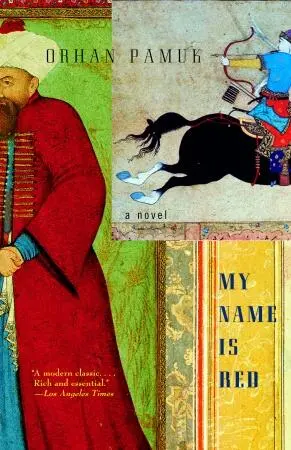
- Название:My Name is Red
- Автор:
- Жанр:
- Год:неизвестен
- ISBN:нет данных
- Рейтинг книги:5 / 5. Голосов: 1
-
Избранное:Добавить в избранное
- Отзывы:
-
Ваша оценка:
My Name is Red: краткое содержание, описание и аннотация
Предлагаем к чтению аннотацию, описание, краткое содержание или предисловие (зависит от того, что написал сам автор книги «My Name is Red»). Если вы не нашли необходимую информацию о книге — напишите в комментариях, мы постараемся отыскать её.
When the Sultan commissions a great book to celebrate his royal self and his extensive dominion, he directs Enishte Effendi to assemble a cadre of the most acclaimed artists in the land. Their task: to illuminate the work in the European style. But because figurative art can be deemed an affront to Islam, this commission is a dangerous proposition indeed, and no one in the elite circle can know the full scope or nature of the project.
Panic erupts when one of the chosen miniaturists disappears, and the Sultan demands answers within three days. The only clue to the mystery-or crime?-lies in the half-finished illuminations themselves. Has an avenging angel discovered the blasphemous work? Or is a jealous contender for the hand of Enishte’s ravishing daughter, the incomparable Shekure, somehow to blame?
Orhan Pamuk’s My Name Is Red is at once a fantasy and a philosophical puzzle, a kaleidoscopic journey to the intersection of art, religion, love, sex, and power.
"Pamuk is a novelist and a great one…My Name is Red is by far the grandest and most astonishing contest in his internal East-West war…It is chock-full of sublimity and sin…The story is told by each of a dozen characters, and now and then by a dog, a tree, a gold coin, several querulous corpses and the color crimson ('My Name is Red')…[Readers will] be lofted by the paradoxical lightness and gaiety of the writing, by the wonderfully winding talk perpetually about to turn a corner, and by the stubborn humanity in the characters' maneuvers to survive. It is a humanity whose lies and silences emerge as endearing and oddly bracing individual truths."- Richard Eder, New York Times Book Review
"A murder mystery set in sixteenth-century Istanbul [that] uses the art of miniature illumination, much as Mann's 'Doctor Faustus' did music, to explore a nation's soul… Erdag Goknar deserves praise for the cool, smooth English in which he has rendered Pamuk's finespun sentences, passionate art appreciations, sly pedantic debates, [and] eerie urban scenes."- John Updike, The New Yorker
"The interweaving of human and philosophical intrigue is very much as I remember it in The Name of the Rose, as is the slow, dense beginning and the relentless gathering of pace… But, in my view, his book is by far the better of the two. I would go so far as to say that Pamuk achieves the very thing his book implies is impossible… More than any other book I can think of, it captures not just Istanbul's past and present contradictions, but also its terrible, timeless beauty. It's almost perfect, in other words. All it needs is the Nobel Prize."-Maureen Freely, New Statesman (UK)
"A perfect example of Pamuk's method as a novelist, which is to combine literary trickery with page-turning readability… As a meditation on art, in particular, My Name is Red is exquisitely subtle, demanding and repaying the closest attention.. We in the West can only feel grateful that such a novelist as Pamuk exists, to act as a bridge between our culture and that of a heritage quite as rich as our own."-Tom Holland, Daily Telegraph (UK)
"Readers… will find themselves lured into a richly described and remarkable world… Reading the novel is like being in a magically exotic dream…Splendidly enjoyable and rewarding… A book in which you can thoroughly immerse yourself." -Allan Massie, The Scotsman (UK)
"A wonderful novel, dreamy, passionate and august, exotic in the most original and exciting way. Orhan Pamuk is indisputably a major novelist."-Philip Hensher, The Spectator (UK)
"[In this] magnificent new novel… Pamuk takes the reader into the strange and beautiful world of Islamic art,in which Western notions no longer make sense… In this world of forgeries, where some might be in danger of losing their faith in literature, Pamuk is the real thing, and this book might well be one of the few recent works of fiction that will be remembered at the end of this century."-Avkar Altinel, The Observer (UK)
My Name is Red — читать онлайн бесплатно полную книгу (весь текст) целиком
Ниже представлен текст книги, разбитый по страницам. Система сохранения места последней прочитанной страницы, позволяет с удобством читать онлайн бесплатно книгу «My Name is Red», без необходимости каждый раз заново искать на чём Вы остановились. Поставьте закладку, и сможете в любой момент перейти на страницу, на которой закончили чтение.
Интервал:
Закладка:
“Let’s continue to illustrate our book,” I said. “Let everything continue as it always has.”
“There’s a murderer among the miniaturists. I am continuing my work with Black Effendi.”
Was he provoking me to kill him?
“Where is Black now?” I asked. “Where is your daughter and her children?”
I sensed that some other power had placed these words into my mouth, yet I couldn’t restrain myself. There was no longer any way for me to be happy and hopeful. I could only be smart and sarcastic. Behind these two always entertaining jinns-intelligence and sarcasm-I sensed the presence of the Devil, who controlled them, overcoming me. At the same moment, the accursed dogs beyond the gate began to howl madly as if they’d tracked the scent of blood.
Had I lived this exact moment long ago? In a distant city, at a time which now seemed far from me, as a snow that I couldn’t see fell, by the light of a candle, I was attempting to explain through tears that I was entirely innocent to a crotchety old dotard, who’d accused me of stealing paint. Back then, just as now, dogs began to howl as if they’d smelled blood. And I understood from Enishte Effendi’s great chin, befitting an evil old man, and from his eyes, which he was finally able to fix mercilessly into mine, that he intended to crush me. I recalled this tattered memory from when I was a ten-year-old miniaturist’s apprentice like a picture whose outlines are clear but whose colors have faded. Thus was I living the present as though it were a distinct but faded memory.
So, as I arose and circled behind Enishte Effendi, lifting that new, huge and heavy bronze inkpot from among the familiar glass, porcelain and crystal ones that rested on his worktable, the hardworking miniaturist within me-that Master Osman had instilled in us all-was illustrating what I did and what I saw in distinct yet faded colors, not as something I was experiencing now but as if it were a memory from long ago. You know how in dreams we shudder to see ourselves as if from the outside, with the same sensation, holding the large yet small-mouthed bronze inkpot, I said:
“When I was a ten-year-old apprentice, I saw just such an inkpot.”
“It’s a three-hundred-year-old Mongol inkpot,” said Enishte Effendi. “Black brought it all the way from Tabriz. It’s for red.”
At that very moment, it was of course the Devil prodding me to drive that inkpot down with all my might onto this conceited old man’s faulty brain. But I didn’t give in to the Devil, and with false hope, I said, “It is I, I’m the one who murdered Elegant Effendi.”
You understand why I said this hopefully, don’t you? I trusted that Enishte would understand, and in turn, forgive me-that he would fear and help me.
I AM YOUR BELOVED UNCLE
A silence filled the room when he confessed he’d murdered Elegant Effendi. I assumed he’d kill me as well. My heart quickened. Had he come here to end my life or to confess and terrify me? Did he himself know what he wanted? I was afraid, realizing how absolutely unacquainted I was with the inner world of this magnificent artist whose splendid lines and magical use of color had been familiar to me for years. I could sense him standing stiffly behind me, there at the nape of my neck, holding that large inkpot reserved for red, but I didn’t turn to face him. I knew my silence would make him uneasy. “The dogs haven’t yet quieted down,” I said.
We fell silent again. This time, I knew that my death, or my somehow avoiding this misfortune, would depend on what I told him. All I knew aside from his work was that he was quite intelligent, and if you grant that an illustrator must never reveal his soul in his work, intelligence is, of course, an asset. How had he cornered me at home when no one else was here? My aged mind was furiously preoccupied with this question, but I was too confused to see myself out of this game. Where was Shekure?
“You knew it was me, didn’t you?” he asked.
I hadn’t known at all, not until he told me. In the back of my mind, I was even wondering whether he hadn’t done well by killing Elegant Effendi, and that the late miniaturist might’ve actually succumbed to his anxieties and made trouble for the rest of us.
I was ever so slightly grateful to this murderer, with whom I was alone in the empty house.
“I’m not surprised you killed him,” I said. Men like us who live with books and dream eternally of their pages fear only one thing in this world. What’s more, we’re struggling with something more forbidden and dangerous; that is, we’re struggling to make pictures in a Muslim city. As with Sheikh Muhammad of Isfahan, we miniaturists are inclined to feel guilty and regretful, we’re the first to blame ourselves before others do, to be ashamed and beg pardon of God and the community. We make our books in secret like shameful sinners. I know too well how submission to the endless attacks of hojas, preachers, judges and mystics who accuse us of blasphemy, how the endless guilt both deadens and nourishes the artist’s imagination.“
“You don’t fault me for murdering that idiotic miniaturist, do you then?”
“What attracts us to writing, illustrating and painting is bound up in this fear of retribution. It’s not only for money and favor that we kneel before our work from morning to evening, continuing by candlelight through the night to the point of blindness and sacrifice ourselves for pictures and books, it’s to escape the prattle of others, to escape the community, but in contrast to this passion to create, we also want those we’ve forsaken to see and appreciate the inspired pictures we’ve made-and if they should call us sinners? Oh, the suffering this brings upon the illustrator of genuine talent! Yet, genuine painting is hidden in the agony no one sees and no one creates. It’s contained in the picture, which on first sight, they’ll say is bad, incomplete, blasphemous or heretical. A genuine miniaturist knows he must reach that point, yet at the same time, he fears the loneliness that awaits him there. Who would accede to such a frightful, nerve-wracking existence? By blaming himself before anyone else does, the artist believes he’ll be spared what he’s feared for years. Others listen to him and believe him only when he admits his guilt, for which he is then condemned to burn in Hell-the illustrator of Isfahan lit these hellfires himself.”
“But you’re not a miniaturist,” he said. “I didn’t kill him out of fear.”
“You murdered him because you wanted to paint as you wished, without fear.”
For the first time in a long while, the miniaturist who aspired to be my murderer said something quite intelligent: “I know you’re explaining all this to distract me, to dupe me, to get yourself out of this situation,” and he added, “but what you’ve just said is the truth. I want you to understand, listen to me.”
I looked into his eyes. He’d completely forgotten the formality customary between us as he spoke: He’d been carried away by his own thoughts. But to where?
“Never fear, I won’t offend your honor,” he said. He laughed bitterly as he circled around to face me. “Even now,” he said, “as I’m doing this, it doesn’t seem to be me. It’s as if there’s something writhing within me compelling me to do its evil bidding. Yet I need that thing nonetheless. It’s that way with painting, too.”
“These are old wives’ tales about the Devil.”
“You think I’m lying, then?”
He didn’t have enough courage to murder me, so he wanted me to enrage him. “Nay, you’re not lying but you’re not acknowledging what you feel either.”
“I acknowledge very well what I feel. I’m suffering the torments of the grave without having died. Unawares, we’ve sunk to our necks in sin because of you, and now you’re preaching ”more courage.“ You’re the one who’s made me a murderer. Nusret Hoja’s rabid henchmen will kill us all.”
Читать дальшеИнтервал:
Закладка:
Похожие книги на «My Name is Red»
Представляем Вашему вниманию похожие книги на «My Name is Red» списком для выбора. Мы отобрали схожую по названию и смыслу литературу в надежде предоставить читателям больше вариантов отыскать новые, интересные, ещё непрочитанные произведения.








Обсуждение, отзывы о книге «My Name is Red» и просто собственные мнения читателей. Оставьте ваши комментарии, напишите, что Вы думаете о произведении, его смысле или главных героях. Укажите что конкретно понравилось, а что нет, и почему Вы так считаете.