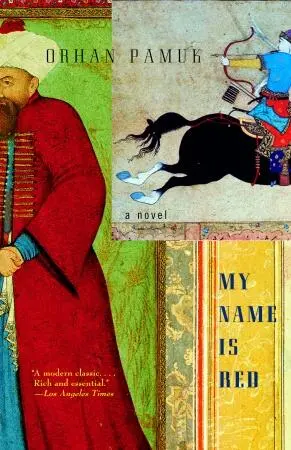
Orhan Pamuk - My Name is Red
Здесь есть возможность читать онлайн «Orhan Pamuk - My Name is Red» весь текст электронной книги совершенно бесплатно (целиком полную версию без сокращений). В некоторых случаях можно слушать аудио, скачать через торрент в формате fb2 и присутствует краткое содержание. Жанр: Современная проза, на английском языке. Описание произведения, (предисловие) а так же отзывы посетителей доступны на портале библиотеки ЛибКат.
- Название:My Name is Red
- Автор:
- Жанр:
- Год:неизвестен
- ISBN:нет данных
- Рейтинг книги:5 / 5. Голосов: 1
-
Избранное:Добавить в избранное
- Отзывы:
-
Ваша оценка:
My Name is Red: краткое содержание, описание и аннотация
Предлагаем к чтению аннотацию, описание, краткое содержание или предисловие (зависит от того, что написал сам автор книги «My Name is Red»). Если вы не нашли необходимую информацию о книге — напишите в комментариях, мы постараемся отыскать её.
When the Sultan commissions a great book to celebrate his royal self and his extensive dominion, he directs Enishte Effendi to assemble a cadre of the most acclaimed artists in the land. Their task: to illuminate the work in the European style. But because figurative art can be deemed an affront to Islam, this commission is a dangerous proposition indeed, and no one in the elite circle can know the full scope or nature of the project.
Panic erupts when one of the chosen miniaturists disappears, and the Sultan demands answers within three days. The only clue to the mystery-or crime?-lies in the half-finished illuminations themselves. Has an avenging angel discovered the blasphemous work? Or is a jealous contender for the hand of Enishte’s ravishing daughter, the incomparable Shekure, somehow to blame?
Orhan Pamuk’s My Name Is Red is at once a fantasy and a philosophical puzzle, a kaleidoscopic journey to the intersection of art, religion, love, sex, and power.
"Pamuk is a novelist and a great one…My Name is Red is by far the grandest and most astonishing contest in his internal East-West war…It is chock-full of sublimity and sin…The story is told by each of a dozen characters, and now and then by a dog, a tree, a gold coin, several querulous corpses and the color crimson ('My Name is Red')…[Readers will] be lofted by the paradoxical lightness and gaiety of the writing, by the wonderfully winding talk perpetually about to turn a corner, and by the stubborn humanity in the characters' maneuvers to survive. It is a humanity whose lies and silences emerge as endearing and oddly bracing individual truths."- Richard Eder, New York Times Book Review
"A murder mystery set in sixteenth-century Istanbul [that] uses the art of miniature illumination, much as Mann's 'Doctor Faustus' did music, to explore a nation's soul… Erdag Goknar deserves praise for the cool, smooth English in which he has rendered Pamuk's finespun sentences, passionate art appreciations, sly pedantic debates, [and] eerie urban scenes."- John Updike, The New Yorker
"The interweaving of human and philosophical intrigue is very much as I remember it in The Name of the Rose, as is the slow, dense beginning and the relentless gathering of pace… But, in my view, his book is by far the better of the two. I would go so far as to say that Pamuk achieves the very thing his book implies is impossible… More than any other book I can think of, it captures not just Istanbul's past and present contradictions, but also its terrible, timeless beauty. It's almost perfect, in other words. All it needs is the Nobel Prize."-Maureen Freely, New Statesman (UK)
"A perfect example of Pamuk's method as a novelist, which is to combine literary trickery with page-turning readability… As a meditation on art, in particular, My Name is Red is exquisitely subtle, demanding and repaying the closest attention.. We in the West can only feel grateful that such a novelist as Pamuk exists, to act as a bridge between our culture and that of a heritage quite as rich as our own."-Tom Holland, Daily Telegraph (UK)
"Readers… will find themselves lured into a richly described and remarkable world… Reading the novel is like being in a magically exotic dream…Splendidly enjoyable and rewarding… A book in which you can thoroughly immerse yourself." -Allan Massie, The Scotsman (UK)
"A wonderful novel, dreamy, passionate and august, exotic in the most original and exciting way. Orhan Pamuk is indisputably a major novelist."-Philip Hensher, The Spectator (UK)
"[In this] magnificent new novel… Pamuk takes the reader into the strange and beautiful world of Islamic art,in which Western notions no longer make sense… In this world of forgeries, where some might be in danger of losing their faith in literature, Pamuk is the real thing, and this book might well be one of the few recent works of fiction that will be remembered at the end of this century."-Avkar Altinel, The Observer (UK)
My Name is Red — читать онлайн бесплатно полную книгу (весь текст) целиком
Ниже представлен текст книги, разбитый по страницам. Система сохранения места последней прочитанной страницы, позволяет с удобством читать онлайн бесплатно книгу «My Name is Red», без необходимости каждый раз заново искать на чём Вы остановились. Поставьте закладку, и сможете в любой момент перейти на страницу, на которой закончили чтение.
Интервал:
Закладка:
The less confident he became, the more he raised his voice and the more fiercely he gripped the inkpot. Would somebody passing down the snowy street hear his shouting and enter the house?
“How did you kill him?” I asked, more to buy time than out of curiosity. “How did you chance to meet at the mouth of that well?”
“The night Elegant Effendi left your house, he came to me,” he said, with an unexpected desire to confess. “He said he’d seen the final double-leaf painting. I tried at length to dissuade him from making an issue out of it. I got him to walk over to the area ravaged by the fire. I told him I had money buried near the well. When he heard that, he believed me…What better proof that an illustrator is motivated by greed alone? That’s another reason I’m not sorry. He was a talented, but mediocre artist. The greedy oaf was ready to dig into the frozen earth with his fingernails. You see, if I truly had gold pieces buried beside that well, I wouldn’t have had to do away with him. Yes, you hired yourself quite a miserable wretch to do your gilding. The dearly departed had finesse, but his choice of color and application was ordinary, and his illuminations were uninspired. I didn’t leave a trace…Tell me, then, what is the essence of ”style“? Today, both the Franks and the Chinese talk about the character of a painter’s talent, what they call ”style.“ Should style distinguish a good artist from others or not?”
“Fear not,” I said, “a new style doesn’t spring from a miniaturist’s own desire. A prince dies, a shah loses a battle, a seemingly never-ending era ends, a workshop is closed and its members disband, searching for other homes and other bibliophiles to become their patrons. One day, a compassionate sultan will assemble these exiles, these bewildered but talented refugee miniaturists and calligraphers, in his own tent or palace and begin to establish his own book-arts workshop. Even if these artists, unaccustomed to one another, continue at first in their respective painting styles, over time, as with children who gradually become friends by roughhousing on the street, they’ll quarrel, bond, struggle and compromise. The birth of a new style is the result of years of disagreements, jealousies, rivalries and studies in color and painting. Generally, it’ll be the most gifted member of the workshop who fathers this form. Let’s also call him the most fortunate. To the rest of the miniaturists falls the singular duty of perfecting and refining this style through perpetual imitation.”
Unable to look me straight in the eye, he assumed an unexpected gentle manner, and begging my compassion as much as my honesty, he asked me, trembling like a maiden:
“Do I have a style of my own?”
I thought tears would flow from my eyes. With all the gentleness, sympathy and kindness I could muster, I hastened to tell him what I believed to be the truth:
“You are the most talented, divinely inspired artist with the most enchanted touch and eye for detail that I’ve seen in all my sixty years. If you put a painting before me which had seen the combined work of a thousand miniaturists, I’d still be able to recognize instantly the God-given magnificence of your pen.”
“Agreed, but I know you’re not wise enough to appreciate the mystery of my skill,” he said. “You’re lying, now, because you’re afraid of me. Describe, once again, the character of my methods.”
“Your pen selects the right line seemingly of its own accord, as if without your touch. What your pen draws is neither truthful nor frivolous! When you portray a crowded gathering, the tension emerging from the glances between figures, their positioning on the page and the meaning of the text metamorphose into an elegant eternal whisper. I return to your paintings again and again to hear that whisper, and each time, I realize with a smile that the meaning has changed, and how shall I put it, I begin to read the painting anew. When these layers of meaning are taken together, a depth emerges that surpasses even the perspectivism of the European masters.”
“Fine and well. Forget about the European masters. Start from the beginning.”
“You have such a truly magnificent and forceful line, that the observer believes in what you’ve painted rather than in reality itself. And just as your talent could create a picture that would force the most devout man to renounce his faith, it could also bring the most hopeless, unrepentant unbeliever to Allah’s path.”
“True, but I’m not sure that amounts to praise. Try again.”
“There’s no miniaturist who knows the consistency of paint and its secrets as well as you do. You always prepare and apply the glossiest, most vibrant, most genuine colors.”
“Yes, and what else?”
“You know you’re the greatest of painters after Bihzad and Mir Seyyid Ali.”
“Yes, I’m aware of this. If you are too, why are you making the book with that model of mediocrity Black Effendi?”
“First, the work he does doesn’t require a miniaturist’s skill,” I said. “Second, unlike yourself, he’s not a murderer.”
He smiled sweetly under the influence of my joke. With this, I thought I might be able to escape this nightmare thanks to a new expression-this word “style.” Upon my broaching the subject, we began a pleasant discussion concerning the bronze Mongol inkpot he held, not like father and son, but like two curious and experienced old men. The weight of the bronze, the balance of the inkpot, the depth of its neck, the length of old calligraphy reed pens and the mysteries of red ink, whose consistency he could feel as he gently swung the inkpot before me…We agreed that if the Mongols hadn’t brought the secrets of red paint-which they’d learned from Chinese masters-to Khorasan, Bukhara and Herat, we in Istanbul couldn’t make these paintings at all. As we talked, the consistency of time, like that of the paint, seemed to change, to flow ever more quickly. In a corner of my mind I was wondering why no one had yet returned home. If only he’d put down that weighty object.
With our customary workaday ease, he asked me, “When your book is finished, will those who see my work appreciate my skill?”
“If we can, God willing, finish this book without interference, Our Sultan will look it over, of course, checking first to see whether we used enough gold leaf in the appropriate places. Then, as if reading a description of Himself, as any sultan would, He’ll stare at his own portrait, struck by His own likeness rather than by our magnificent illustrations; thereafter, if He takes the time to examine the spectacle we’ve painstakingly and devotedly created at the expense of the light of our eyes, so much the better. You know, as well as I, that barring a miracle, He’ll lock the book away in His treasury without even asking who made the frame or the gilded illuminations, who painted this man or that horse-and like all skillful artisans, we’ll go back to painting, ever hopeful that one day a miracle of acknowledgment will find us.”
We were silent for a while, as if patiently waiting for something.
“When will that miracle happen?” he asked. “When will all those paintings we’ve worked on until we could no longer see straight truly be appreciated? When will they give me, give us, the respect we deserve?”
“Never!”
“How so?”
“They’ll never give you what you want,” I said. “In the future, you’ll be even less appreciated.”
“Books last for centuries,” he said proudly but without confidence.
“Believe me, none of the Venetian masters have your poetic sensibility, your conviction, your sensitivity, the purity and brightness of your colors, yet their paintings are more compelling because they more closely resemble life itself. They don’t paint the world as seen from the balcony of a minaret, ignoring what they call perspective; they depict what’s seen at street level, or from the inside of a prince’s room, taking in his bed, quilt, desk, mirror, his tiger, his daughter and his coins. They include it all, as you know. I’m not persuaded by everything they do. Attempting to imitate the world directly through painting seems dishonorable to me. I resent it. But there’s an undeniable allure to the paintings they make by those new methods. They depict what the eye sees just as the eye sees it. Indeed, they paint what they see, whereas we paint what we look at. Beholding their work, one comes to realize that the only way to have one’s face immortalized is through the Frankish style. And it’s not only the inhabitants of Venice who are captured by this notion, but all the tailors, butchers, soldiers, priests and grocers in all the Frankish lands…They all have their portraits made this way. Just a glance at those paintings and you too would want to see yourself this way, you’d want to believe that you’re different from all others, a unique, special and particuliar human being. Painting people, not as they are perceived by the mind, but as they are actually seen by the naked eye, painting in the new method, allows for this possibility. One day everyone will paint as they do. When ”painting“ is mentioned, the world will think of their work! Even a poor foolish tailor who understands nothing of illustrating will want such a portrait so he might be convinced, upon seeing the unique curve of his nose, that he’s not an ordinary simpleton, but an extraordinary man.”
Читать дальшеИнтервал:
Закладка:
Похожие книги на «My Name is Red»
Представляем Вашему вниманию похожие книги на «My Name is Red» списком для выбора. Мы отобрали схожую по названию и смыслу литературу в надежде предоставить читателям больше вариантов отыскать новые, интересные, ещё непрочитанные произведения.








Обсуждение, отзывы о книге «My Name is Red» и просто собственные мнения читателей. Оставьте ваши комментарии, напишите, что Вы думаете о произведении, его смысле или главных героях. Укажите что конкретно понравилось, а что нет, и почему Вы так считаете.