Orhan Pamuk - My Name is Red
Здесь есть возможность читать онлайн «Orhan Pamuk - My Name is Red» весь текст электронной книги совершенно бесплатно (целиком полную версию без сокращений). В некоторых случаях можно слушать аудио, скачать через торрент в формате fb2 и присутствует краткое содержание. Жанр: Современная проза, на английском языке. Описание произведения, (предисловие) а так же отзывы посетителей доступны на портале библиотеки ЛибКат.
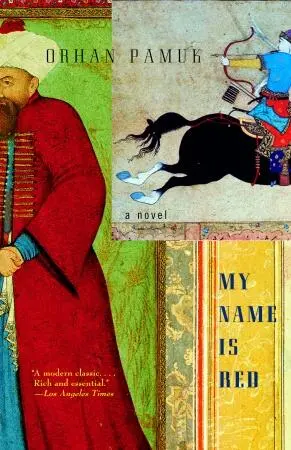
- Название:My Name is Red
- Автор:
- Жанр:
- Год:неизвестен
- ISBN:нет данных
- Рейтинг книги:5 / 5. Голосов: 1
-
Избранное:Добавить в избранное
- Отзывы:
-
Ваша оценка:
My Name is Red: краткое содержание, описание и аннотация
Предлагаем к чтению аннотацию, описание, краткое содержание или предисловие (зависит от того, что написал сам автор книги «My Name is Red»). Если вы не нашли необходимую информацию о книге — напишите в комментариях, мы постараемся отыскать её.
When the Sultan commissions a great book to celebrate his royal self and his extensive dominion, he directs Enishte Effendi to assemble a cadre of the most acclaimed artists in the land. Their task: to illuminate the work in the European style. But because figurative art can be deemed an affront to Islam, this commission is a dangerous proposition indeed, and no one in the elite circle can know the full scope or nature of the project.
Panic erupts when one of the chosen miniaturists disappears, and the Sultan demands answers within three days. The only clue to the mystery-or crime?-lies in the half-finished illuminations themselves. Has an avenging angel discovered the blasphemous work? Or is a jealous contender for the hand of Enishte’s ravishing daughter, the incomparable Shekure, somehow to blame?
Orhan Pamuk’s My Name Is Red is at once a fantasy and a philosophical puzzle, a kaleidoscopic journey to the intersection of art, religion, love, sex, and power.
"Pamuk is a novelist and a great one…My Name is Red is by far the grandest and most astonishing contest in his internal East-West war…It is chock-full of sublimity and sin…The story is told by each of a dozen characters, and now and then by a dog, a tree, a gold coin, several querulous corpses and the color crimson ('My Name is Red')…[Readers will] be lofted by the paradoxical lightness and gaiety of the writing, by the wonderfully winding talk perpetually about to turn a corner, and by the stubborn humanity in the characters' maneuvers to survive. It is a humanity whose lies and silences emerge as endearing and oddly bracing individual truths."- Richard Eder, New York Times Book Review
"A murder mystery set in sixteenth-century Istanbul [that] uses the art of miniature illumination, much as Mann's 'Doctor Faustus' did music, to explore a nation's soul… Erdag Goknar deserves praise for the cool, smooth English in which he has rendered Pamuk's finespun sentences, passionate art appreciations, sly pedantic debates, [and] eerie urban scenes."- John Updike, The New Yorker
"The interweaving of human and philosophical intrigue is very much as I remember it in The Name of the Rose, as is the slow, dense beginning and the relentless gathering of pace… But, in my view, his book is by far the better of the two. I would go so far as to say that Pamuk achieves the very thing his book implies is impossible… More than any other book I can think of, it captures not just Istanbul's past and present contradictions, but also its terrible, timeless beauty. It's almost perfect, in other words. All it needs is the Nobel Prize."-Maureen Freely, New Statesman (UK)
"A perfect example of Pamuk's method as a novelist, which is to combine literary trickery with page-turning readability… As a meditation on art, in particular, My Name is Red is exquisitely subtle, demanding and repaying the closest attention.. We in the West can only feel grateful that such a novelist as Pamuk exists, to act as a bridge between our culture and that of a heritage quite as rich as our own."-Tom Holland, Daily Telegraph (UK)
"Readers… will find themselves lured into a richly described and remarkable world… Reading the novel is like being in a magically exotic dream…Splendidly enjoyable and rewarding… A book in which you can thoroughly immerse yourself." -Allan Massie, The Scotsman (UK)
"A wonderful novel, dreamy, passionate and august, exotic in the most original and exciting way. Orhan Pamuk is indisputably a major novelist."-Philip Hensher, The Spectator (UK)
"[In this] magnificent new novel… Pamuk takes the reader into the strange and beautiful world of Islamic art,in which Western notions no longer make sense… In this world of forgeries, where some might be in danger of losing their faith in literature, Pamuk is the real thing, and this book might well be one of the few recent works of fiction that will be remembered at the end of this century."-Avkar Altinel, The Observer (UK)
My Name is Red — читать онлайн бесплатно полную книгу (весь текст) целиком
Ниже представлен текст книги, разбитый по страницам. Система сохранения места последней прочитанной страницы, позволяет с удобством читать онлайн бесплатно книгу «My Name is Red», без необходимости каждый раз заново искать на чём Вы остановились. Поставьте закладку, и сможете в любой момент перейти на страницу, на которой закончили чтение.
Интервал:
Закладка:
“So? We can make that portrait, as well,” quipped the witty assassin.
“We won’t!” I replied. “Haven’t you learned from your victim, the late Elegant Effendi, how afraid we are of being labeled imitators of the Franks? Even if we venture bravely to paint like them, it’ll amount to the same thing. In the end, our methods will die out, our colors will fade. No one will care about our books and our paintings, and those who do express interest will ask with a sneer, with no understanding whatsoever, why there’s no perspective-or else they won’t be able to find the manuscripts at all. Indifference, time and disaster will destroy our art. The Arabian glue used in the bindings contains fish, honey and bone, and the pages are sized and polished with a finish made from egg white and starch. Greedy, shameless mice will nibble these pages away; termites, worms and a thousand varieties of insect will gnaw our manuscripts out of existence. Bindings will fall apart and pages will drop out. Women lighting their stoves, thieves, indifferent servants and children will thoughtlessly tear out the pages and pictures. Child princes will scrawl over the illustrations with toy pens. They’ll blacken people’s eyes, wipe their runny noses on the pages, doodle in the margins with black ink. And religious censors will blacken out whatever is left. They’ll tear and cut up our paintings, perhaps use them to make other pictures or for games and such entertainment. While mothers destroy the illustrations they consider obscene, fathers and older brothers will jack off onto the pictures of women and the pages will stick together, not only because of this, but also due to being smeared with mud, water, bad glue, spit and all manner of filth and food. Stains of mold and dirt will blossom like flowers where the pages have stuck together. Rain, leaky roofs, floods and dirt will ruin our books. Of course, together with the tattered, faded and unreadable pages, which water, humidity, bugs and neglect will have reduced to pulp, the one last volume to emerge intact, like a miracle, from the bottom of a bone-dry chest will also one day disappear, swallowed up in the flames of a merciless fire. Is there a neighborhood in Istanbul that hasn’t been burned to the ground at least once every twenty years that we might expect such a book to survive? In this city, where every three years more books and libraries disappear than those the Mongols burned and plundered in Baghdad, what painter could possibly imagine that his masterpiece might last more than a century, or that one day his pictures might be seen, and he revered like Bihzad? Not only our own art, but every single work made in this world over the years will vanish in fires, be destroyed by worms or be lost out of neglect: Shirin proudly watching Hüsrev from a window; Hüsrev delightfully spying on Shirin as she bathes by moonlight; lovers gazing at each other with grace and subtlety; Rüstem’s wrestling a white demon to death at the bottom of a well; the anguished state of a lovelorn Mejnun befriending a white tiger and a mountain goat in the desert; the capture and hanging of a deceitful shepherd dog who presents a sheep from his flock to the she-wolf he mates with each night; the flower, angel, leafy twig, bird and teardrop border illuminations; the lute players that embellish Hafiz’s enigmatic poems; the wall ornamentations that have ruined the eyes of thousands, nay tens of thousands of miniaturist apprentices; the small plaques hung above doors and on walls; the couplets secretly written between the embedded borders of illustrations; the humble signatures hidden at the bases of walls, in corners, in facade embellishments, under the soles of feet, beneath shrubbery and between rocks; the flower-covered quilts covering lovers; the severed infidel heads patiently awaiting Our Sultan’s late grandfather as he victoriously marches upon an enemy fortress; the cannon, guns and tents that even in your youth you helped illustrate and that appeared in the background as the ambassador of the infidels kissed the feet of Our Sultan’s great-grandfather; the devils, with and without horns, with and without tails, with pointed teeth and with pointed nails; the thousands of varieties of birds including Solomon’s wise hoopoe, the jumping swallow, the dodo and the singing nightingale; the serene cats and restless dogs; fast-moving clouds; the small charming blades of grass reproduced in thousands of pictures; the amateurish shadows falling across rocks and tens of thousands of cypress, plane and pomegranate trees whose leaves were drawn one after another with the patience of Job; the palaces-and their hundreds of thousands of bricks-which were modeled on palaces from the time of Tamerlane or Shah Tahmasp but accompanied stories from much earlier eras; the tens of thousands of melancholy princes listening to music played by beautiful women and boys sitting on magnificent carpets in fields of flowers and beneath flowering trees; the extraordinary pictures of ceramics and carpets that owe their perfection to the thousands of apprentice illustrators from Samarkand to Islambol beaten to the point of tears over the last one hundred fifty years; the sublime gardens and the soaring black kites that you still depict with your old enthusiasm, your astounding scenes of death and war, your graceful hunting sultans, and with the same finesse, your startled fleeing gazelles, your dying shahs, your prisoners of war, your infidel galleons and your rival cities, your shiny dark nights that glimmer as if night itself had flowed from your pen, your stars, your ghostlike cypresses, your red-tinted pictures of love and death, yours and all the rest, all of it will vanish…”
Raising the inkpot, he struck me on the head with all his strength.
I tottered forward under the force of the blow. I felt a horrible pain that I could never even hope to describe. The entire world was wrapped in my pain and faded to yellow. A large portion of my mind assumed that this attack was intentional; yet, along with the blow-or perhaps because of it-another, faltering part of my mind, in a sad show of goodwill, wanted to say to the madman who aspired to be my murderer: “Have mercy, you’ve attacked me in error.”
He raised the inkpot again and brought it down upon my head.
This time, even the faltering part of my mind understood that this was no mistake, but madness and wrath that might very well end in my death. I was so terrified by this state of affairs that I began to raise my voice, howling with all my strength and suffering. The color of this howl would be verdigris, and in the blackness of evening on the empty streets, no one would be able to hear its hue; I knew I was all alone.
He was startled by my wail and hesitated. We momentarily came eye to eye. I could tell from his pupils that, despite his horror and embarrassment, he’d resigned himself to what he was doing. He was no longer the master miniaturist I knew, but an unfamiliar and ill-willed stranger who didn’t speak my language, and this sensation protracted my momentary isolation for centuries. I wanted to hold his hand, as if to embrace this world; it was of no use. I begged, or thought I did: “My child, my dear child, please do not end my life.” As if in a dream, he seemed not to hear.
He lowered the inkpot onto my head again.
My thoughts, what I saw, my memories, my eyes, all of it, merging together, became fear. I could see no one color and realized that all colors had become red. What I thought was my blood was red ink; what I thought was ink on his hands was my flowing blood.
How unjust, cruel, and merciless I found it to be dying at that instant. Yet, this was the conclusion that my aged and bloody head was slowly coming to. Then I saw it. My recollections were stark white, like the snow outside. My heart ached as it throbbed as if within my mouth.
Читать дальшеИнтервал:
Закладка:
Похожие книги на «My Name is Red»
Представляем Вашему вниманию похожие книги на «My Name is Red» списком для выбора. Мы отобрали схожую по названию и смыслу литературу в надежде предоставить читателям больше вариантов отыскать новые, интересные, ещё непрочитанные произведения.






Обсуждение, отзывы о книге «My Name is Red» и просто собственные мнения читателей. Оставьте ваши комментарии, напишите, что Вы думаете о произведении, его смысле или главных героях. Укажите что конкретно понравилось, а что нет, и почему Вы так считаете.