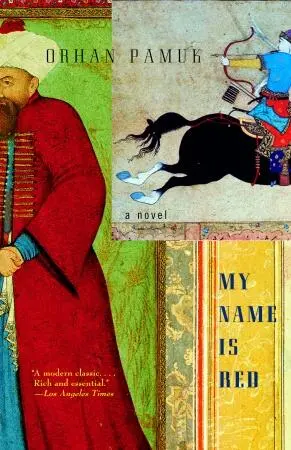
Orhan Pamuk - My Name is Red
Здесь есть возможность читать онлайн «Orhan Pamuk - My Name is Red» весь текст электронной книги совершенно бесплатно (целиком полную версию без сокращений). В некоторых случаях можно слушать аудио, скачать через торрент в формате fb2 и присутствует краткое содержание. Жанр: Современная проза, на английском языке. Описание произведения, (предисловие) а так же отзывы посетителей доступны на портале библиотеки ЛибКат.
- Название:My Name is Red
- Автор:
- Жанр:
- Год:неизвестен
- ISBN:нет данных
- Рейтинг книги:5 / 5. Голосов: 1
-
Избранное:Добавить в избранное
- Отзывы:
-
Ваша оценка:
My Name is Red: краткое содержание, описание и аннотация
Предлагаем к чтению аннотацию, описание, краткое содержание или предисловие (зависит от того, что написал сам автор книги «My Name is Red»). Если вы не нашли необходимую информацию о книге — напишите в комментариях, мы постараемся отыскать её.
When the Sultan commissions a great book to celebrate his royal self and his extensive dominion, he directs Enishte Effendi to assemble a cadre of the most acclaimed artists in the land. Their task: to illuminate the work in the European style. But because figurative art can be deemed an affront to Islam, this commission is a dangerous proposition indeed, and no one in the elite circle can know the full scope or nature of the project.
Panic erupts when one of the chosen miniaturists disappears, and the Sultan demands answers within three days. The only clue to the mystery-or crime?-lies in the half-finished illuminations themselves. Has an avenging angel discovered the blasphemous work? Or is a jealous contender for the hand of Enishte’s ravishing daughter, the incomparable Shekure, somehow to blame?
Orhan Pamuk’s My Name Is Red is at once a fantasy and a philosophical puzzle, a kaleidoscopic journey to the intersection of art, religion, love, sex, and power.
"Pamuk is a novelist and a great one…My Name is Red is by far the grandest and most astonishing contest in his internal East-West war…It is chock-full of sublimity and sin…The story is told by each of a dozen characters, and now and then by a dog, a tree, a gold coin, several querulous corpses and the color crimson ('My Name is Red')…[Readers will] be lofted by the paradoxical lightness and gaiety of the writing, by the wonderfully winding talk perpetually about to turn a corner, and by the stubborn humanity in the characters' maneuvers to survive. It is a humanity whose lies and silences emerge as endearing and oddly bracing individual truths."- Richard Eder, New York Times Book Review
"A murder mystery set in sixteenth-century Istanbul [that] uses the art of miniature illumination, much as Mann's 'Doctor Faustus' did music, to explore a nation's soul… Erdag Goknar deserves praise for the cool, smooth English in which he has rendered Pamuk's finespun sentences, passionate art appreciations, sly pedantic debates, [and] eerie urban scenes."- John Updike, The New Yorker
"The interweaving of human and philosophical intrigue is very much as I remember it in The Name of the Rose, as is the slow, dense beginning and the relentless gathering of pace… But, in my view, his book is by far the better of the two. I would go so far as to say that Pamuk achieves the very thing his book implies is impossible… More than any other book I can think of, it captures not just Istanbul's past and present contradictions, but also its terrible, timeless beauty. It's almost perfect, in other words. All it needs is the Nobel Prize."-Maureen Freely, New Statesman (UK)
"A perfect example of Pamuk's method as a novelist, which is to combine literary trickery with page-turning readability… As a meditation on art, in particular, My Name is Red is exquisitely subtle, demanding and repaying the closest attention.. We in the West can only feel grateful that such a novelist as Pamuk exists, to act as a bridge between our culture and that of a heritage quite as rich as our own."-Tom Holland, Daily Telegraph (UK)
"Readers… will find themselves lured into a richly described and remarkable world… Reading the novel is like being in a magically exotic dream…Splendidly enjoyable and rewarding… A book in which you can thoroughly immerse yourself." -Allan Massie, The Scotsman (UK)
"A wonderful novel, dreamy, passionate and august, exotic in the most original and exciting way. Orhan Pamuk is indisputably a major novelist."-Philip Hensher, The Spectator (UK)
"[In this] magnificent new novel… Pamuk takes the reader into the strange and beautiful world of Islamic art,in which Western notions no longer make sense… In this world of forgeries, where some might be in danger of losing their faith in literature, Pamuk is the real thing, and this book might well be one of the few recent works of fiction that will be remembered at the end of this century."-Avkar Altinel, The Observer (UK)
My Name is Red — читать онлайн бесплатно полную книгу (весь текст) целиком
Ниже представлен текст книги, разбитый по страницам. Система сохранения места последней прочитанной страницы, позволяет с удобством читать онлайн бесплатно книгу «My Name is Red», без необходимости каждый раз заново искать на чём Вы остановились. Поставьте закладку, и сможете в любой момент перейти на страницу, на которой закончили чтение.
Интервал:
Закладка:
“How do you mean?”
“If we were wed, would you live with my father, together with us?”
“I don’t know.”
“Think about this as soon as possible. You don’t have much time, believe me. My father senses that some evil is coming our way, and I think he’s right. If Hasan and his men raid our home with a handful of Janissaries and bring my father before the judge, would you testify that you’d in fact seen my husband’s corpse? You’ve recently come from Persia, they would believe you.”
“I would testify, but I wasn’t the one who killed him.”
“All right, then. Together with another witness, in order that I be declared a widow, would you testify before the judge that you saw my husband’s bloody corpse on the battlefield in Persia?”
“I didn’t actually see it, my dear, but for your sake I would testify so.”
“Do you love my children?”
“I do.”
“Tell me, what is it about them that you love?”
“I love Shevket’s strength, decisiveness, honesty, intelligence and stubbornness,” I said. “And I love Orhan’s sensitive and delicate demeanor and his astuteness. I love the fact that they’re your children.”
My black-eyed beloved smiled slightly and shed a few tears. Then, in the calculated fluster of a woman hoping to accomplish a lot in a short time, she changed the subject:
“My father’s book ought to be completed and presented to Our Sultan. This book is the source of the bad luck that plagues us.”
“What devilry has plagued us besides the murder of Elegant Effendi?”
This question displeased her. Appearing insincere in her attempt to be sincere, she said:
“The followers of Nusret Hoja are spreading rumors that my father’s book is a desecration and bears the marks of Frankish infideldom. Have the miniaturists who frequent our house grown jealous of each other to the degree that they’re hatching plans? You’ve been among them, you would know best!”
“Your late husband’s brother,” I said, “does he have any association with these miniaturists, your father’s book or the followers of Nusret Hoja, or does he keep to himself?”
“He’s not involved in any of that, but he doesn’t keep to himself at all,” she said.
A mysterious and strange quiet passed.
“When you lived in the same house with Hasan wasn’t there any way you could get away from him?”
“As much as possible in a two-room house.”
A few dogs, not too far away, giving themselves over completely to whatever they were up to, began barking excitedly.
I couldn’t bring myself to ask why Shekure’s late husband, a man who’d emerged victorious from so many battles and had become the proprietor of a fief, saw fit to have his wife live together with his brother in a two-room house. Timidly and hesitantly, I asked my childhood beloved the following question: “Why did you see fit to marry him?”
“I was, of course, certain to be married off to someone,” she said. This was true, and it succinctly and cleverly explained her marriage in a way that avoided praising her husband and upsetting me. “You’d left, perhaps never to return. Disappearing in a sulk might be a symptom of love, yet a sulking lover is also tiresome and holds no promise of a future.” This was true as well, but it wasn’t cause enough to marry that rogue. It wasn’t too difficult to deduce from her coy expression alone that a short time after I’d abandoned Istanbul, Shekure had forgotten about me, like everyone else had. She’d told me this blatant lie to mend my broken heart, if only a little, and I considered it a sign of her good intentions, which demanded my gratitude. I began to explain how during my travels I couldn’t get her out of my thoughts, how at night her image haunted me like a specter. This was the most secret, most profound agony I’d suffered and I assumed I’d never be able to share it with another; the agony was quite real, but as I realized with surprise at that instant, it wasn’t the least bit sincere.
So that my feelings and desires might be rightfully understood, I must presently lay bare the meaning of this distinction between truth and sincerity that I’ve come to know for the first time: How expressing one’s reality in words, as truthful as they might be, goads one to insincerity. Perhaps, the best example might be made of us miniaturists, who’ve grown edgy of late due to the murderer in our midst. Consider a perfect painting-the image of a horse, for instance-no matter how well it represents a real horse, the horse meticulously conceived by Allah or the horses of the great master miniaturists, it might still fail to match the sincerity of the talented miniaturist who drew it. The sincerity of the miniaturist, or of us humble servants of Allah, doesn’t emerge in moments of talent and perfection; on the contrary, it emerges through slips of the tongue, mistakes, fatigue and frustration. I say this for the sake of those young ladies who will become disillusioned when they see that there was no difference between the strong desire I felt for Shekure at that moment-as she too could tell-and, say, the dizzying lust I’d felt for a delicately featured, copper-complexioned, burgundy-mouthed Kazvin beauty during my travels. With her profound God-given savvy and jinnlike intuition, Shekure understood both my being able to withstand twelve years of pure torture for love’s sake as well as my behaving like a miserable thrall of lust who thought of nothing but the quick satisfaction of his dark desires the first time we were alone. Nizami had compared the mouth of that beauty of beauties, Shirin, to an inkwell filled with pearls.
When the eager dogs began barking with renewed fervor, a restless Shekure said, “I ought to go now.” It was at that moment we both realized that the house of the Jew’s ghost had indeed become quite dark, although there was still time before nightfall. My body sprung up of its own volition, to hug her once again, but like a wounded sparrow, she quickly hopped away.
“Am I still beautiful? Answer me quickly.”
I told her. How beautifully she listened to me, believing and agreeing with what I said.
“And my clothes?”
I told her.
“Do I smell nice?”
Of course, Shekure also knew that what Nizami referred to as “love chess” did not consist of such rhetorical games, but of the hidden emotional maneuvers between lovers.
“What kind of living do you expect to earn?” she asked. “Will you be able to care for my fatherless children?”
As I talked about my more than twelve years of governmental and secretarial experience, the vast knowledge I’d acquired in battle and witnessing death and my luminous prospects, I embraced her.
“How beautifully we embraced each other just now,” she said. “And already everything has lost its primal mystery.”
To prove how sincere I was, I hugged her even tighter. I asked her why, after having kept it for twelve years, she’d had Esther return the painting I’d made for her. In her eyes I read surprise at my weariness and an affection that welled up within her. We kissed. This time I didn’t find myself immobilized by a staggering yoke of lust; both of us were stunned by the fluttering-like a flock of sparrows-of a powerful love that had entered our hearts, chests and stomachs. Isn’t lovemaking the best antidote to love?
As I palmed her large breasts, Shekure pushed me away in an even more determined and sweeter way than before. She implied that I wasn’t a mature-enough man to maintain a trustworthy marriage with a woman that I’d sullied beforehand. I was careless enough to forget that the Devil would get involved in any hasty deeds and too inexperienced to know how much patience and quiet suffering underlie happy marriages. She’d escaped my arms and was walking toward the door, her linen veil having fallen around her neck. I caught sight of the snow falling onto the streets, which always succumbed to the darkness first, and forgetting that we’d been whispering here, perhaps to avoid disturbing the spirit of the Hanged Jew, I cried out:
Читать дальшеИнтервал:
Закладка:
Похожие книги на «My Name is Red»
Представляем Вашему вниманию похожие книги на «My Name is Red» списком для выбора. Мы отобрали схожую по названию и смыслу литературу в надежде предоставить читателям больше вариантов отыскать новые, интересные, ещё непрочитанные произведения.









Обсуждение, отзывы о книге «My Name is Red» и просто собственные мнения читателей. Оставьте ваши комментарии, напишите, что Вы думаете о произведении, его смысле или главных героях. Укажите что конкретно понравилось, а что нет, и почему Вы так считаете.