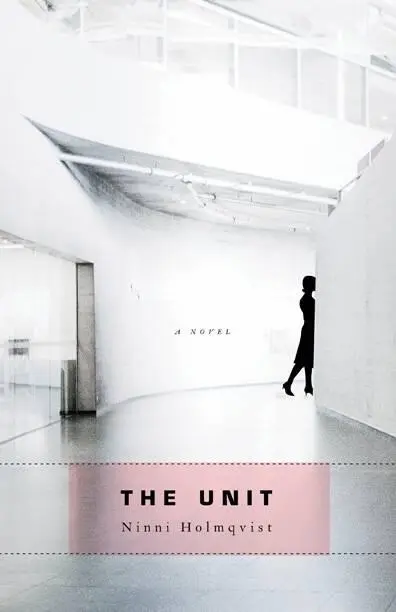
Ninni Holmqvist - The Unit
Здесь есть возможность читать онлайн «Ninni Holmqvist - The Unit» весь текст электронной книги совершенно бесплатно (целиком полную версию без сокращений). В некоторых случаях можно слушать аудио, скачать через торрент в формате fb2 и присутствует краткое содержание. Жанр: Современная проза, на английском языке. Описание произведения, (предисловие) а так же отзывы посетителей доступны на портале библиотеки ЛибКат.
- Название:The Unit
- Автор:
- Жанр:
- Год:неизвестен
- ISBN:нет данных
- Рейтинг книги:3 / 5. Голосов: 1
-
Избранное:Добавить в избранное
- Отзывы:
-
Ваша оценка:
The Unit: краткое содержание, описание и аннотация
Предлагаем к чтению аннотацию, описание, краткое содержание или предисловие (зависит от того, что написал сам автор книги «The Unit»). Если вы не нашли необходимую информацию о книге — напишите в комментариях, мы постараемся отыскать её.
The Unit uncannily echoes its organ-donation-dystopia predecessor, Kazuo Ishiguro’s Never Let Me Go (2005); both imagine societies of extreme utilitarianism that plunder their margins for body parts, and both raise the prospect of art for art’s sake, and love for love’s, as weapons against such thinking. The Unit’s heroine, Dorrit, has chosen not to have children and thus “spill over like rising bread dough”; at the book’s opening, Dorrit’s independence has just earned her incarceration in the Unit, a death camp puzzlingly replete with art galleries and gourmet restaurants where her individualism seems to lapse into passivity.
Through flashbacks, we learn of all Dorrit has lost-her career as a novelist, her beloved dog, the small house she owned herself, the opportunities to save herself by becoming “useful” to society. These snippets of memory are interspersed with descriptions of the eponymous unit and its dying inhabitants, descriptions so matter-of-fact they lull. The novel grips toward the end when Dorrit finds love-and with it a potential escape-and makes a startling choice.
Dorrit’s play-by-play narration can be clunky in translation, but the spare, cumulative prose effectively reveals a character whose story can barely ward off the disintegration of the self it relates. Holmqvist cleverly makes that very self unreliable; The Unit is the latest in a trend of anti-heroic dystopias such as Never Let Me Go and P.D. James’s The Children of Men. In these novels of bad futures, the trustworthy memories of protagonists such as Nineteen Eighty-Four’s Winston Smith (“Airstrip One… had been called England or Britain, though London, [Winston] felt fairly certain, had always been called London”) are replaced by the self-delusions of narrators who mislead the reader and themselves lose control of the stories they are telling. In these novels, rebellion must be expressed obliquely. Like Kathy, the complacent carer of Never Let Me Go, who survives her childhood friends, nursing them as they donate all their organs, Dorrit displaces her anger onto a clearer-eyed friend who calls the Unit what it is, a “luxury slaughterhouse.”
While Holmqvist builds a powerfully imaginative scenario around the concept of killing off the childless, her message on gender roles is clumsy and unconvincing. In Dorrit’s world, flirting and other “typically male” behavior has been criminalized, and retrograde domestic fantasies have to be played out in secret, making the missionary position an act of transgression. We have come a long way from the rage of Margaret Atwood’s 1985 A Handmaid’s Tale, with its neo-Biblical America in which all women are forced either to bear children or to raise them. In today’s climate of threatened reproductive rights, a critique of compulsory motherhood would be welcome, but The Unit displays the same innate conservatism that is the pitfall of Never Let Me Go-a disturbing willingness to locate tragedy not in the horror of forced organ donation and premature death, but in Kathy and Dorrit’s lost opportunities to become mothers.
Copyright 2010 Fran Bigman
The Unit — читать онлайн бесплатно полную книгу (весь текст) целиком
Ниже представлен текст книги, разбитый по страницам. Система сохранения места последней прочитанной страницы, позволяет с удобством читать онлайн бесплатно книгу «The Unit», без необходимости каждый раз заново искать на чём Вы остановились. Поставьте закладку, и сможете в любой момент перейти на страницу, на которой закончили чтение.
Интервал:
Закладка:
I started to laugh-involuntarily. Johannes looked at me and started laughing too, a low, rumbling, and slightly hesitant laugh; perhaps he was laughing out of politeness because I was laughing, or so that he wouldn’t seem stupid, or perhaps he was just as torn as I was; perhaps this was his way of laughing involuntarily.
Majken, who had been standing a little way off in the room talking to Alice and Vanja and some other visitors, was now on her way over to us with a half full glass in her hand.
“Do you find it funny?” asked Majken, gesturing toward the picture of the fetus.
“Yes,” I said. “Or no. Or both. It’s… unpleasant. And yet it’s funny.”
“Hm…” said Majken. “That’s actually how I felt when I was painting it. The other way around, though. My first feeling was a kind of angry humor. But as I worked the fetus became more and more distorted and frightening. In the end I was actually slightly afraid of it. And I still am, I think.”
I was watching her as she talked, her green eyes exuding a sense of calm and harmony. But at the outer corner of one eye a tiny nerve was vibrating, almost imperceptibly; it twitched and quivered beneath the skin. This quivering, together with just the tiniest hint of tension around her mouth, was the only thing that gave away the fact that this harmony was not complete, that there was something inside that was not calm, and I was seized by an almost irresistible urge to put my arms around her, to console and protect. To try to save her. But just as during our nighttime stroll in Monet’s garden a week ago, I was afraid I would ruin the atmosphere if I gave in to my emotions and impulses.
The gallery was, as galleries usually are, light and airy-polished wooden floor, white walls, high ceiling-and in this particular gallery there was daylight despite the fact that it was evening. Since Majken was principally a visual artist, the exhibition consisted mainly of paintings, colorful and figurative. But at the far end of the bright hall was a wall painted black. There was a doorway in the wall with a heavy black curtain in front of it. Above the doorway was a sign in big blue neon letters: HERE.
As you approached the doorway and the curtain, you could hear, very faintly, a whispering voice from inside. It was enticing, this voice, there was something meditative and magnetic about it, and I was drawn all the way to the door; I moved the curtain aside slightly and looked into compact darkness. I walked in and let the curtain fall behind me. I stood still in the darkness, waiting for my eyes to grow accustomed to it, and after a little while I could just make out a faint, bluish light farther in.
I started to walk cautiously toward the light and the whispering, and immediately I could hear not one but two whispering voices. Or perhaps three, or even more, it was hard to make out, they were speaking out of the darkness, but from different directions. They were different distances away from me, coming and going, sometimes continuing on from one another, sometimes talking over one another. The voices were eager, but in a good way, not angry or pushy. It was impossible to make out what they were saying, but I had the impression that they were calling to me-well, not just to me, of course, but to me in my capacity as a visitor. The floor beneath my feet felt soft and silent, like a fitted carpet, and I couldn’t hear my own footsteps. I couldn’t see anything either, apart from the distant, bluish light far ahead; there was only black darkness around me, and I had the feeling that I was moving in a tunnel of some kind. After a while I also got the impression that there were several people around me. I couldn’t see anyone, but sometimes I thought I could hear breathing that wasn’t my own, or I felt a faint movement of the air as someone passed me, but I wasn’t sure.
The voices, the whispering voices, grew in number as I moved farther in. They didn’t get any louder, I was the one approaching them. I passed individual voices, leaving them behind me, but only to approach several more. Suddenly I was surrounded by these gentle, enticing, whispering voices. There were both women’s and men’s voices at first, but after a while I could hear the occasional child’s voice, shriller and higher, among the rest.
The blue glow ahead of me grew brighter and expanded; I was getting closer and closer, and it was getting cooler now, not cold but cool, and the smell of damp earth crept toward me. It was as if I were going into a cave, and when I got even farther in I heard, in the distance, something dripping among all the whispering voices, then the echo of slow footsteps. The whole thing was very calming: the sounds, the darkness, the smell of earth and the coolness, and I could feel my heartbeat literally slowing down and finding a more measured rhythm. My arms, shoulders, and the back of my neck felt pleasantly relaxed. My steps also grew slower, lighter, almost as if I were moving in slow motion. I was completely calm; my brain was lying there with its full weight inside my skull-for the first time in my life I could feel the weight of my brain. It lay there, heavy and silent. It wasn’t thinking, it wasn’t having opinions, it wasn’t arguing, it wasn’t analyzing. It was only controlling my bodily functions and sensory organs, and I don’t think my senses had ever been so sharp before. And in this very clear, highly receptive and yet incredibly relaxed state I stepped into an oval room with high, small glass paintings along the black walls, my footsteps echoing on a marble floor. There were obviously people in here; it was their footsteps I had heard, accompanied by the whispering voices and the sound of dripping.
The people were dark shadows, moving as if they were in a trance. The dripping sound was louder now, closer, the whispering voices as before, some close, some farther away, children’s voices and adult voices, women and men, and the words were still impossible to make out. It was dark in here too, but the glass paintings, with abstract motifs in shades of blue and turquoise, were illuminated and in their faint glow I could see, apart from the figures moving slowly around the room, a large rounded stone, a natural rock, about the same height as the withers of a small pony or a large dog, in the center of the room. And from somewhere above a drop of water fell at regular intervals, perhaps every five or six seconds, straight down into a hollow in the top of the stone. The hollow was full of water and the water was overflowing, running down the curve of the stone into a round black vat in which the stone was standing.
I stood there watching the falling droplets and the running water, covering the stone like a clear veil, until I became conscious of the warmth of another body at my side, and looked up. It was Majken herself, and she nodded silently at me. I nodded back. The whites of her eyes were luminous in the bluish glow of the glass paintings; her hair had its nocturnal golden gray sheen and looked very soft and silky, like angora, and without thinking about what I was doing I raised my hand and stroked her hair gently and slowly with the tips of my fingers-it really was very soft-and let them glide down over the nape of her neck and along her spine. When I reached the base of her spine I stopped, and slowly withdrew my hand.
And now I felt someone doing the same thing to me-exactly that: someone , because it wasn’t Majken, it was someone standing directly behind me, moving their fingertips lightly down from the top of my head over my hair, down the nape of my neck and my spine, stopping at the base of my spine and disappearing. Afterward I turned around, but too slowly, I didn’t see who it was, I just heard the echo of measured footsteps moving away and dissolving into the darkness.
5
Интервал:
Закладка:
Похожие книги на «The Unit»
Представляем Вашему вниманию похожие книги на «The Unit» списком для выбора. Мы отобрали схожую по названию и смыслу литературу в надежде предоставить читателям больше вариантов отыскать новые, интересные, ещё непрочитанные произведения.










Обсуждение, отзывы о книге «The Unit» и просто собственные мнения читателей. Оставьте ваши комментарии, напишите, что Вы думаете о произведении, его смысле или главных героях. Укажите что конкретно понравилось, а что нет, и почему Вы так считаете.