Malcolm Bradbury - Doctor Criminale
Здесь есть возможность читать онлайн «Malcolm Bradbury - Doctor Criminale» весь текст электронной книги совершенно бесплатно (целиком полную версию без сокращений). В некоторых случаях можно слушать аудио, скачать через торрент в формате fb2 и присутствует краткое содержание. Город: London, Год выпуска: 2000, ISBN: 2000, Издательство: Picador, Жанр: Современная проза, на английском языке. Описание произведения, (предисловие) а так же отзывы посетителей доступны на портале библиотеки ЛибКат.
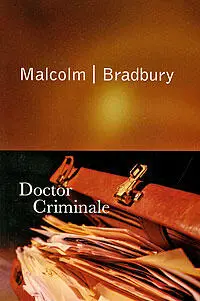
- Название:Doctor Criminale
- Автор:
- Издательство:Picador
- Жанр:
- Год:2000
- Город:London
- ISBN:978-0330390347
- Рейтинг книги:5 / 5. Голосов: 1
-
Избранное:Добавить в избранное
- Отзывы:
-
Ваша оценка:
Doctor Criminale: краткое содержание, описание и аннотация
Предлагаем к чтению аннотацию, описание, краткое содержание или предисловие (зависит от того, что написал сам автор книги «Doctor Criminale»). Если вы не нашли необходимую информацию о книге — напишите в комментариях, мы постараемся отыскать её.
Doctor Criminale — читать онлайн бесплатно полную книгу (весь текст) целиком
Ниже представлен текст книги, разбитый по страницам. Система сохранения места последней прочитанной страницы, позволяет с удобством читать онлайн бесплатно книгу «Doctor Criminale», без необходимости каждый раз заново искать на чём Вы остановились. Поставьте закладку, и сможете в любой момент перейти на страницу, на которой закончили чтение.
Интервал:
Закладка:
In case you are wondering, I never did get to see the opera in Vienna. As soon as Gerstenbacker had gone on his way, back to do Codicil’s bidding, as any good assistant should, I called Lavinia in her suite at the Hotel de France. ‘I’m just having coffee and hot rolls in bed,’ she said, ‘Listen, I found this wonderful exhibition at the Hermes villa called “Eroticism, Amorous Advances”. I’ve got two tickets. Come on over and we’ll try it.’ ‘Maybe I should pass up on eroticism today,’ I said, ‘Something interesting just came up.’ And I told her the story of Codicil and his strange little assistant. ‘I don’t believe it,’ said Lavinia, ‘You mean old Codicil doesn’t even write his own books?’ ‘Apparently it’s an old European custom,’ I said, ‘You remember School of Rembrandt.’ ‘You mean, so it’s really Dante’s assistant’s Divine Comedy ? Goethe’s pupil’s Faust ? That’s it,’ I said, ‘What’s more, Codicil claims he doesn’t remember a thing. Nobody remembers a thing. They all prefer not to.’ ‘I know, they have a name for it here, Waldheimer’s Disease,’ said Lavinia, ‘This is getting interesting, Francis.’
‘So what do I do now?’ I asked, ‘Codicil was the only lead.’ ‘Leave it to me,’ said Lavinia, ‘I can dump Eroticism for one day. I’ll cable London, call the travel agent, get down to the bank for some more cash. What’s the good of being a producer if you don’t produce?’ And to give her due credit, Lavinia certainly produced. She produced money, rickets, hotel arrangements, everything the occasion called for. Not much later, with the morning still quite young, I found myself standing on the platform at one of Vienna’s several railway stations, next to the coaches of the Salieri Express – one of those great European trains that adds and multiplies, subtracts and divides, this coach, going off to Brug or Altona, that one to Brigenza or Tallinn. I stood beside the coach marked Budapest, waiting for Lavinia, who had still not arrived. It was just as the train doors were about to close that I saw her, running heavily down the platform, yet another travel wallet waving in her hand.
‘There we are, that should cover everything,’ she said, ‘Now remember your treatment, don’t forget your plot. A man of many lives and loves.’ ‘Well, maybe,’ I said, ‘That was just how it looked to me at the time.’ ‘Find them, Francis, we’re talking television,’ said Lavinia, ‘And remember, when you get to this man Hollo, nestle in his bosom like a viper.’ ‘Do I gather you’re not coming?’ I asked. ‘Far too much to do in Vienna, darling, I’m afraid,’ said Lavinia. ‘But there’s nothing here,’ I said. ‘Oh, yes, atmosphere and background,’ said Lavinia, ‘What a shame. I was really looking forward to taking you to the opera. And to the champers after.’ ‘Never mind, Lavinia,’ I said, ‘I expect you’ll find someone to share it with.’ ‘Yes, I expect I will,’ admitted Lavinia. ‘Oh, and don’t forget to do something about young Gerstenbacker,’ I said, ‘He made all this happen.’ I’ll get in touch and find him a treat of some kind, don’t worry,’ said Lavinia.
Along the platform, the guard began whistling and waving his baton; I climbed up the steps of the Budapest coach. ‘Such a pity, darling,’ said Lavinia, reaching up to give me a very large kiss, ‘When one thinks of the things that might have been. But usually never are, of course.’ ‘I know,’ I said. ‘Well, bye, darling, must go, I’ve a lunch date at Sacher,’ said Lavinia, ‘Do good, and remember this. In fact say it every night before you go to sleep. Very tight budget.’ ‘Yes, Lavinia,’ I said, as the train doors hissed shut in front of me. A few minutes later, signs saying MELKA and MINOLTA, BAUHAUS and BP, SPAR and WANG were flying past the window of my second-class carriage, and I was once more rushing across Europe, looking, again, for Doctor Bazlo Criminale.
5
So where were you when the Eighties ended?
So where were you, exactly, when the Eighties ended? Try asking me and I can tell you quite precisely, the way some of the oldies can remember just what they were doing at the moment President John F. Kennedy was assassinated. I was on board that great trans-European train the Salieri Express, riding i east from Vienna to Budapest, Hungary, for what I thought was a very brief visit. I sat alone in the grey-upholstered compartment; my lightweight bag lay on the rack, my lightweight anorak hung on the hook beside me. Near me on the seat lay a paperback copy of The Magic Mountain , Thomas Mann’s fine I novel about disordered Europe just before the First World War. I had begun to read it; now for some reason I had set it aside and it lay neglected. I’d quickly bought it in the excellent British Bookshop, near the Stephansdom in Vienna, partly because it dealt with another part of turn-of-the-century forest kindly young Gerstenbacker had taken me through the previous day, but also for another reason. For the novel contains a famous portrait of a modern thinker, called Naphta in the book, and based on the Marxist Hungarian philosopher Georg Lukacs. And Lukacs (Budapest 1885 geboren, author of The Meaning of Contemporary Realism and Theory of the Novel) – a man of whom Mann said, ‘As long as he was talking, he was always right’ – was supposed to have had great influence over and significance for the man I was now hunting, Bazlo Criminale.
As soon as I started the book, I began having strange feelings of discomfort. For Mann’s book opens with a nice young man, Hans Castorp, well-meaning, naive, unassuming (in other words, just like myself), sitting alone with a book in the grey-upholstered compartment of a trans-European train, bag on the rack, coat on the hook, a book on the seat. Eighty years ahead of me, he’s beginning his quest for life in a disordered world, leaving the flatlands and off to the uplands on a very short visit that will last a long time. His view of the world is about to change completely; the world itself is about to change too. After a few minutes I put down the book and stared through the window. The train was crossing the Burgenland, once Austria’s Russian zone. To my left were the lowlands of the Danube plain – marshes, long fields, small tractors, little villages with onion-domed churches (perhaps a building with a cabbage on the top wasn’t so odd after all). To my right high hills sloped up to the great grey crags and whitened tops of the Eastern Alps. Grey mist blew across the plain to my left; the mountains on the right were dark with storm and wintry cloud. Behind me lay Vienna, baroque and deceptive; not far ahead lay the Hungarian frontier, at Hegyeshalom, recently a grim border through which the refugees of 1956 and 1989 had poured, bur now, they told me, no problem, no problem at all.
Feeling slightly uneasy, I pushed Mann’s book away and looked round the neat compartment. In front of me was a small table, rubbish bin underneath, on which lay a couple of papers left by the kind management for sophisticated international travellers like myself. One was a small blue rail timetable, which stated with precision and conviction the various arrival and departure times of the Salieri Express. The other was a small Austrian tabloid newspaper of no distinction, the Kurier , dated Freitag, 23 November, 1990 (the day, of course, on which I was travelling). I picked it up and began to read. Now, as I told you earlier, I don’t exactly read German, but there are times – late at night, after a drink or two, and especially when I’ve spent a couple of days in a German-speaking country – when it seems very nearly comprehensible. The headline for the day was a long one, and it read: ‘Die Eiserne Lady gibt auf: Rücktritt nach 11 Jahren. Eine Ära ist zu Ende.’
Читать дальшеИнтервал:
Закладка:
Похожие книги на «Doctor Criminale»
Представляем Вашему вниманию похожие книги на «Doctor Criminale» списком для выбора. Мы отобрали схожую по названию и смыслу литературу в надежде предоставить читателям больше вариантов отыскать новые, интересные, ещё непрочитанные произведения.






Обсуждение, отзывы о книге «Doctor Criminale» и просто собственные мнения читателей. Оставьте ваши комментарии, напишите, что Вы думаете о произведении, его смысле или главных героях. Укажите что конкретно понравилось, а что нет, и почему Вы так считаете.