Malcolm Bradbury - Doctor Criminale
Здесь есть возможность читать онлайн «Malcolm Bradbury - Doctor Criminale» весь текст электронной книги совершенно бесплатно (целиком полную версию без сокращений). В некоторых случаях можно слушать аудио, скачать через торрент в формате fb2 и присутствует краткое содержание. Город: London, Год выпуска: 2000, ISBN: 2000, Издательство: Picador, Жанр: Современная проза, на английском языке. Описание произведения, (предисловие) а так же отзывы посетителей доступны на портале библиотеки ЛибКат.
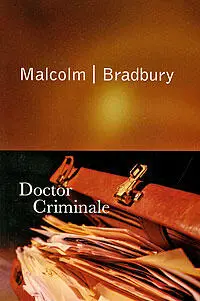
- Название:Doctor Criminale
- Автор:
- Издательство:Picador
- Жанр:
- Год:2000
- Город:London
- ISBN:978-0330390347
- Рейтинг книги:5 / 5. Голосов: 1
-
Избранное:Добавить в избранное
- Отзывы:
-
Ваша оценка:
Doctor Criminale: краткое содержание, описание и аннотация
Предлагаем к чтению аннотацию, описание, краткое содержание или предисловие (зависит от того, что написал сам автор книги «Doctor Criminale»). Если вы не нашли необходимую информацию о книге — напишите в комментариях, мы постараемся отыскать её.
Doctor Criminale — читать онлайн бесплатно полную книгу (весь текст) целиком
Ниже представлен текст книги, разбитый по страницам. Система сохранения места последней прочитанной страницы, позволяет с удобством читать онлайн бесплатно книгу «Doctor Criminale», без необходимости каждый раз заново искать на чём Вы остановились. Поставьте закладку, и сможете в любой момент перейти на страницу, на которой закончили чтение.
Интервал:
Закладка:
The building Gerstenbacker took me to was the famous Secession Building (motto: ‘To the age its art, and to art its freedom’); sure enough, it did indeed have a kind of cabbage-shaped metal dome on the top of it. We walked inside, to see the place where, in the 18905, Viennese baroque met Viennese modernism, and an art of the new, now already beginning to look like an art of the old, was born. ‘What about Professor Codicil?’ I asked as we looked round, ‘Does he see much of Criminale?’ ‘I think perhaps not any more, I think he no more comes so often,’ said Gerstenbacker, ‘Do you like to know who paid for all this?’ ‘Yes, who did?’ I asked. ‘Wittgenstein’s father,’ said Gerstenbacker. ‘So where does he spend most of his time these days?’ ‘In the tomb, I think. He is dead,’ said Gerstenbacker.
‘Now please, Gerstenbacker, not Wittgenstein’s father,’ I said sharply, ‘I’m trying to talk to you about Doctor Criminale.’ ‘But how can I tell you these things, really I have no idea,’ said Gerstenbacker innocently, ‘Did you know that Ludwig Wittgenstein and Adolf Hitler went to the same school?’ ‘No idea at all?’ I asked, ‘Wittgenstein and Hitler went to the same school ?’ ‘Yes, in Linz,’ said Gerstenbacker, ‘If only Adolf Hitler had had a bit better marks, he might today be professor of philosophy at your University of Cambridge.’ ‘That’s quite a thought,’ I said, ‘If Wittgenstein had had worse ones, he could have been up there telling the Nuremberg rallies that the limits of our language are the limits of our world.’ For a moment Gerstenbacker considered this gravely. ‘Perhaps it is theoretically possible,’ he said at last, ‘I do not think it is likely. But he would not have gone to Cambridge and you would have had no Viennese philosophy at all.’
When we went out into the street outside the Secession Building, Gerstenbacker started again. ‘So now I think you would like to see an opera house with cats.’ ‘What is an opera house with cats?’ I asked. ‘You don’t know cats?’ he asked, ‘Cats are by Andrew Lloyd Webber.’ By now I thought I had taken the point. Gerstenbacker was a perfectly nice young man, but the task assigned to him by Codicil was plainly to get me as far away from Criminale as possible. ‘You’re very kind, Mr Gerstenbacker,’ I said, ‘But really I don’t want to see any more Imperial Vienna, any more Baroque Vienna, any more Secession Vienna, any more Freudian Vienna. I especially don’t want to see Andrew Lloyd Webber’s Vienna. What I want to see is Criminale’s Vienna.’ ‘But it doesn’t exist,’ he said. ‘No?’ I asked. ‘After the Second World War when he came there really was no Vienna.’ ‘At least you admit he came,’ I said, ‘But what do you mean there was no Vienna?’ ‘Well, there were four Viennas,’ said Gerstenbacker, ‘There were four zones, Russian, American, British, French, yes? And now I think you must go to see the Blue Danube.’ ‘It’s not necessary,’ I said. ‘But of course,’ said Gerstenbacker, shocked, ‘You cannot come to Vienna and never see the Blue Danube. We will go to Nussdorf.’
So we went on a tram to Nussdorf, where we stood on the end of a decrepit pier and did not see the Blue Danube. For the Blue Danube, as you probably know all too well already, since we live in an age of travel, is not actually blue. That is probably why the Viennese, quite some time ago, considerately moved the Danube right out of the city altogether and put it in a concrete cutting in a far suburb, where it would not constantly be checked, and they could go on singing about it without embarrassment. We stood on the pier and stared down at a dirty brown flow as it passed nervelessly by; nearby a group of dispirited Japanese tourists refused even to uncap their cameras, despite the urgings of their dirndled guide. ‘It’s brown,’ I said, ‘It’s brown and muddy.’ ‘Yes,’ said Gerstenbacker, ‘But it is also going blue in certain lights.’ ‘Gerstenbacker,’ I said, as we turned and walked back into Nussdorf, ‘have you ever actually seen the Blue Danube when it was blue?’ ‘No, but I come from Graz,’ said Gerstenbacker. ‘Have any of your friends or relatives seen the Blue Danube when it was blue?’ I asked. ‘No,’ said Gerstenbacker, ‘But in Vienna we know it is blue.’
‘You mean it’s blue for the tourists,’ I suggested. ‘No, it is blue for us also,’ said Gerstenbacker, ‘And now I think you would like to try the Heurige, the new wine. I know a very good place in Heiligen where we can try some special growths.’ ‘Gerstenbacker,’ I said, as we got into a taxi, ‘am I right in thinking that one of your jobs as a great professor’s small assistant is to make sure I find out nothing at all about Doctor Criminale?’ ‘It’s possible,’ said Gerstenbacker, ‘Now I know you will like this place very much and after we have tasted some wines I will explain if you like why the Blue Danube is blue.’ ‘Very well,’ I said. ‘Oh by the way, this wine is quite strong,’ said Gerstenbacker, ‘Really we should eat a little pig with it, if your religion permits it.’ I looked at him. ‘My religion?’ I asked, ‘Oh, you mean the Jane Fonda diet? Yes, I’m allowed to eat pig.’ ‘Good,’ he said, ‘I think we will have a very nice evening.’
Gerstenbacker was quite right. In Heiligen we went into one of those large village inns where they advertise the new wines have arrived with a bunch of twigs outside; we sat down on hard wooden benches in a vast, folksy winehall, where a peasant band in leather knickerbockers drew music from a strange array of tubas, trumpets, logs and woodsaws; Gerstenbacker called over the apple-cheeked waitress, her purse hung like an economic pregnancy beneath her apron, and gave her a list of vintages. In wine as all else (except the matter of Bazlo Criminale), young Gerstenbacker was a fountain of knowledge; he talked of villages and vineyards and varieties, making me take a glass of this, share a flagon of that, and the more we tasted, the more expansive grew his talk. ‘Yes, why the Blue Danube is blue,’ he said, ‘Perhaps you don’t know it, but when Strauss wrote that music we had just lost a battle with Germans and our power was in decline. So for us the Danube became blue.’ ‘I see,’ I said. ‘Then was Sarajevo when the Archduke was shot by Princip, then 1918, when we lost our empire, our borders, our pride. You will understand this very well, I think, because you are British.’ ‘Yes, we do share some things in common,’ I said. ‘But it was not really the same,’ said Gerstenbacker, ‘We lost everything, our meaning, our history, our reality. All we had was music, dreams, illusions.’ ‘And the Blue Danube became even bluer,’ I said. Gersteribacker nodded. ‘Then there was 1945, we had lost again,’ he said, ‘Now we were nothing at all, an occupied country. We had to forget war, forget history. The Blue Danube is blue because we say it is blue. In Vienna, after what happened, do not expect too much reality. Now there is another wine we must try.’
After a further half-hour, Gerstenbacker’s wing collar had come awry, he wore his spectacles at an angle, and he had grown wildly talkative. ‘Tell me please, do you know this place Castle Howard?’ I nodded. ‘It is very nice, yes? I would really like to go there, for my thesis. Also Penshurst, Garsington, Charleston, Cliveden, where there was a set.’ ‘Very nice,’ I said, ‘It sounds a splendid subject for a thesis.’ ‘You see, most of your great philosophers were aristocrats, Earl of Russell, G.E. Moore and so on,’ said Gerstenbacker, ‘That is why they had time for strange questions, do I mean what I say when I say what I mean, is the moon made of green cheese, and so on. Wittgenstein loved this.’ ‘And you do too,’ I said, ‘Well, if you want any help in arranging a visit . . .’ ‘It’s possible, you think so?’ asked Gerstenbacker, staring at me eagerly through his twisted spectacles, ‘Maybe you will speak to your Ambassador when you see him at a party?’ ‘Maybe not the Ambassador,’ I said, ‘I don’t move that much in diplomatic circles. But we could probably get you over on this television project. If you were able to give us some leads on Bazlo Criminale.’
Читать дальшеИнтервал:
Закладка:
Похожие книги на «Doctor Criminale»
Представляем Вашему вниманию похожие книги на «Doctor Criminale» списком для выбора. Мы отобрали схожую по названию и смыслу литературу в надежде предоставить читателям больше вариантов отыскать новые, интересные, ещё непрочитанные произведения.





Обсуждение, отзывы о книге «Doctor Criminale» и просто собственные мнения читателей. Оставьте ваши комментарии, напишите, что Вы думаете о произведении, его смысле или главных героях. Укажите что конкретно понравилось, а что нет, и почему Вы так считаете.