Malcolm Bradbury - Doctor Criminale
Здесь есть возможность читать онлайн «Malcolm Bradbury - Doctor Criminale» весь текст электронной книги совершенно бесплатно (целиком полную версию без сокращений). В некоторых случаях можно слушать аудио, скачать через торрент в формате fb2 и присутствует краткое содержание. Город: London, Год выпуска: 2000, ISBN: 2000, Издательство: Picador, Жанр: Современная проза, на английском языке. Описание произведения, (предисловие) а так же отзывы посетителей доступны на портале библиотеки ЛибКат.
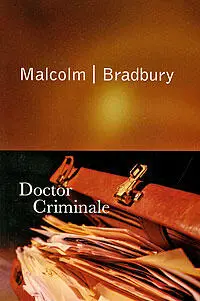
- Название:Doctor Criminale
- Автор:
- Издательство:Picador
- Жанр:
- Год:2000
- Город:London
- ISBN:978-0330390347
- Рейтинг книги:5 / 5. Голосов: 1
-
Избранное:Добавить в избранное
- Отзывы:
-
Ваша оценка:
Doctor Criminale: краткое содержание, описание и аннотация
Предлагаем к чтению аннотацию, описание, краткое содержание или предисловие (зависит от того, что написал сам автор книги «Doctor Criminale»). Если вы не нашли необходимую информацию о книге — напишите в комментариях, мы постараемся отыскать её.
Doctor Criminale — читать онлайн бесплатно полную книгу (весь текст) целиком
Ниже представлен текст книги, разбитый по страницам. Система сохранения места последней прочитанной страницы, позволяет с удобством читать онлайн бесплатно книгу «Doctor Criminale», без необходимости каждый раз заново искать на чём Вы остановились. Поставьте закладку, и сможете в любой момент перейти на страницу, на которой закончили чтение.
Интервал:
Закладка:
I stood outside the Votivkirche, and looked around. To one side stood the fine late-nineteenth-century buildings of the University of Vienna, decked out, like all university buildings, with its fair share of graffiti, the quick, modern way to publish. To the other were various notable buildings, and one of them, I suddenly realized, was the Hotel de France. And there, coming out of the beflagged entrance, ushered by a doorman, I was sure I saw Lavinia. The doorman helped her into a horse-drawn landau, and she jangled off, doubtless on another demanding day of producer’s duties. Stopping the passersby who were emerging from the metro at the Schottenpassage, I found one who spoke English, and was able to direct me to the Café Karl Kraus. This lay just round the corner in a sidestreet, one of those grandly elegant Secession cafés of which Vienna is still full. Looking through the window, I saw many tables, each of them overhung with fine brass lily-shaped lamps. At them, I saw, as I lifted the heavy door curtain and went inside, sat portly middle-aged people, people of substance; the men were mostly in loden coats, the women in embroidered blouses and porkpie hats with birdfeathers stuck in them. All had big winter boots on, and all of them were drinking coffee and reading newspapers stuck on very long wooden sticks.
An elderly and dignified head waiter approached me; ‘Grüss Gott, mein Herr,’ he said, looking me up and down. ‘Good morning,’ I said, ‘I’m looking for the professor.’ He looked at me strangely; I saw that many of the customers had set down their cakes and were raising their heads from their newspapers to inspect me. ‘You want the professor?’ he asked. ‘Yes, please, the professor,’ I said. ‘But, mein Herr,’ he said, ‘all the people here are professors. Over there, Herr Professor Doktor Stubl, the clinician, over there Herr Professor Magister Klimt, economistic. Over there is Herr Professor Hofrat Koegl, and over there Professor Doktor Ziegler, the famous Kritiker. Bitte, mein Herr, which professor?’ The professors were now all looking at me interrogatively, as if I had just arrived, late, for a viva on an examination in which I had not done at all well. ‘Professor Doktor Otto Codicil,’ I said. ‘Of course, the professor!’ said the maître d’, ‘He is at his usual table. Please to follow me.’ So I followed him right through the midst of the prodigious academic gathering to an alcove at the further end of the café, where behind curtains two men sat in conversation over coffee and cakes.
One was in his fairly late middle years, grey-haired, very large, formidably burly, and wearing an embroidered loden jacket that, for all its spacious fitting, somehow nowhere near contained his bulk. His companion was a good deal younger, little more than a youth. The maître d’ detained me with his arm for a moment, and went and whispered in the ear of the larger, older man. He put down his fork, turned, and stared at me analytically for some seconds. Then he rose enormously to his feet, came towards me, and held out an enormous hand. ‘My dear sir,’ he said, ‘Must I take it you are last night’s blandisher from the world of the ephemera?’ ‘I’m the man from British television,’ I said. ‘Exactly so,’ he said, ‘Professor Doktor Otto Codicil.’ ‘I’m Francis Jay,’ I said. ‘Then please be so kind as to join me at my table,’ he said, ‘But first before you sit down please meet my assistant, Herr Gerstenbacker. Our excellent young Gerstenbacker writes with me his habilitation and officially assists me in a variety of smallish ways.’
By now Gerstenbacker, too, had risen to meet me, his small face beaming beside and beneath Codicil’s great one. In appearance he seemed no more than eighteen, but he clearly made it his business to appear much older. He wore perfectly round spectacles, a small moustache, a black jacket, and a high-winged collar with a black bow tie. He bowed at me politely, remained standing to push my chair into position under me, and then said, ‘Welcome. Please, have a cake.’ ‘Gerstenbacker keeps an eye, or perhaps I had better say an ear, on my English,’ said Codicil, chuckling. ‘It is not necessary,’ said Gerstenbacker hastily, ‘Professor Codicil has a perfect English. He has once been the President of the Anglo-Austrian Friendship Society.’ ‘For my sins,’ said Codicil, ‘You must address it sometime. I will merely drop a word to my friend your British Ambassador.’ ‘I’m afraid there wouldn’t be time for that,’ I said, ‘I’m only here in Vienna for a couple of days.’ ‘Is that really?’ said Codicil, looking pleased, ‘So this is quite a fleeting sort of a visit, as they say. A here today and gone tomorrow affair.’ ‘Almost,’ I said. ‘Then maybe you will not mind if I am frank at once,’ said Codicil, looking me over again, ‘To me you are not at all what I expected.’ ‘No?’ I said, ‘What had you expected?’
Codicil leaned forward. ‘I had imagined,’ he said, ‘that someone seriously devoted to the difficult study of Criminale would be, and let me say I mean now no offence, of much older years and much greater stature. As I say, this means no offence. But you are a young man, no older than Gerstenbacker, a neophyte at the mysteries. Now please, do you prefer this cake, or that one? Or have both, or something else altogether? No need to hold your horses. Remember, this tab is entirely on me.’ ‘I’d just like coffee, if you don’t mind,’ I said, resisting this atmosphere of a school treat. ‘I think you like very much our coffee,’ said Gerstenbacker, as Codicil leaned back in his chair and waved his arm imperiously at the waiter, ‘I know the British admire it very much. I have been there, to your country.’
‘Yes, our young friend Gerstenbacker writes his thesis for me on a very interesting topic, Empirical Philosophy and the English Country House,’ said Codicil, ‘You are familiar with the British tradition of linguistic empiricism, important, of course, though in no sense as important as that of German idealism.’ ‘But quite important, don’t you think?’ asked Gerstenbacker anxiously. ‘Absolutely.’ I said. Gerstenbacker beamed. ‘Gerstenbacker’s proposal is that this tradition ignores the major continental heritage because your philosophers were all aristocrats or persons of Bloomsbury, for whom thinking was part-time,’ said Codicil. ‘The Country House is the home of the amateur spirit,’ said Gerstenbacker, ‘That is why I concentrate there. Also these are very nice places to visit.’ ‘Of course I have told Gerstenbacker he too is a mere neophyte at the mysteries,’ said Codicil, ‘Really he must study for ten more years at least before he begins to understand anything. His real life of the mind has yet to begin. Isn’t it so, Gerstenbacker?’ ‘Exactly so, Herr Professor,’ said Gerstenbacker humbly.
Codicil suddenly turned to me. ‘And so, you think you have read my book?’ he asked. ‘As well as I could,’ I said, ‘I’m afraid my German is nowhere near as good as your English.’ Codicil beamed, then thought visibly, then frowned. ‘Then you have not read my book,’ he said, ‘To know a book you must know the soul, the heart and above all the tongue of the writer.’ ‘That’s why I wanted to meet you,’ I said. ‘To gather up my soul, my heart, and my tongue?’ cried Codicil, ‘Believe me, these treasures are not for sale. They can only be won by a lifetime of effort. And you also say you have read Criminale?’ ‘Quite a bit,’ I said. ‘The matter with Martin Heidegger?’ he asked. ‘The quarrel over irony?’ I countered. ‘Tell me,’ said Codicil, ‘do you accept that Criminale grasps both horns of the Heideggerian dilemma?’ ‘Well, perhaps one horn rather better than the other,’ I said. Codicil looked at me, considered, then clapped me heartily on the back. ‘I agree with you!’ he said, chuckling, ‘Heidegger was too clever an old fox to be defeated so easily. I knew him well, you see.’ ‘Of course the Professor has known everybody,’ said Gerstenbacker.
Читать дальшеИнтервал:
Закладка:
Похожие книги на «Doctor Criminale»
Представляем Вашему вниманию похожие книги на «Doctor Criminale» списком для выбора. Мы отобрали схожую по названию и смыслу литературу в надежде предоставить читателям больше вариантов отыскать новые, интересные, ещё непрочитанные произведения.




Обсуждение, отзывы о книге «Doctor Criminale» и просто собственные мнения читателей. Оставьте ваши комментарии, напишите, что Вы думаете о произведении, его смысле или главных героях. Укажите что конкретно понравилось, а что нет, и почему Вы так считаете.