Malcolm Bradbury - Doctor Criminale
Здесь есть возможность читать онлайн «Malcolm Bradbury - Doctor Criminale» весь текст электронной книги совершенно бесплатно (целиком полную версию без сокращений). В некоторых случаях можно слушать аудио, скачать через торрент в формате fb2 и присутствует краткое содержание. Город: London, Год выпуска: 2000, ISBN: 2000, Издательство: Picador, Жанр: Современная проза, на английском языке. Описание произведения, (предисловие) а так же отзывы посетителей доступны на портале библиотеки ЛибКат.
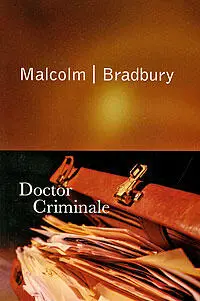
- Название:Doctor Criminale
- Автор:
- Издательство:Picador
- Жанр:
- Год:2000
- Город:London
- ISBN:978-0330390347
- Рейтинг книги:5 / 5. Голосов: 1
-
Избранное:Добавить в избранное
- Отзывы:
-
Ваша оценка:
Doctor Criminale: краткое содержание, описание и аннотация
Предлагаем к чтению аннотацию, описание, краткое содержание или предисловие (зависит от того, что написал сам автор книги «Doctor Criminale»). Если вы не нашли необходимую информацию о книге — напишите в комментариях, мы постараемся отыскать её.
Doctor Criminale — читать онлайн бесплатно полную книгу (весь текст) целиком
Ниже представлен текст книги, разбитый по страницам. Система сохранения места последней прочитанной страницы, позволяет с удобством читать онлайн бесплатно книгу «Doctor Criminale», без необходимости каждый раз заново искать на чём Вы остановились. Поставьте закладку, и сможете в любой момент перейти на страницу, на которой закончили чтение.
Интервал:
Закладка:
Then, a decade or so later, the French suddenly discovered what the Eiffel Tower was really for. It made the perfect radio transmitter, and this meant it was a perfect act of prescience on Gustave’s part, because radio hadn’t even been invented when he put it up. Instead of putting him in prison, Eiffel was feted and given the Légion d’Honneur, and the Tower, far from meaning nothing, came to mean everything, became the symbol of modern, future-hungry Paris itself. And so, a hundred years on, in 1989, when it once again came time for end-of-the-century celebration, the Bicentennial celebrations of the French Revolution also became the Centennial celebrations of the Eiffel Tower. The much-hated, monument of modernity was now lovingly restored (by, I believe, the firm of Eiffel, which survives). Of course the French also celebrated, as the French do, by putting up an edifice. They therefore went to a postmodern Chinese-American architect, I.M. Pei, ours being a multi-cultural age. Pei’s thoughts were moving neither sideways nor upwards. He looked downwards, into the labyrinths and catacombs of the Louvre, exposed foundations and dungeons, the theme-park of old history, and then capped the lot with a small crystal pyramid of latticed precision.
And why not? Don’t we live now not in modern but postmodern times, the age of pluristyle, form as parody, art as quotation, the era of culture as world fair? In Berlin Honecker’s wall was coming down and turning into art-work, everywhere politics and culture were becoming spectacle. So, that July, lit by lasers and beamed worldwide (courtesy the transmission facilities of the Eiffel Tower), an international soprano sang the Marseillaise, and in the Champs-Elysées Egyptian belly-dancers gyrated with Caribbean limbo dancers, gays danced with, lesbians, Structuralist philosophers bunny-hopped with feminist gynocritics, Hungarian security men tangoed with French riot cops, in a great multiplication of images and styles and cultures and genders, so that everything was everything and nothing at the same time. And I know this, because this time I was there myself, writing some smart Deconstructive piece about it for my Serious Sunday. Great changes, great changes; we had learned how to live in the age of virtual reality, or so I said in my piece. And great changes need new philosophies, I observed also, mentioning the names of various new pioneers of thought: Lacan and Foucault, Deleuze and Baudrillard, Derrida and Lyotard, and – it now all came back to me – Bazlo Criminale i himself.
But even the thought that new times needed new thoughts was not itself all that new. For example, I remembered, when Gustave was pushing up his great phallic tower over Paris in 1889, a young philosopher named Henri Bergson was publishing his book Time and Free Will , which argued that the inner life of human consciousness had its own strange clock, quite different from that of daily historical time – a very modern notion which was found very appealing by his relative, by marriage, the even younger Marcel Proust. Meanwhile back in Vienna, which was becoming so modern and so gay, the young Doktor Sigmund Freud was having rather similar thoughts. He was not yet a great professor, he had not yet moved to his famous consulting rooms at Berggasse 19, which I had so conspicuously been trying to avoid in my last night’s dream-work, and the secret of dreams had not yet revealed itself to him as he bicycled through the Vienna Woods. But in 1889 he had already put out his plate, and was already trying out the method of free association – later to be known as the talking cure – on the contorted mental interior and labyrinthine psychic dungeons of a certain Frau Emmy von N.
But such things were happening everywhere in 1889. On that other great European river, the Rhine, in the Swiss city of Basel, another great professor, Professor Doktor Friedrich Nietzsche, had devoted himself to bringing the modern about. It had not been an easy job, and in fact in 1889 he started to go mad from rather too much of it. He began singing and grimacing uncontrollably in the streets, was found embracing carthorses, and he took to predicting, not very accurately, various plagues, earthquakes, droughts, global warmings, world wars and other millennial things. He sent letters to the Pope and other world notables, signed ‘Nietzsche Caesar’, suggesting that various people and some entire races should be shot. It was his divine and imperial mission to bring the fatality of the modern into existence, as he explained to various fellow academics (‘Dear Professor, in the end I would much have preferred being a Basel professor to being God. But I did not care to carry my personal egotism so far that for its sake I should fail to complete the creation of the world’). They got the great philosopher to the doctor at last. He conducted an examination, noting in his report: ‘Claims he is a famous man and asks for women all the time.’ Well, why not; he was, after all, a Herr Doktor Professor, the maker of the modern, and surely deserved his fair share of kindly human attention.
And despite all his difficulties, Nietzsche did manage to bring out a last book in that year of 1889. Called Götzendämmerung , or The Twilight of the False Gods , it was all about the age of earthquakes, apocalypse, and the coming of the modern. It was subtitled ‘How to Philosophize With a Hammer’, and this new technique in philosophy was to interest several people who came to birth in 1889. One was the child of a customs official at Braunau, up on the German-Austrian border, who attended the same school as Ludwig Wittgenstein, and then went to Vienna, hoping to become a painter. He did, though only of houses. But he joined the German army, survived the great collapse of 1918, and then reappeared, philosophical hammer at the ready, as Adolf Hitler, trying to forge the new world order exactly fifty years further on, in the year of 1939, and fifty years before the Berlin Wall came down.
So when you thought about it 1889 was quite a year, right across Europe – the time of Freud and Nietzsche, Ibsen and Zola, Max Nordau and Max Weber. In fact it was the great year of Modernismus, modern thought. And in Britain that year . . . well, in Britain that year, the British, as the British do, were coming along just a little late. The book of the year (I recalled from my research for my piece) was Jerome K. Jerome’s Three Men in a Boat , and London’s newest opera, all fantastic dreams and celestial-sounding music, was Gilbert and Sullivan’s The Gondoliers . But a dock strike produced a famous anthem, ‘The Red Flag’, George Bernard Shaw produced his Fabian Essays , and people started talking about Decadence. That year Oscar Wilde was feted, and Emile Zola’s British publisher was sent to prison for foulness. Six years later it was all changed. Emile Zola was being feted, and Oscar Wilde was being sent to prison for foulness. But nobody, not even Gustave Eiffel, ever claimed that the modern always proceeded in straight lines.
Nonetheless, it proceeded. Twenty-five years after 1889, the famous shot was fired at the Archduke in Sarajevo, somewhere to the south of me now. The Habsburg Empire fell the whole map of Europe was reshaped, and, as Gerstenbacker had so thoughtfully explained to me, the Blue Danube became even bluer. Twenty-five years after that, the age of disaster resumed. Freud died in London, James Joyce—published the finale of modernism, Finnegans Wake , in Paris, Hitler unwrapped his philosophical hammer in Poland, world war started again. Violence went crazy, modernity exploded, Europe tore up its borders and its cities, the Holocaust came, and the Blue Danube became bluer still. Twenty-five years after that was a quieter year, though some things of importance happened. The Cold War peaked, President Kennedy had just been assassinated, Leonid Brezhnev, Harold Wilson and Lyndon B. Johnson were all appointed to various top offices, and I saw the light of day. And twenty-five years after that . . . well, we all know about twenty-five years after that. In the world as graced now by my own presence, the statues of a hundred years ago, fifty years ago, twenty-five years ago, all came tumbling down. And the Hungarian border – which I just happened to be crossing at this particular moment, guards going down the train – opened up. And so did the entire eastern landscape my train now began to cross.
Читать дальшеИнтервал:
Закладка:
Похожие книги на «Doctor Criminale»
Представляем Вашему вниманию похожие книги на «Doctor Criminale» списком для выбора. Мы отобрали схожую по названию и смыслу литературу в надежде предоставить читателям больше вариантов отыскать новые, интересные, ещё непрочитанные произведения.



Обсуждение, отзывы о книге «Doctor Criminale» и просто собственные мнения читателей. Оставьте ваши комментарии, напишите, что Вы думаете о произведении, его смысле или главных героях. Укажите что конкретно понравилось, а что нет, и почему Вы так считаете.