Malcolm Bradbury - Doctor Criminale
Здесь есть возможность читать онлайн «Malcolm Bradbury - Doctor Criminale» весь текст электронной книги совершенно бесплатно (целиком полную версию без сокращений). В некоторых случаях можно слушать аудио, скачать через торрент в формате fb2 и присутствует краткое содержание. Город: London, Год выпуска: 2000, ISBN: 2000, Издательство: Picador, Жанр: Современная проза, на английском языке. Описание произведения, (предисловие) а так же отзывы посетителей доступны на портале библиотеки ЛибКат.
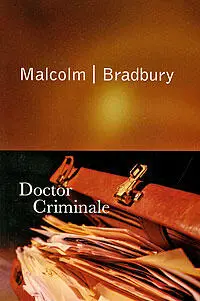
- Название:Doctor Criminale
- Автор:
- Издательство:Picador
- Жанр:
- Год:2000
- Город:London
- ISBN:978-0330390347
- Рейтинг книги:5 / 5. Голосов: 1
-
Избранное:Добавить в избранное
- Отзывы:
-
Ваша оценка:
Doctor Criminale: краткое содержание, описание и аннотация
Предлагаем к чтению аннотацию, описание, краткое содержание или предисловие (зависит от того, что написал сам автор книги «Doctor Criminale»). Если вы не нашли необходимую информацию о книге — напишите в комментариях, мы постараемся отыскать её.
Doctor Criminale — читать онлайн бесплатно полную книгу (весь текст) целиком
Ниже представлен текст книги, разбитый по страницам. Система сохранения места последней прочитанной страницы, позволяет с удобством читать онлайн бесплатно книгу «Doctor Criminale», без необходимости каждый раз заново искать на чём Вы остановились. Поставьте закладку, и сможете в любой момент перейти на страницу, на которой закончили чтение.
Интервал:
Закладка:
I was sharp enough to realize that, unless the world contained some more Iron Ladies that I didn’t know about, this almost certainly referred to Britain’s then Prime Minister, Mrs Margaret Thatcher, under whose regime I had grown accustomed to live. So I tuned my intelligence and set to work on the sentence. It seemed to say: The Iron Lady Takes Off, Fed Up After Eleven Years. An Era Is at an End.’ Was this true, I asked myself, amazed; could I be interpreting the words correctly? Now what you must understand is that I myself was one of the great brood of Thatcher’s Children. I was hardly past the hard acned days of puberty when she marched into 10 Downing Street in 1979, pronouncing in her loud clear voice ‘Now there is work to be done.’ Her life and work shaped mine. The ups and downs, the highs and lows, the booms and recessions, the Big Bangs and Small Crashes of her three terms of office were nothing less than the swings and cycles of what I liked to call my adult life. With my soul and my overdraft, my professional ambitions and my mountain bike, I was spawned from the era of what the Austrian newspaper in front of me described as ‘Der Thatcherismus’ – a term that, incidentally, sounded far more impressive in German than it ever possibly could in English.
So she’d gone, stepped down, gabbed off? How could she? Was it possible, how had it happened? I turned over the pages of the tabloid; and there inside, right across a double-page spread, was the fuller story, headed ‘Des Ringen um die Nachfolge.’ This sounded just like one of the Wagner operas Lavinia had been threatening me with in Vienna; but what did it mean? The Battle of the Night Birds? And if there had been a great drama, where was the cast? I looked down the page, and there they all were, set out as if in some opera programme, with photographs and brief descriptions. There was, I saw, Michael Heseltine, der Opportunist ;well, I understood that. Then there was Douglas Hurd, der alte Routinier (the old what? Truckdriver?), Sir Geoffrey Howe, der Totengraber (the Grave-snatcher?), and John Major, der Senkrechtstarter (what could that be? Kickstart?). Not quite, I found, scuffling hastily through my dictionary. The opera was The Struggle for the Succession, and the principal characters were the Opportunist, the Wise Old Hand, the Gravedigger, and the Vertical Take-Off Aircraft, who, I gathered, triumphed in the end. Add book by Martin Amis, celestial-sounding music by Andrew Lloyd Webber, oedipal dreams by Freud, a chorus or two of ‘Don’t Cry for Me, Argentina’, and Vienna’s newest musical extravaganza was plainly all ready to play.
Well, fine for them; but where, I thought, a young man in a grey-upholstered compartment, did all these dramas and denouements leave me? Just yesterday I’d been a poor youth without a history, a neophyte at the mysteries, as Professor Codicil had put it in his typically grandiloquent way. I was just another simple lad who didn’t even know why the Blue Danube had to be blue. Now, over the course of a single sleepless night (and mine, I realized, could hardly have been the only one), I had somehow acquired a little history after all. It was a modest portion, true enough – nothing compared with what had upturned Europe just a year before: the tumbling of the Berlin Wall, the ending of the Cold War, the opening up of the Eastern frontier I was just about to cross. In Britain, after all, we don’t hurry at history like that; but change had come, just the same. And the Iron Lady had made history, no doubt about that. Her rise, and now her fall, had been a great performance, made of conspiracy and pride, hubris and treachery, the ideal stuff for the media’s endless narrative, some of which I had written myself. Yes, for me too, Eine Ära ist zu Ende; an era had come to an end.
So what, then, would follow Der Thatcherismus? I looked again at the Austrian tabloid, and at once found the answer. What followed Der Thatcherismus was, of course, Der Post-Thatcherismus, the smart new epoch of which I had suddenly become a paid-up member. The thought made for strange emotions. Say what you would, the Thatcher Age had had a peculiar solidity; now the world seemed curiously indeterminate, no longer as stable and sure as it had been yesterday. I thought back again to the tour of Vienna that dear young Gerstenbacker had subjected me to the day before, when he was so desperately trying to please his master by diverting my mind from thoughts of Bazlo Criminale with the spectacles of a fin-de-siècle age. And it occurred to me now that, when centuries end, old orders do have a way of shaking and tumbling. In fact, when one considered it, there is nothing like observing a past suddenly slipping away and a great new millennium coming along for stirring the mind with troubled, if exciting, notions of change.
So, sitting there in my grey-upholstered compartment, I began to think about how different European centuries had ended. I recalled, for instance, that in 1889, one hundred years before the Berlin Wall came down, the Eiffel Tower went up. It went up because just a hundred years before that, in the turbulent ending of the previous century, the French Revolution had exploded, the world had turned upside-down, even the calendar had briefly begun anew. And so, in the same year as the Mayerling tragedy, when Vienna became so modern, and so gay, the French decided to celebrate, as the French do, by building an edifice, and turned to M. Gustave Eiffel. Why not? He was their greatest bridge-builder, and his triumphs were many. He had built an amazing span across the River Douro at Oporto, designed the locks for de Lesseps’ Suez Canal, built the Observatory at Nice, even put up a charming railway station in Budapest, into which I hoped I would shortly be stepping. He could therefore be counted on to put up some fine modern buildings for the Centennial World Fair, and maybe throw a fine iron bridge across the Seine that would give Parisians better access to their favourite cafés, boîtes , museums and artists’ studios. They gave him the commission.
What they didn’t know was that Eiffel’s thoughts had recently shifted from sideways to upwards. In a matter of months Eiffel got out his ironwork and built his tower. One morning in 1889 Parisians woke up and there, by God, it was. You couldn’t miss it; but, like a building that had a cabbage on top of it, it seemed to make no sense at all. It was fairly evidently a monument to something, but unfortunately there was nothing written on it to say what it was a monument to. It looked like the spire of a great cathedral, but the nave was missing, and there was no altar to worship at and no particular deity mentioned. It resembled the great new American business skyscrapers going up in the cities of Chicago and New York, but because there was no inside to its outside, there was not too much hope of doing any real business in it. Thirteen years earlier, to celebrate the centennial of another revolutionary war, the American War of Independence, the French had shipped across the Atlantic another great memorial. This was the Statue of Liberty, sculpture by Bartholdi interior ironwork by Gustave Eiffel. But its meaning was absolutely clear, its message, to the huddled masses yearning to breathe free, perfectly plain. This time Eiffel seemed to have omitted something, in fact everything. He had given Paris the ironwork without the statue, the engineering without the sculpture, the torch without the liberty, the bones without the flesh.
Today, of course, high on our fine postmodern wisdom, we know exactly what Gustave was all about. Eiffel’s Tower was a monument to only one thing: itself. It was a spectacle, and there was nothing much to be done with it, except look up at its head from its feet, or down at its feet from its head, or clamber up and down in it, staring at the panorama of Paris it opened up and controlled on every side. So of course it annoyed the classicists, affronted the romantics, angered the realists, infuriated the naturalists, and offended almost everyone, with the exception of the Douanier Rousseau. Leading writers hated it, including Guy de Maupassant, who always dined afterwards in its restaurant, because it was the only place in Paris you couldn’t see the tower from. The shopkeepers demanded that the tower be pulled down before it fell on them – a familiar fate of monuments to something, or indeed, in this case, nothing. And when, a couple of years later, Eiffel, in some complicated and very French financial scandal, was accused of picking the locks on the Suez Canal, and nearly went to prison, most people thought it served him more or less right.
Читать дальшеИнтервал:
Закладка:
Похожие книги на «Doctor Criminale»
Представляем Вашему вниманию похожие книги на «Doctor Criminale» списком для выбора. Мы отобрали схожую по названию и смыслу литературу в надежде предоставить читателям больше вариантов отыскать новые, интересные, ещё непрочитанные произведения.




Обсуждение, отзывы о книге «Doctor Criminale» и просто собственные мнения читателей. Оставьте ваши комментарии, напишите, что Вы думаете о произведении, его смысле или главных героях. Укажите что конкретно понравилось, а что нет, и почему Вы так считаете.