Malcolm Bradbury - Doctor Criminale
Здесь есть возможность читать онлайн «Malcolm Bradbury - Doctor Criminale» весь текст электронной книги совершенно бесплатно (целиком полную версию без сокращений). В некоторых случаях можно слушать аудио, скачать через торрент в формате fb2 и присутствует краткое содержание. Город: London, Год выпуска: 2000, ISBN: 2000, Издательство: Picador, Жанр: Современная проза, на английском языке. Описание произведения, (предисловие) а так же отзывы посетителей доступны на портале библиотеки ЛибКат.
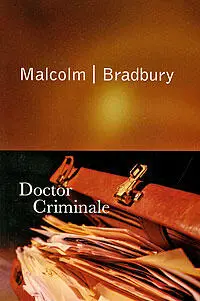
- Название:Doctor Criminale
- Автор:
- Издательство:Picador
- Жанр:
- Год:2000
- Город:London
- ISBN:978-0330390347
- Рейтинг книги:5 / 5. Голосов: 1
-
Избранное:Добавить в избранное
- Отзывы:
-
Ваша оценка:
Doctor Criminale: краткое содержание, описание и аннотация
Предлагаем к чтению аннотацию, описание, краткое содержание или предисловие (зависит от того, что написал сам автор книги «Doctor Criminale»). Если вы не нашли необходимую информацию о книге — напишите в комментариях, мы постараемся отыскать её.
Doctor Criminale — читать онлайн бесплатно полную книгу (весь текст) целиком
Ниже представлен текст книги, разбитый по страницам. Система сохранения места последней прочитанной страницы, позволяет с удобством читать онлайн бесплатно книгу «Doctor Criminale», без необходимости каждый раз заново искать на чём Вы остановились. Поставьте закладку, и сможете в любой момент перейти на страницу, на которой закончили чтение.
Интервал:
Закладка:
Which brought me back again to Bazlo Criminale, the man I was chasing once more as my train edged slowly on towards Budapest. Where did he fit in all this, where did it put him? He belonged, I reflected, just about one age back from mine: in the trough after the Modern, but before what people now call postmodern times – rightly, I suppose, because the crises, the anxieties, the hideous outrages left by the modern age have certainly not gone away. As Gerstenbacker had reminded me, he lived through the worst, as I had not: the Age of the Holocaust and the Age of Hiroshima, the times of Stalin and Eisenhower, Krushchev and Kennedy, Castro and Mao, Andropov and Khomeini, Gorbachev and Reagan. He had seen crisis follow crisis: the Suez Crisis and the Hungarian Revolution, the Berlin Crisis and the Cuban Missile Crisis, the Vietnam War and the Prague Spring, the Paris events of 1968 and the Watergate Crisis, the Afghanistan Crisis and the Iran Hostage Crisis – and now, stirring in the background, the Gulf Crisis. He had lived through thaw and freeze, repression and then hope and then more repression. He had lived in occupied cities, crossed dangerous borders, been overlooked by watchtowers and telephone bugs and unmarked cars and censors, menaced by gulags and all the dangers that had been hidden in the kinds of landscape I saw beyond the window. He had lived among theories and philosophies that had sought to territorialize the entire modern idea. He belonged to the age of forgetting, of avoiding, eliminating, blanking, burning, in a time of terror and error, of ideas imprisoned, books forbidden, thoughts silenced, people unpersoned, classes eliminated.
And, in ways I did not understand, he had survived, become a hero of ideas. He had managed, in ways that I did not begin to understand, to be on both sides of the wall, find the key to the back door, build the bridges of thinking, backwards and forwards, sideways and upwards, that were needed through a chaotic and tragic human age. He did not come from my age, and that meant I did not understand his. In fact, as Codicil said, I was an investigative simpleton, and he was born in dramas and tragedies I could hardly begin to share. From what Gerstenbacker had said with the wine in him last night, it seemed clear he had his share of secrets that he’d made his tricky way through a time of chaos, terror, deception and disguise. He was probably flawed, tainted in some fashion; he was certainly interesting. And now that I too lived in a time of transition, and saw in my own small way that no age lasts, that no framework is secure, that even the contemporary is not forever, I began to see a good deal more point to my search.
I stared out of the window of the Salieri Express. Contrary to myth, European trains are usually lumbering, contemplative, slow. They move reflectively through complicated landscapes, shuddering over bridges and going through strange valleys or impossible passes. The crews change suddenly, the temperaments of the passengers shift. Now there was plainly an Eastern European world to be seen outside. I saw high-rise concrete suburbs, workers’ apartments and grim-fronted stores, gridded streets and crowded yellow trams. There was a glimpse of water, a spire or two, a sudden sight of a long stone aqueduct. I checked the railway timetable and saw the train must now be coming into Budapest, at just the time the management said it would. I picked up The Magic Mountain , put it in the pocket of my anorak, there on the hook, took down the luggage from the rack, slipped the Kurier in my bag. I went down the corridor as the train doors jerked open, and stepped onto the platform.
People in grey clothes and plastic leather caps pushed and bustled; overalled porters shoved along great barrows. The posters on the station walls were in a language of very great obscurity, but they spoke of the things I immediately recognized – colas and jeans, television sets and pantihose. The architecture was grimly tiled, savagely functional. I looked round everywhere for a glimpse of Eiffel’s ironwork and Eiffel’s glass, but there was nothing there to suggest the work of the old bridgebuilder. No, as seems to happen so often in the kind of life I lead, I had plainly ended up in some completely different station. I went through a plastic-walled passage and out to the forecourt, found a small, air-polluting taxi, and gave the address of my hotel, where I would call Sandor Hollo, the only real line I now had to Doctor Bazlo Criminale.
6
Budapest is not one city but two . . .
Budapest is, of course, really not one city at all, but two. Unlike Vienna, which has hidden the Danube away in a culvert on its fringes, Budapest allows the great river – brown, wide, and fast-flowing by now, as it floods on southward and eastward – to surge through its middle, dividing it into two refracting capitals, looped together by great bridges, which stare across its waters at each other. High old Buda looks down from its hilltops onto flat nineteenth-century Pest; lowdown Pest stares up at the castle, the battlements, the double hills and deep valleys of ancient Buda. But when my taxi reached the hotel that Lavinia had booked for me that morning back in Vienna, I discovered that I was staying in neither of these places. My hotel lay in the very centre of the river, on Margaret Island, reached by a zigzag bridge, a quiet green corner that made an excellent resort for lovers and joggers, summer walkers and playing children, and no doubt, in the older, darker times just behind us, colluding spies and conspirators.
Back in the days of the Dual Monarchy and the belle époque , the tired and sated aristocrats of middle Europe had, I gathered, come here to its great Grand Hotel for the famous hot sulphur baths, hoping to purge away their old amorous and gastronomic excesses and at the same rime start on new ones. Rumour has it that Franz Schubert was made better here, though we can take it that Franz Kafka was made a good deal worse. Then, in the new postwar order of things, it was Party bosses and members of the nomenklatura , small government officials and workers for the post office, Russian tourists and East German attaches, who came to put on the grotesque rubber bathing-caps, splash in its fountains, take in its sulphurous steam, roll in its mud. Now the Grand Hotel was not so grand, though it retained its shape and dignity. With the twists and turns of recent history, it has taken on another incarnation, and been quite heavily restored. Today it is the Ramada Inn, and stressed German executives and excited American tourists now enjoy the pleasures of its stinking sulphur and eternal mud.
I checked in and got my key in the hotel’s now smart lobby, and changed Austrian schillings for Hungarian forints. Then a slow sad elevator took me upstairs to the long, many-bedroomed corridor, smelling of sulphur and chlorine, on which I hunted for my room. I found it at the very end, one of the smaller suites; even at the former Grand Hotel of Budapest, Lavinia had done all she could to make sure I had not ended up in total luxury. Nonetheless it had a tiny balcony, a view over the fast-flowing Danube, and an enchanting misty glimpse of fairytale battlements on the hillside above. I could not complain. I unpacked a little, sat down at the desk, picked up the telephone, and called the number of Sandor Hollo, which Gerstenbacker had given me. There was a dull dragging sound, then a crackling answer-phone message in Hungarian, one of the world’s most obscure languages, with the exception of African Click, then a quick flourish of Bartok, then the dragging sound resumed.
I tried for most of the afternoon. From what Gerstenbacker had told me, I had assumed that Sandor Hollo was a teacher of philosophy at the university, and so I imagined that he was even now closeted with his students, lecturing to his classes, sitting over books in the university library, or doing whatever university teachers do if they are not Professor Otto Codicil. Still, I kept on trying, on the half-hour, until I saw that November darkness had begun to fall over the river, and bright floodlights were now picking out the battlements and buildings on the high Buda bank. So now I gave up, made my way downstairs, and went over to the hotel bar for a drink. Here, on the barstools, I found myself surrounded by a group of Hungarian beauties, all of them wearing mini-dresses and leather boots that came up over their knees. They sat with their drinks and eyed me with the greatest curiosity. I quickly finished my beer, and went over to the maître d’ at the entrance to the dining-room, to ask for a table for dinner.
Читать дальшеИнтервал:
Закладка:
Похожие книги на «Doctor Criminale»
Представляем Вашему вниманию похожие книги на «Doctor Criminale» списком для выбора. Мы отобрали схожую по названию и смыслу литературу в надежде предоставить читателям больше вариантов отыскать новые, интересные, ещё непрочитанные произведения.







Обсуждение, отзывы о книге «Doctor Criminale» и просто собственные мнения читателей. Оставьте ваши комментарии, напишите, что Вы думаете о произведении, его смысле или главных героях. Укажите что конкретно понравилось, а что нет, и почему Вы так считаете.