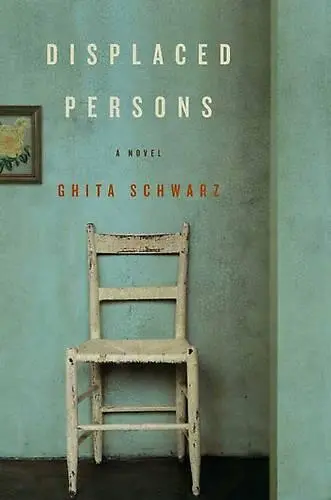
Ghita Schwarz - Displaced Persons
Здесь есть возможность читать онлайн «Ghita Schwarz - Displaced Persons» весь текст электронной книги совершенно бесплатно (целиком полную версию без сокращений). В некоторых случаях можно слушать аудио, скачать через торрент в формате fb2 и присутствует краткое содержание. Жанр: Современная проза, на английском языке. Описание произведения, (предисловие) а так же отзывы посетителей доступны на портале библиотеки ЛибКат.
- Название:Displaced Persons
- Автор:
- Жанр:
- Год:неизвестен
- ISBN:нет данных
- Рейтинг книги:5 / 5. Голосов: 1
-
Избранное:Добавить в избранное
- Отзывы:
-
Ваша оценка:
Displaced Persons: краткое содержание, описание и аннотация
Предлагаем к чтению аннотацию, описание, краткое содержание или предисловие (зависит от того, что написал сам автор книги «Displaced Persons»). Если вы не нашли необходимую информацию о книге — напишите в комментариях, мы постараемся отыскать её.
In May 1945, Pavel Mandl, a Polish Jew recently liberated from a concentration camp, lands near a displaced persons camp in the British occupation zone of newly defeated Germany. Alone, possessing nothing but a map, a few tins of food, a toothbrush, and his identity papers, he must scrape together a new life in a chaotic community of refugees, civilians, and soldiers.
Gifted with a talent for black-market trading, Pavel soon procures clothing, false documents, and a modest house, where he installs himself and a pair of fellow refugees – Fela, a young widow who fled Poland for Russia at the outset of the war, and Chaim, a resourceful teenage boy whose smuggling skills have brought him to the Western zones. The trio soon form a makeshift family, searching for surviving relatives, railing against their circumscribed existence, and dreaming of visas to America.
Fifteen years later, haunted by decisions they made as "DPs," Pavel and Fela are married and living in Queens with their young son and daughter, and Chaim has recently emigrated from Israel with his wife, Sima. Pavel opens a small tailoring shop with his scheming brother-in-law while Fela struggles to establish peace in a loosely traditional household; Chaim and Sima adapt cheerfully to American life and its promise of freedom from a brutal past. Their lives are no longer dominated by the need to endure, fight, hide, or escape. Instead, they grapple with past trauma in everyday moments: taking the children to the municipal pool, shopping for liquor, arguing with landlords.
For decades, Pavel, Fela, and Chaim battle over memory and identity on the sly, within private groups of survivors. But as the Iron Curtain falls in the 1990s, American society starts to embrace the tragedy as a cultural commodity, and survivor politics go public. Clever and stubborn, tyrannical and generous, Pavel, Fela, and Chaim articulate the self-conscious strivings of an immigrant community determined to write its own history, on its own terms.
In Displaced Persons, Ghita Schwarz reveals the interior despairs and joys of immigrants shaped by war – ordinary men and women who have lived through cataclysmic times – and illuminates changing cultural understandings of trauma and remembrance.
Displaced Persons — читать онлайн бесплатно полную книгу (весь текст) целиком
Ниже представлен текст книги, разбитый по страницам. Система сохранения места последней прочитанной страницы, позволяет с удобством читать онлайн бесплатно книгу «Displaced Persons», без необходимости каждый раз заново искать на чём Вы остановились. Поставьте закладку, и сможете в любой момент перейти на страницу, на которой закончили чтение.
Интервал:
Закладка:
A miracle had happened to Sima’s mother, a miracle that no doubt saved Sima’s life. Her mother had been taken to jail and had fallen to the floor, begging the guard to release her. She had a child at home and a husband, she had lied, at the front. The little girl would starve, would freeze, would not live without her mother.
The guard had watched blankly, in what seemed to Sima’s mother a strict, controlled rage. Stop crying! he had ordered. Get up, stand up! He had pointed to a door. Go inside that room and wait, without making a sound!
Sima’s mother had scrambled up and opened the door. It was a dark room, but cold: she saw immediately that a large window was open. The words of the guard: without making a sound. Shoes off, she had crept out the window into the steppe and run home to find her daughter.
It seemed impossible that this could have occurred, that what Sima had wished could come true. She had sat alone on the hospital steps, making promises to herself: When two women with gray kerchiefs pass by, the third woman will be my mother. When the door of the entryway slams seven times, the eighth noise will be my mother. At her social work program, Sima had learned the English words for these wishes: magical thinking. But the magic had happened, not precisely according to the numbers Sima had calculated, the thirteen old men, the three pregnant women, but magic nonetheless, if a magic of errors. Her mother had stumbled to the hospital after finding Sima gone, had wrapped her in a blanket before wrapping her in her arms, and had carried her red-faced, five-year-old body home.
No one believed stories like this anymore, but these were the stories of anyone who lived. In Europe, on the steppe, to look at the world practically, realistically, with a cold, knowing eye, was to read only death sentences. It was when magical thinking came true that one lived. An open window here, an abandoned work camp there. Her father had escaped from hard labor; he too had come home.
Baruch was not a dazzling figure, and it was hard to imagine how even in youth he could have wrapped himself around the heart of a girl from a good family in a small town. He murmured gruff thank-yous for all Sima’s favors and calls, but did not seem to like her particularly well. He never asked for her personal advice, only for technical assistance with his housing and welfare and job applications. Once he missed an appointment with Sima and forgot to call; he had been accepted as a salad man in a moderate-priced restaurant not too far from downtown. It frustrated Sima, though everything in her training had taught her not to let it hurt her. Usually she succeeded.
She adjusted the tale to accommodate her irritation. The new story unfolded in a less dramatic series of scenes: Baruch was not the lover but the friend of the lover, the confidant of Moshe himself, told of the plans to flee Mlawa, perhaps inspired to flee himself because of the lovers. In Russia, Baruch would have encountered Moshe again in the Russian army, would have heard a message from Moshe before he died, would have tried to bring the message to Fela despite the obstacles and chaos of cold and hunger and battle. In another version, Baruch knew Moshe as a living being, a man who had lived side by side with Baruch in postwar Europe, just as Fela had imagined: married, attached, but alive, still longing for news of his first love. They would go together to a reunion-yes, a reunion of their landsmanner , the remnants of their broken hometown, and they would see her. No, better, the reunion would be in Israel, without Baruch. Moshe, along with the other new émigrés from Russia, would attend, not daring to be hopeful. Alone, without the interference of assistance bureaucracies or immigration authorities, he would see Fela’s sister Bluma, only partly disguised by age and fatigue, and Bluma would respond to a tap on the shoulder.
Excuse me, he would say, is your name Berlinka?
Yes, the sister of Fela would say. Yes. And you?
I, he would say, I am Moshe Lev.
In the shock that would follow, Bluma would reveal that Fela was alive. She would ask what had become of him; had he seen her, those days in Germany, after the war?
No, he would answer, no.
Then sudden anger. Bluma would turn cold. Why didn’t you look for her after the war? How she suffered. How she suffered.
And who says I didn’t look? Moshe would exclaim. I was in prison. There was nowhere to look. I wrote to the Red Cross, to the Joint-but nothing, no word. It wasn’t so easy, at that time, if you stayed in the East. No committees for the refugees, no communications in the Russian zone. What do you think-I would not look if I could?
She’s married, said Bluma. With children.
Yes, Moshe would say. And I am too.
The drama would close with an anguished silence beween Bluma and Moshe, the two closest figures of Fela’s first life: To let it alone or to tell her? The truth, or peace?
In Brooklyn Baruch would receive the letter from his friend. He would think on it and think on it. He would divulge the tale to Sima. And then? How would Sima and Baruch contrive to put the two back together? Each could know a version of the tale, but it was up to the romantic pair themselves, separated by continents, to reveal their identities.
AN EFFICIENCY STUDIO HAD opened in the Brighton Beach project for seniors, and the administrators had squeezed Baruch to the top of the list by the start of February. Sima paid a follow-up visit on Friday morning, in the middle of the month. It was a long way out; she took the agency car.
The day was uncommonly warm and sunny for the time of year, a taste of spring before the snowstorm predicted for the weekend.
She lied to Baruch. I wanted to tell you a hello, said Sima. Hello from Fela Mandl.
Who? said Baruch.
Excuse me, said Sima. Fela Berlinka.
Berlinka, said Baruch. Berlinka, Berlinka. The word chimed out of his mouth in a singsong.
The sisters from Mlawa? Sima finally said.
Yes, said Baruch. Oh yes, a very good family. Yes, she said hello? He seemed gratified, but only slightly. What else do I have to do? he said to Sima. Will you still keep visiting?
Only if you want me to, said Sima.
I’m all right on my own, said Baruch. Do you know how much a private phone costs here? It’s very expensive. How can anyone do it? I have to use the common one downstairs, and there’s always a wait.
Sima pushed her fingers into her purse for a business card. Here, she said, placing it on the table near the window. Just in case you need something. She closed the door behind her, then stepped toward the elevator. She pressed the button to call it. Through the porthole of the elevator door Sima could see the compartment lowering itself down.
But then she turned back and knocked on Baruch’s door.
Did you forget something? His face was softer than it had been a moment ago.
He likes to think that sometimes I too can be weak, Sima thought. She returned the soft look. Yes, Mr. Sosnower. I forgot to ask you-
She paused. He looked at her, waiting. Should she go through with it? Could she really alter a woman’s history with a question? Then Sima pressed down the thought, forced herself to continue. Did you ever know a Moshe Lev? From your town, from Mlawa?
Moshe Lev-Baruch said, his soft look vanishing. Of course! Yes, he too was from Mlawa. How funny that you ask-how do you-
I remember hearing his name from my friend. She wondered what had become of him.
Really? Hmm, well, I did not know him so well in Poland. But I suppose-Baruch’s face remained blank, still surprised but not excited-I suppose everyone wonders, still, after so many years. It was a funny thing, running into him in Kiev when I did, after so many years living in the same neighborhood, and not seeing him since we were schoolboys. Of course he was a bit older than I, but a brother of mine would have gone to school with him-a fine man. We were on a line together to buy something, maybe milk? Yes, that was it. He recognized me, actually. He said he did not forget faces from his hometown. But that was so long ago.
Читать дальшеИнтервал:
Закладка:
Похожие книги на «Displaced Persons»
Представляем Вашему вниманию похожие книги на «Displaced Persons» списком для выбора. Мы отобрали схожую по названию и смыслу литературу в надежде предоставить читателям больше вариантов отыскать новые, интересные, ещё непрочитанные произведения.








Обсуждение, отзывы о книге «Displaced Persons» и просто собственные мнения читателей. Оставьте ваши комментарии, напишите, что Вы думаете о произведении, его смысле или главных героях. Укажите что конкретно понравилось, а что нет, и почему Вы так считаете.