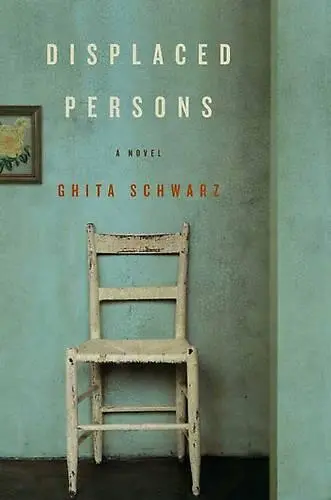
Ghita Schwarz - Displaced Persons
Здесь есть возможность читать онлайн «Ghita Schwarz - Displaced Persons» весь текст электронной книги совершенно бесплатно (целиком полную версию без сокращений). В некоторых случаях можно слушать аудио, скачать через торрент в формате fb2 и присутствует краткое содержание. Жанр: Современная проза, на английском языке. Описание произведения, (предисловие) а так же отзывы посетителей доступны на портале библиотеки ЛибКат.
- Название:Displaced Persons
- Автор:
- Жанр:
- Год:неизвестен
- ISBN:нет данных
- Рейтинг книги:5 / 5. Голосов: 1
-
Избранное:Добавить в избранное
- Отзывы:
-
Ваша оценка:
Displaced Persons: краткое содержание, описание и аннотация
Предлагаем к чтению аннотацию, описание, краткое содержание или предисловие (зависит от того, что написал сам автор книги «Displaced Persons»). Если вы не нашли необходимую информацию о книге — напишите в комментариях, мы постараемся отыскать её.
In May 1945, Pavel Mandl, a Polish Jew recently liberated from a concentration camp, lands near a displaced persons camp in the British occupation zone of newly defeated Germany. Alone, possessing nothing but a map, a few tins of food, a toothbrush, and his identity papers, he must scrape together a new life in a chaotic community of refugees, civilians, and soldiers.
Gifted with a talent for black-market trading, Pavel soon procures clothing, false documents, and a modest house, where he installs himself and a pair of fellow refugees – Fela, a young widow who fled Poland for Russia at the outset of the war, and Chaim, a resourceful teenage boy whose smuggling skills have brought him to the Western zones. The trio soon form a makeshift family, searching for surviving relatives, railing against their circumscribed existence, and dreaming of visas to America.
Fifteen years later, haunted by decisions they made as "DPs," Pavel and Fela are married and living in Queens with their young son and daughter, and Chaim has recently emigrated from Israel with his wife, Sima. Pavel opens a small tailoring shop with his scheming brother-in-law while Fela struggles to establish peace in a loosely traditional household; Chaim and Sima adapt cheerfully to American life and its promise of freedom from a brutal past. Their lives are no longer dominated by the need to endure, fight, hide, or escape. Instead, they grapple with past trauma in everyday moments: taking the children to the municipal pool, shopping for liquor, arguing with landlords.
For decades, Pavel, Fela, and Chaim battle over memory and identity on the sly, within private groups of survivors. But as the Iron Curtain falls in the 1990s, American society starts to embrace the tragedy as a cultural commodity, and survivor politics go public. Clever and stubborn, tyrannical and generous, Pavel, Fela, and Chaim articulate the self-conscious strivings of an immigrant community determined to write its own history, on its own terms.
In Displaced Persons, Ghita Schwarz reveals the interior despairs and joys of immigrants shaped by war – ordinary men and women who have lived through cataclysmic times – and illuminates changing cultural understandings of trauma and remembrance.
Displaced Persons — читать онлайн бесплатно полную книгу (весь текст) целиком
Ниже представлен текст книги, разбитый по страницам. Система сохранения места последней прочитанной страницы, позволяет с удобством читать онлайн бесплатно книгу «Displaced Persons», без необходимости каждый раз заново искать на чём Вы остановились. Поставьте закладку, и сможете в любой момент перейти на страницу, на которой закончили чтение.
Интервал:
Закладка:
If we had a calendar it would be easier, Dvora had said one night. But it is around that time. We can approximate. So get ready for your wish.
What should I wish for?
It’s your wish. Only don’t wish for something foolish, like bread or meat. That’s the kind of thing God doesn’t have any control over.
Sima had looked at her mother’s face, serious and focused.
And you don’t have to wish for your father to come home either, because I’ve already taken care of that with my wish.
You wish for him to come back?
I wish for all of us to get out of here alive, so your father coming back is included. It’s wasteful to have two of the same.
Maybe it’s better if two people do it.
Believe me, think of something else, something bigger.
I can’t think of anything bigger.
Yes you can, said her mother. Think of something very big, something that takes a long time to come true. You have to give these things time. And you can keep it a secret.
What had Sima wished for? She could not have been more than five, and thirty years had passed. Of course she did not remember. But in the end her father had returned, and they had lived, and they had come to Palestine. Was that what she had wished for? It would have been like her, taking her mother’s cue. A country, a real home, no need to run from anywhere. Absolutely, that would have been just like her as a small child, wishing her mother’s wish without even knowing it.
And then, of course, it would have been like her to move away anyway, to leave her mother and father, just for the love of a man.
For a time, Chaim could leave her parents’ apartment flushed with an enthusiasm for living in the heat, working with his hands even as he studied, safe, almost safe, in control, as Berel would remind him, of his own destiny. But the optimism would leave him. He did not feel in control of his destiny. He had no parents to cling to, and he felt a constant numbing fear. And Sima felt the fear too, of the monthly calls into the reserves, of their Arab neighbors whose poverty and resentment seemed to accuse them of some ongoing crime. Chaim felt it more, he felt it even of his own people in uniform-it scratched at him from inside, so much that he confessed it to her once in a while. He wanted to go.
And at that time she had not felt Israel to be her home. Her father’s attachment to a country, her mother’s too-perhaps this was what they had in common, this was a dream they had shared, for all their differences in temperament-they had been devoted, accepting, even eager for this new life, where her mother cleaned houses and her father cleaned milk vats and Sima-younger, stronger-cleaned offices. Really, what did it matter to them? Her mother still had vanity of course-she bought a pair of gloves that she used for the sole purpose of putting on her nylon stockings without tearing them, stockings she wore twice a year on the High Holidays-but for Sima, the pain of her job and her ugly hands and her two worn dresses was overwhelming. She had worked hard to look cheerful and pleased for her parents, and to push down the darkness inside her in front of her new friends, and even in front of her oldest friend, a hard girl she had met somewhere in Russia, then found again in Rehovot in the first years. Sima had worked hard to ignore the darkness, to make her outside light.
Her mother had had difficulty with Hebrew-at least her father had his boyhood schooling-but to Sima it was just another job, learning the new language, the experiments with her teeth and tongue to imitate well, to laugh properly, to slide in like a native. A false native. She always felt some anxiety in Hebrew, as if about to be caught, recognized, accused: Sheep! Soap! It had happened to her maybe once or twice when she had arrived, the mockery of schoolmates for being among the weak of the diaspora, the old Jews, the ones who let themselves be slaughtered for fear of fighting. The name-calling had happened only once or twice, maybe three times at most, but it was enough.
By now she spoke English very well. She spoke English to her daughter. She had lived in New York twelve years, longer than in any other place in her life. And soon, she felt, it was inevitable, she would speak it better than the languages she had been born into but did not speak outside her home. It was something to be proud of, her English, and it made her excited, the ability to move things in and out in a new language, the language the world thought of as powerful and important. In her head sometimes she would search for a Hebrew or Yiddish word, once in a while even something in Polish or Russian. Occasionally something indeterminate and jumbled, a private language whose sound she could not name but which was the language inside her, the language of a lost place, would bubble up. But her mouth spoke a careful and lilting English. And even this was something to be proud of, the accent people took to be European, of uncertain origin but sophisticated. Even at the beginning, sleeping on the sofa bed at the Queens home of Fela and Pavel, she had felt herself an object of admiring curiosity. It was more than her youth, she thought, but she had responded by acting young and cheerful, flirting with Larry and painting rouge on Helen’s cheeks, Pavel standing at the threshold of the living room, watching in silence, happy.
Chaim had felt it too, she thought. Not just in the Mandls’ house, with Fela touching his arm constantly as he washed dishes with her, but everywhere. When they had come to America it had been a pride to be from Israel. All the things she had not felt when she lived in Rehovot, she felt in New York, people impressed with her service in the army, with what they presumed to be her knowledge of the land. Not like now, all the criticism, all the judgment. That’s right, feel sorry for the Arabs! Well, she had been poor too, poorer yet, without a home either, without anything! And who had spoken out for her?
SHE GOT UP TO stretch her legs, use the bathroom. Seven hours left. When she came back to her seat she had to tap awake the woman on the aisle. She looked at her watch again. Six hours and fifty minutes left. She had had no communication with anyone in her family for the last six and a half hours.
She sat down, rustled under her blanket. To be alone was a terrible thing. In Russia the people who had their families with them lived; those who came there alone starved, fell ill, took risks that led to arrest again and again. It amazed Sima that her husband could have emerged alive out of Poland alone as he was, without a friend or a brother to accompany him.
It amazed her, and yet she forgot it all the time. Chaim’s face had a smooth health, his blue eyes had a flatness that made him seem untouched. Like the sea, her mother had said all those years ago, and Sima had felt a thrill that her boyfriend had looks worthy of comparison to something so grand and enveloping. But in time Sima thought: Not the sea, but the sky. Not something she could dive into, searching and breathing, not something she could cross. Unreachable.
Chaim had opened up to Sima’s father. Berel had remembered him from the DP camp in Belsen. When Chaim walked through the door the first time, on one of Sima’s weekends home from the army, Berel had given him a sharp look that Sima took to be suspicion. But it was recognition: two questions later, Berel knew for sure that Chaim was the young man who had worked as an aide in Sima’s camp classroom. Sima had been surprised-it had changed her view of him. Chaim had taught her when she was a child, he had stopped her from crying, he had held her hand on outings. The excitement she felt when she saw his slim frame now seemed to be part of something deeper, fate or destiny.
In those days Sima had known nothing about him. He was her boyfriend, a swaggerer like all of them, but also kind, quiet in private, gentle. The cocky walk seemed to her an imitation of his fellow soldiers, a public gesture to show he had adapted to the desert. He was from Europe, of course-their shared accent in Hebrew had made them exchange a smile when they first met, at a café one night, among a large group of young people. So few in her group were from Europe -so few of his friends, too. No one talked about such things then; they tried to blend in. But their little cadences, softer than native Hebrew, slower, less confident, made them feel they already knew each other without saying so much; and alone, outside the hearing of native Israelis, they could speak in Yiddish.
Читать дальшеИнтервал:
Закладка:
Похожие книги на «Displaced Persons»
Представляем Вашему вниманию похожие книги на «Displaced Persons» списком для выбора. Мы отобрали схожую по названию и смыслу литературу в надежде предоставить читателям больше вариантов отыскать новые, интересные, ещё непрочитанные произведения.








Обсуждение, отзывы о книге «Displaced Persons» и просто собственные мнения читателей. Оставьте ваши комментарии, напишите, что Вы думаете о произведении, его смысле или главных героях. Укажите что конкретно понравилось, а что нет, и почему Вы так считаете.