Hermann Hesse - The Glass Bead Game
Здесь есть возможность читать онлайн «Hermann Hesse - The Glass Bead Game» весь текст электронной книги совершенно бесплатно (целиком полную версию без сокращений). В некоторых случаях можно слушать аудио, скачать через торрент в формате fb2 и присутствует краткое содержание. Год выпуска: 1969, Жанр: Современная проза, Социально-психологическая фантастика, на английском языке. Описание произведения, (предисловие) а так же отзывы посетителей доступны на портале библиотеки ЛибКат.
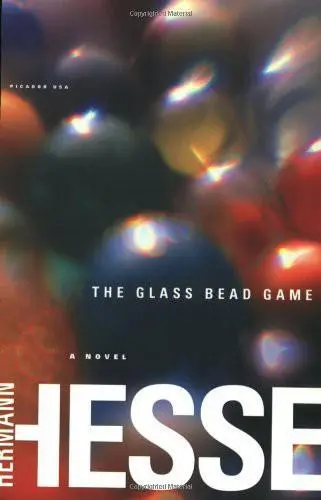
- Название:The Glass Bead Game
- Автор:
- Жанр:
- Год:1969
- ISBN:нет данных
- Рейтинг книги:4 / 5. Голосов: 2
-
Избранное:Добавить в избранное
- Отзывы:
-
Ваша оценка:
The Glass Bead Game: краткое содержание, описание и аннотация
Предлагаем к чтению аннотацию, описание, краткое содержание или предисловие (зависит от того, что написал сам автор книги «The Glass Bead Game»). Если вы не нашли необходимую информацию о книге — напишите в комментариях, мы постараемся отыскать её.
Something like chess but far more intricate, the game of Magister Ludi known as the Glass Bead Game is thought in its purest form, a synthesis through which philosophy, art, music and scientific law are appreciated simultaneously. The scholar-players are isolated within Castalia, an autonomous elite institution devoted wholly to the mind and the imagination…
The Glass Bead Game — читать онлайн бесплатно полную книгу (весь текст) целиком
Ниже представлен текст книги, разбитый по страницам. Система сохранения места последней прочитанной страницы, позволяет с удобством читать онлайн бесплатно книгу «The Glass Bead Game», без необходимости каждый раз заново искать на чём Вы остановились. Поставьте закладку, и сможете в любой момент перейти на страницу, на которой закончили чтение.
Интервал:
Закладка:
This association had borne all sorts of fruits, and perhaps we may be permitted to say a word about these even at the cost of anticipating our story somewhat; or at any rate about the fruit which Knecht most prized. It ripened slowly, slowly, grew as tentatively and warily as the seeds of high mountain trees that have been planted down in the lush lowlands: these seeds, consigned to rich soil and a kindly climate, carry in themselves as their legacy the restraint and mistrust with which their forebears grew; the slow tempo of growth belongs among their hereditary traits. Thus the prudent old man, accustomed to keep close watch over all possible influences upon him, permitted the element of Castalian spirit brought to him by his young friend and antipodal colleague to strike root only reluctantly and inch by inch. Gradually, however, it sprouted; and of all the good things that Knecht experienced in his years at the monastery, this was the best and most precious of all to him: this scanty, hesitant growth of trust and openness from seemingly hopeless beginnings on the part of the experienced older man, this slowly germinating and even more slowly admitted sympathy for his younger admirer as a person and, beyond that, for the specifically Castalian elements in his personality. Step by step the younger man, seemingly little more than pupil, listener, and learner, led Father Jacobus — who initially had used the words “Castalian” and Glass Bead Game player only with ironic emphasis, and often as outright invective — toward a tolerant and ultimately respectful acceptance of this other mentality, this other Order, this other attempt to create an aristocracy of the spirit. Father Jacobus ceased to carp at the youth of the Order, though with its little more than two centuries the Benedictines were the elder by some fifteen hundred years. He ceased to regard the Glass Bead Game as mere aesthetic dandyism; and he ceased to rule out the prospect of friendship and alliance between two Orders so ill matched in age.
Joseph regarded this partial conquest of Father Jacobus as a personal cause for rejoicing. He remained unaware that the authorities considered it the utmost of his accomplishments on his mission to Mariafels. Now and again he wondered in vain what was the real reason for his assignment to the monastery. Though initially it had seemed to be a promotion and distinction envied by his competitors, could it not signify a form of inglorious premature retirement, a relegation to a dead end? But then one could learn something everywhere, so why not here too? On the other hand, from the Castalian point of view this monastery, Father Jacobus alone excepted, was certainly no garden of learning or model of scholarship. He wondered, too, whether his isolation among nothing but unexacting dilettantes was not already affecting his prowess in the Glass Bead Game. He could not quite tell whether he was losing ground. For all his uncertainty, however, he was helped by his lack of ambition as well as his already quite advanced amor fati. On the whole his life as a guest and unimportant teacher in this cosy old monastic world was more to his liking than his last months at Waldzell as one of a circle of ambitious men. If fate wished to leave him forever in this small colonial post, he would certainly try to change some aspects of his life here — for example, contrive to bring one of his friends here or at least ask for a longish leave in Castalia every year — but for the rest he would be content.
The reader of this biographical sketch may possibly be waiting for an account of another side of Knecht’s experience in the monastery, namely the religious side. But we can venture only some tentative hints. It is certainly likely that Knecht had some deeply felt encounter with religion, with Christianity as daily-practiced in the monastery. In fact from some of his later remarks and attitudes it is quite clear that he did. But whether and to what extent he became a Christian is a question we must leave unanswered; these realms are closed to our researches. In addition to the respect for religions generally cultivated in Castalia, Knecht had a kind of inner reverence which we would scarcely be wrong to call pious. Moreover, he had already been well instructed in the schools on the classical forms of Christian doctrine, especially in connection with his studies of church music. Above all he was well acquainted with the sacramental meaning and ritual of the Mass.
With a good deal of astonishment as well as reverence, he had found among the Benedictines a living religion which he had hitherto known only theoretically and historically. He attended many services, and after he had familiarized himself with some of the writings of Father Jacobus, and taken to heart some of their talks, he became fully aware of how phenomenal this Christianity was — a religion that through the centuries had so many times become unmodern and outmoded, antiquated and rigid, but had repeatedly recalled the sources of its being and thereby renewed itself, once again leaving behind those aspects which in their time had been modern and victorious. He did not seriously resist the idea, presented to him every so often in those talks, that perhaps Castalian culture was merely a secularized and transitory offshoot of Christian culture in its Occidental form, which would some day be reabsorbed by its parent. Even if that were so, he once remarked to Father Jacobus, his, Joseph Knecht’s, own place lay within the Castalian and not the Benedictine system; he had to serve the former, not the latter, and prove himself within it. His task was to work for the system of which he was a member, without asking whether it could claim perpetual existence, or even a long span of life. He could only regard conversion as a rather undignified form of escape, he said. In similar fashion Johann Albrecht Bengel, whom they both venerated, had in his time served a small and transitory sect without neglecting his duties to the Eternal. Piety, which is to say faithful service and loyalty up to the point of sacrificing one’s life, was part and parcel of every creed and every stage of individual development; such service and loyalty were the only valid measure of devoutness.
Knecht had been staying with the Benedictine Fathers for some two years when a visitor appeared at the monastery who was kept apart from him with great care. Even a casual introduction was avoided. His curiosity roused by these procedures, he observed the stranger for the few days of his visit and indulged in all sorts of speculations. He became convinced that the stranger’s religious habit was a disguise. The unknown held long conferences behind closed doors with the Abbot and Father Jacobus, and was always receiving and sending urgent messages. Knecht, who by now had at least heard rumors about the political connections and traditions of the monastery, guessed that the guest must be a high-ranking statesman on a secret mission, or a sovereign traveling incognito. As he reflected on the matter, he recalled several guests of the past few months whose visits, in hindsight, seemed to him equally mysterious or significant. Now he remembered the chief of the Castalian “police,” his friendly mentor Dubois, and the request that he keep an eye on such events in the monastery. And although he still felt neither the urge nor the vocation for making such reports, his conscience troubled him for having not written to the kindly man for so long a time. No doubt Dubois was disappointed in him. So he wrote him a long letter, tried to explain his silence, and in order to give some substance to his letter said a few words about his association with Father Jacobus. He had no idea how carefully and by how many important persons his letter would be read back in Castalia.
FIVE
THE MISSION
KNECHT’S FIRST STAY at the monastery lasted two years. At this time he was in his thirty-seventh year. One morning, some two months after his long letter to Dubois, he was called into the Abbot’s office. He expected the affable Abbot would want to chat a bit about Chinese, and made his appearance promptly. Gervasius came forward to meet him, a letter in hand.
Читать дальшеИнтервал:
Закладка:
Похожие книги на «The Glass Bead Game»
Представляем Вашему вниманию похожие книги на «The Glass Bead Game» списком для выбора. Мы отобрали схожую по названию и смыслу литературу в надежде предоставить читателям больше вариантов отыскать новые, интересные, ещё непрочитанные произведения.




Обсуждение, отзывы о книге «The Glass Bead Game» и просто собственные мнения читателей. Оставьте ваши комментарии, напишите, что Вы думаете о произведении, его смысле или главных героях. Укажите что конкретно понравилось, а что нет, и почему Вы так считаете.