Hermann Hesse - The Glass Bead Game
Здесь есть возможность читать онлайн «Hermann Hesse - The Glass Bead Game» весь текст электронной книги совершенно бесплатно (целиком полную версию без сокращений). В некоторых случаях можно слушать аудио, скачать через торрент в формате fb2 и присутствует краткое содержание. Год выпуска: 1969, Жанр: Современная проза, Социально-психологическая фантастика, на английском языке. Описание произведения, (предисловие) а так же отзывы посетителей доступны на портале библиотеки ЛибКат.
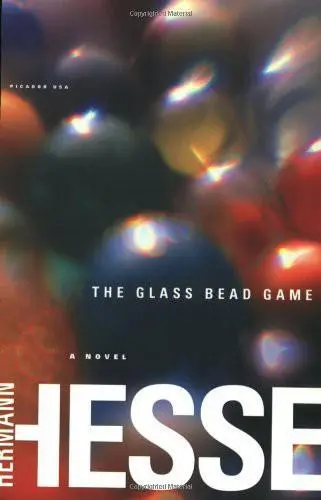
- Название:The Glass Bead Game
- Автор:
- Жанр:
- Год:1969
- ISBN:нет данных
- Рейтинг книги:4 / 5. Голосов: 2
-
Избранное:Добавить в избранное
- Отзывы:
-
Ваша оценка:
The Glass Bead Game: краткое содержание, описание и аннотация
Предлагаем к чтению аннотацию, описание, краткое содержание или предисловие (зависит от того, что написал сам автор книги «The Glass Bead Game»). Если вы не нашли необходимую информацию о книге — напишите в комментариях, мы постараемся отыскать её.
Something like chess but far more intricate, the game of Magister Ludi known as the Glass Bead Game is thought in its purest form, a synthesis through which philosophy, art, music and scientific law are appreciated simultaneously. The scholar-players are isolated within Castalia, an autonomous elite institution devoted wholly to the mind and the imagination…
The Glass Bead Game — читать онлайн бесплатно полную книгу (весь текст) целиком
Ниже представлен текст книги, разбитый по страницам. Система сохранения места последней прочитанной страницы, позволяет с удобством читать онлайн бесплатно книгу «The Glass Bead Game», без необходимости каждый раз заново искать на чём Вы остановились. Поставьте закладку, и сможете в любой момент перейти на страницу, на которой закончили чтение.
Интервал:
Закладка:
That evening he called at the Father’s rather isolated apartment at the end of a quiet side-wing of the monastery. As he stood in the corridor, wondering which door to knock at, he heard piano music, to his considerable surprise. It was a sonata by Purcell, played unpretentiously and without virtuosity, but cleanly and in impeccable tempo. The pure music sounded through the door; its heartfelt gaiety and sweet triads reminded him of the days in Waldzell when he had practiced pieces of this sort on various instruments with his friend Ferromonte. He waited, listening with deep enjoyment, for the end of the sonata. In the still, twilit corridor it sounded so lonely and unworldly, and so brave and innocent also, both childlike and superior, as all good music must in the midst of the unredeemed muteness of the world.
He knocked at the door. Father Jacobus called, “Come in,” and received him with his unassuming dignity. Two candles were still burning by the small piano. “Yes,” Father Jacobus said in answer to Knecht’s question, “I play for a half-hour or even an hour every night. I usually call a halt to my day’s work when darkness falls and would rather not read or write during the hours before sleep.”
They talked about music, about Purcell, Handel, the ancient musical tradition among the Benedictines — of all the Catholic Orders the one most devoted to the arts. Knecht expressed a desire to know something of the history of the Order. The conversation grew lively and touched on a hundred questions. The old monk’s historical knowledge seemed to be truly astounding, but he frankly admitted that the history of Castalia, of the Castalian idea and Order, had not interested him. He had scarcely studied it, he said, and did not conceal his critical attitude toward this Castalia whose “Order” he regarded as an imitation of the Christian models, and fundamentally a blasphemous imitation since the Castalian Order had no religion, no God, and no Church as its basis. Knecht listened respectfully, but pointed out that other than Benedictine and Roman Catholic views of religion, God and the Church were possible, and moreover had existed, and that it would not do to deny the purity of their intentions nor their profound influence on the life of the mind.
“Quite so,” Jacobus said. “No doubt you are thinking of the Protestants, among others. They were unable to preserve religion and the Church, but at times they displayed a great deal of courage and produced some exemplary men. I spent some years studying the various attempts at reconciliation among the hostile Christian denominations and churches, especially those of the period around 1700, when we find such people as the philosopher and mathematician Leibniz and that eccentric Count Zinsendorf endeavoring to reunite the inimical brothers. Altogether, the eighteenth century, hasty and shallow though it often seems in its judgments, has such a rich and many-faceted intellectual history. The Protestants of that period strike me as particularly interesting. There was one man I discovered, a philologist, teacher, and educator of great stature — a Swabian Pietist, by the way — whose moral influence can be clearly traced for two hundred years after his death. But that is another subject. Let us return to the question of the legitimacy and historical mission of real Orders…”
“Oh no,” Joseph Knecht broke in. “Please say more about this teacher you have just mentioned. I almost think I can guess who he is.”
“Guess.”
“I thought at first of Francke of Halle, but since you say he was a Swabian I can think of none other than Johann Albrecht Bengel.”
Jacobus laughed. An expression of pleasure transfigured his face. “You surprise me, my friend,” he exclaimed. “It was indeed Bengel I had in mind. How do you happen to know of him? Or is it normal in your astonishing Province that people know such abstruse and forgotten things and names? I would vouch that if you were to ask all the Fathers, teachers, and pupils in our monastery, and those of the last few generations as well, not one would know this name.”
“In Castalia, too, few would know it, perhaps no one besides myself and two of my friends. I once engaged in studies of eighteenth-century Pietism for private reasons, and as it happened I was much impressed by several Swabian theologians — chief among them Bengel. At the time he seemed to me the ideal teacher and guide for youth. I was so taken with the man that I even had a photo made of his portrait in an old book, and kept it above my desk.”
Father Jacobus continued to chuckle. “Our meeting is certainly taking place under unusual auspices,” he said. “It is remarkable enough that you and I should both have come upon this forgotten man in the course of our studies. Perhaps it is even more remarkable that this Swabian Protestant should have been able to influence both a Benedictine monk and a Castalian Glass Bead Game player. Incidentally, I imagine that your Glass Bead Game is an art requiring a great deal of imagination, and wonder that so stringently sober a man as Bengel should have attracted you.”
Knecht, too, chuckled with amusement. “Well,” he said, “if you recall that Bengel devoted years of study to the Revelation of St. John, and what sort of system he devised for interpreting its prophecies, you will have to admit that our friend could be the very opposite of sober.”
“That is true,” Father Jacobus admitted gaily. “And how do you explain such contradictions?”
“If you will permit me a joke, I would say that what Bengel lacked, and unconsciously longed for, was the Glass Bead Game. You see, I consider him among the secret forerunners and ancestors of our Game.”
Cautiously, once again entirely in earnest, Jacobus countered: “It strikes me as rather bold to annex Bengel, of all people, for your pedigree. How do you justify it?”
“It was only a joke, but a ioke that can be defended. While he was still quite young, before he became engrossed in his great work on the Bible, Bengel once told friends of a cherished plan of his. He hoped, he said, to arrange and sum up all the knowledge of his time, symmetrically and synoptically, around a central idea. That is precisely what the Glass Bead Game does.”
“After all, the whole eighteenth century toyed with the encyclopedic idea,” Father Jacobus protested.
“So it did,” Joseph agreed. “But what Bengel meant was not just a juxtaposition of the fields of knowledge and research, but an interrelationship, an organic denominator. And that is one of the basic ideas of the Glass Bead Game. In fact, I would go further in my claims: if Bengel had possessed a system similar to that offered by our Game, he probably would have been spared all the misguided effort involved in his calculation of the prophetic numbers and his annunciation of the Antichrist and the Millennial Kingdom. Bengel did not quite find what he longed for: the way to channel all his various talents toward a single goal. Instead, his mathematical gifts in association with his philological bent produced that weird blend of pedantry and wild imagination, the ‘order of the ages,’ which occupied him for so many years.”
“It is fortunate you are not a historian,” Jacobus commented. “You tend to let your own imagination run away with you. But I understand what you mean. I am myself a pedant only in my own discipline.”
It was a fruitful conversation, out of which sprang mutual understanding and a kind of friendship. It seemed to the Benedictine scholar more than coincidence, or at least a very special kind of coincidence, that the two of them — each operating within his own, Benedictine or Castalian, limitations — should have discovered this poor instructor at a Württemberg monastery, this man at once fine-strung and rock-hard, at once visionary and practical. Father Jacobus concluded that there must be something linking the two of them for the same unspectacular magnet to affect them both so powerfully. And from that evening on, which had begun with the Purcell sonata, that link actually existed. Jacobus enjoyed the exchange of views with so well trained yet still so supple a young mind; this was a pleasure he did not often have. And Knecht found his association with the historian, and the education Jacobus provided, a new stage on the path of awakening — that path which he nowadays identified as his life. To put the matter succinctly: from Father Jacobus he learned history. He learned the laws and contradictions of historical studies and historiography. And beyond that, in the following years he learned to see the present and his own life as historical realities.
Читать дальшеИнтервал:
Закладка:
Похожие книги на «The Glass Bead Game»
Представляем Вашему вниманию похожие книги на «The Glass Bead Game» списком для выбора. Мы отобрали схожую по названию и смыслу литературу в надежде предоставить читателям больше вариантов отыскать новые, интересные, ещё непрочитанные произведения.




Обсуждение, отзывы о книге «The Glass Bead Game» и просто собственные мнения читателей. Оставьте ваши комментарии, напишите, что Вы думаете о произведении, его смысле или главных героях. Укажите что конкретно понравилось, а что нет, и почему Вы так считаете.