Hermann Hesse - The Glass Bead Game
Здесь есть возможность читать онлайн «Hermann Hesse - The Glass Bead Game» весь текст электронной книги совершенно бесплатно (целиком полную версию без сокращений). В некоторых случаях можно слушать аудио, скачать через торрент в формате fb2 и присутствует краткое содержание. Год выпуска: 1969, Жанр: Современная проза, Социально-психологическая фантастика, на английском языке. Описание произведения, (предисловие) а так же отзывы посетителей доступны на портале библиотеки ЛибКат.
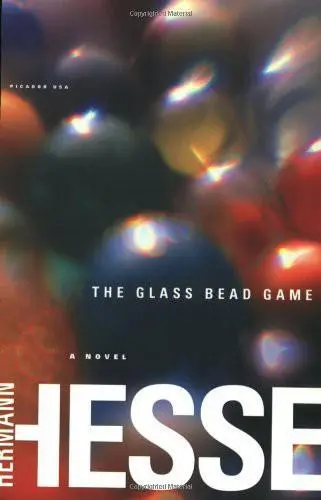
- Название:The Glass Bead Game
- Автор:
- Жанр:
- Год:1969
- ISBN:нет данных
- Рейтинг книги:4 / 5. Голосов: 2
-
Избранное:Добавить в избранное
- Отзывы:
-
Ваша оценка:
The Glass Bead Game: краткое содержание, описание и аннотация
Предлагаем к чтению аннотацию, описание, краткое содержание или предисловие (зависит от того, что написал сам автор книги «The Glass Bead Game»). Если вы не нашли необходимую информацию о книге — напишите в комментариях, мы постараемся отыскать её.
Something like chess but far more intricate, the game of Magister Ludi known as the Glass Bead Game is thought in its purest form, a synthesis through which philosophy, art, music and scientific law are appreciated simultaneously. The scholar-players are isolated within Castalia, an autonomous elite institution devoted wholly to the mind and the imagination…
The Glass Bead Game — читать онлайн бесплатно полную книгу (весь текст) целиком
Ниже представлен текст книги, разбитый по страницам. Система сохранения места последней прочитанной страницы, позволяет с удобством читать онлайн бесплатно книгу «The Glass Bead Game», без необходимости каждый раз заново искать на чём Вы остановились. Поставьте закладку, и сможете в любой момент перейти на страницу, на которой закончили чтение.
Интервал:
Закладка:
Their talks often grew into regular disputations, with formal attacks and rebuttals. In the beginning it was Father Jacobus who proved to be the more aggressive of the pair. The more deeply he came to know his young friend’s mind, the more he regretted that so promising a young man should have grown up without the discipline of a religious education, rather in the pseudo-discipline of an intellectual and aesthetic system of thought. Whenever he found something objectionable in Knecht’s way of thinking, he blamed it on that “modern” Castalian spirit with its abstruseness and its fondness for frivolous abstractions. And whenever Knecht surprised him by wholesome views and remarks akin to his own thought, he exulted because his young friend’s sound nature had so well withstood the damage of Castalian education. Joseph took this criticism of Castalia very calmly, repelling the attacks only when the old scholar seemed to him to have gone too far in his passion. But among the good Father’s belittling remarks about Castalia were some whose partial truth Joseph had to admit, and on one point he changed his mind completely during his stay in Mariafels. This had to do with the relationship of Castalian thought to world history, any sense of which, Father Jacobus said, was totally lacking in Castalia. “You mathematicians and Glass Bead Game players,” he would say, “have distilled a kind of world history to suit your own tastes. It consists of nothing but the history of ideas and of art. Your history is bloodless and lacking in reality. You know all about the decay of Latin syntax in the second or third centuries and don’t know a thing about Alexander or Caesar or Jesus Christ. You treat world history as a mathematician does mathematics, in which nothing but laws and formulas exist, no reality, no good and evil, no time, no yesterday, no tomorrow, nothing but an eternal, shallow mathematical present.”
“But how is anyone to study history without attempting to bring order into it?” Knecht asked.
“Of course one should bring order into history,” Jacobus thundered. “Every science is, among other things, a method of ordering, simplifying, making the indigestible digestible for the mind. We think we have recognized a few laws in history and try to apply them to our investigations of historical truth. Suppose an anatomist is dissecting a body. He does not confront wholly surprising discoveries. Rather, he finds beneath the epidermis a congeries of organs, muscles, tendons, and bones which generally conform to a pattern he has brought to his work. But if the anatomist sees nothing but his pattern, and ignores the unique, individual reality of his object, then he is a Castalian, a Glass Bead Game player; he is using mathematics on the least appropriate object. I have no quarrel with the student of history who brings to his work a touchingly childish, innocent faith in the power of our minds and our methods to order reality; but first and foremost he must respect the incomprehensible truth, reality, and uniqueness of events. Studying history, my friend, is no joke and no irresponsible game. To study history one must know in advance that one is attempting something fundamentally impossible, yet necessary and highly important. To study history means submitting to chaos and nevertheless retaining faith in order and meaning. It is a very serious task, young man, and possibly a tragic one.”
Among the remarks of Father Jacobus which Knecht at the time quoted in letters to his friends, here is one more characteristic outburst:
“Great men are to youth like the raisins in the cake of world history. They are also part of its actual substance, of course, and it is not so simple and easy as might be thought to distinguish the really great men from the pseudo-greats. Among the latter, it is the historical moment itself, and their ability to foresee its coming and seize it, that gives them the semblance of greatness. Quite a few historians and biographers, to say nothing of journalists, consider this ability to divine and seize upon a historical moment — in other words, temporary success — as in itself a mark of greatness. The corporal who becomes a dictator overnight, or the courtesan who for a while controls the good or ill humor of a ruler of the world, are favorite figures of such historians. And idealistically minded youths, on the other hand, most love the tragic failures, the martyrs, those who came on the scene a moment too soon or too late. For me, since I am after all chiefly a historian of our Benedictine Order, the most attractive and amazing aspects of history, and the most deserving of study, are not individuals and not coups, triumphs, or downfalls; rather I love and am insatiably curious about such phenomena as our congregation. For it is one of those long-lived organizations whose purpose is to gather, educate, and reshape men’s minds and souls, to make a nobility of them, not by eugenics, not by blood, but by the spirit — a nobility as capable of serving as of ruling. In Greek history I was fascinated not by the galaxy of heroes and not by the obtrusive shouting in the Agora, but by efforts such as those of the Pythagorean brotherhood or the Platonic Academy. In Chinese history no other feature is so striking as the longevity of the Confucian system. And in our own Occidental history the Christian Church and the Orders which serve it as part of its structure, seem to me historical elements of the foremost importance. The fact that an adventurer contrives to conquer or found a kingdom which lasts twenty, fifty, or even a hundred years, or that a well-meaning idealist on a royal or imperial throne once in a while brings greater honesty into politics, or attempts to carry some visionary cultural project to fruition; that under high pressure a nation or other community has been capable of incredible feats of achievement and suffering — all that interests me far less than the ever-recurrent efforts to establish such organizations as our Order, and that some of these efforts have endured for a thousand or two thousand years. I shall say nothing of holy Church itself; for us believers it is beyond discussion. But that communities such as the Benedictines, the Dominicans, later the Jesuits and others, have survived for centuries and, despite their ups and downs, the assaults upon them, and the adaptations they have made, retain their face and their voice, their gesture, their individual soul — this is, for me, the most remarkable and meritorious phenomenon in history.”
Knecht even admired Father Jacobus’s spells of angry unfairness. At the time, however, he had no notion of who Father Jacobus really was. He regarded him solely as a profound and brilliant scholar and was unaware that here was someone who was consciously participating in world history, and helping to shape it as the leading statesman of his Order. As an expert in contemporary politics as well as political history, Father Jacobus was constantly being approached from many sides for information, advice, and mediation. For some two years, up to the time of his first vacation, Knecht continued to think of Father Jacobus solely as a scholar, knowing no more of the man’s life, activity, reputation, and influence than the monk cared to reveal. The learned Father knew how to keep his counsel, even in friendship; and his brothers in the monastery were also far abler at concealment than Joseph would have imagined.
After some two years Knecht had adapted to the life in the monastery as perfectly as any guest and outsider could. From time to time he had helped the organist modestly continue the thin thread of an ancient and great tradition in the monastery’s small chorus of motet singers. He had made several finds in the monastic musical archives and had sent to Waldzell, and especially to Monteport, several copies of old works. He had trained a small beginners’ class of Glass Bead Game players, among whom the most zealous pupil was young Anton. He had taught Abbot Gervasius no Chinese, but had at least imparted the technique of manipulating the yarrow sticks and an improved method of meditating on the aphorisms in the Book of Oracles. The Abbot had grown accustomed to him, and had long since stopped trying to coax his guest into taking an occasional glass of wine. The semiannual reports sent by the Abbot to the Glass Bead Game Master, in reply to official inquiries as to the usefulness of Joseph Knecht, were full of praise. In Castalia, the lesson plans and marks in Knecht’s Game course were scrutinized even more closely than these reports; the middling level of instruction was recognized, but the Castalian authorities were satisfied with the way the teacher had adapted to this level and, in general, to the customs and the spirit of the monastery. They were even more pleased, and truly surprised — although they kept this to themselves — by his frequent and friendly association with the famous Father Jacobus.
Читать дальшеИнтервал:
Закладка:
Похожие книги на «The Glass Bead Game»
Представляем Вашему вниманию похожие книги на «The Glass Bead Game» списком для выбора. Мы отобрали схожую по названию и смыслу литературу в надежде предоставить читателям больше вариантов отыскать новые, интересные, ещё непрочитанные произведения.





Обсуждение, отзывы о книге «The Glass Bead Game» и просто собственные мнения читателей. Оставьте ваши комментарии, напишите, что Вы думаете о произведении, его смысле или главных героях. Укажите что конкретно понравилось, а что нет, и почему Вы так считаете.