Hermann Hesse - The Glass Bead Game
Здесь есть возможность читать онлайн «Hermann Hesse - The Glass Bead Game» весь текст электронной книги совершенно бесплатно (целиком полную версию без сокращений). В некоторых случаях можно слушать аудио, скачать через торрент в формате fb2 и присутствует краткое содержание. Год выпуска: 1969, Жанр: Современная проза, Социально-психологическая фантастика, на английском языке. Описание произведения, (предисловие) а так же отзывы посетителей доступны на портале библиотеки ЛибКат.
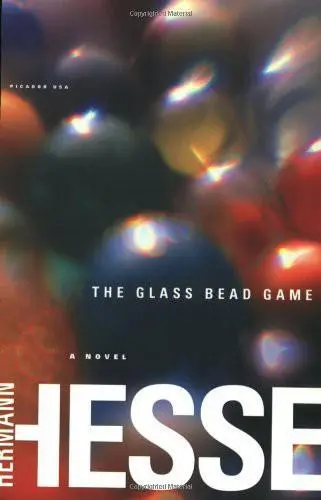
- Название:The Glass Bead Game
- Автор:
- Жанр:
- Год:1969
- ISBN:нет данных
- Рейтинг книги:4 / 5. Голосов: 2
-
Избранное:Добавить в избранное
- Отзывы:
-
Ваша оценка:
The Glass Bead Game: краткое содержание, описание и аннотация
Предлагаем к чтению аннотацию, описание, краткое содержание или предисловие (зависит от того, что написал сам автор книги «The Glass Bead Game»). Если вы не нашли необходимую информацию о книге — напишите в комментариях, мы постараемся отыскать её.
Something like chess but far more intricate, the game of Magister Ludi known as the Glass Bead Game is thought in its purest form, a synthesis through which philosophy, art, music and scientific law are appreciated simultaneously. The scholar-players are isolated within Castalia, an autonomous elite institution devoted wholly to the mind and the imagination…
The Glass Bead Game — читать онлайн бесплатно полную книгу (весь текст) целиком
Ниже представлен текст книги, разбитый по страницам. Система сохранения места последней прочитанной страницы, позволяет с удобством читать онлайн бесплатно книгу «The Glass Bead Game», без необходимости каждый раз заново искать на чём Вы остановились. Поставьте закладку, и сможете в любой момент перейти на страницу, на которой закончили чтение.
Интервал:
Закладка:
“We shall discuss that tomorrow,” the hermit said, and showed his guest to a bed.
Next morning Knecht sat down by the goldfish pool and gazed into the cool small world of darkness and light and magically shimmering colors, where the bodies of the golden fish glided in the dark greenish blueness and inky blackness. Now and then, just when the entire world seemed enchanted, asleep forever in a dreamy spell, the fish would dart with a supple and yet alarming movement, like flashes of crystal and gold, through the somnolent darkness. He looked down, becoming more and more absorbed, daydreaming rather than meditating, and was not conscious when Elder Brother stepped softly out of the house, paused, and stood for a long time watching his bemused guest. When Knecht at last shook off his abstraction and stood up, he was no longer there, but his voice soon called from inside an invitation to tea. They greeted each other briefly, drank tea, and sat listening in the matutinal stillness to the sound of the small jet of water from the fountain, a melody of eternity. Then the hermit stood up, busied himself here and there about the irregularly shaped room, now and then glancing, blinking rapidly, at Knecht. Suddenly he asked: “Are you ready to don your shoes and continue your journeying?”
Knecht hesitated. Then he said: “If it must be so, I am ready.”
“And if it should chance that you stay here a little while, are you ready to be obedient and to keep as still as a goldfish?”
Again Knecht said he was ready.
“It is well,” Elder Brother said. “Now I shall lay the stalks and consult the oracle.”
While Knecht sat and looked on with an awe equal to his curiosity, keeping “as still as a goldfish,” Elder Brother fetched from a wooden beaker, which was rather a kind of quiver, a handful of sticks. These were the yarrow stalks. He counted them out carefully, returned one part of the bundle to the vessel, laid a stalk aside, divided the rest into two equal bundles, kept one in his left hand, and with the sensitive fingertips of his right hand took tiny little clusters from the pack in his left. He counted these and laid them aside until only a few stalks remained. These he held between two fingers of his left hand. After thus reducing one bundle by ritual counting to a few stalks, he followed the same procedure with the other bundle. He laid the counted stalks to one side, then went through both bundles again, one after the other, counting, clamping small remnants of bundles between two fingers. His fingers performed all this with economical motions and quiet agility; it looked like an occult game of skill governed by strict rules, practiced thousands of times and brought to a high degree of virtuoso dexterity. After he had gone through the same process several times, three small bundles remained. From the number of stalks in them he read an ideograph which he drew with a tapering brush on a small piece of paper. Now the whole complicated procedure began anew; the sticks were divided again into two equal bundles, counted, laid aside, thrust between fingers, until in the end again three tiny bundles remained which resulted in a second ideograph. Moved about like dancers, making very soft, dry clicks, the stalks came together, changed places, formed bundles, were separated, were counted anew; they shifted positions rhythmically, with a ghostly sureness. At the end of each process an ideograph was written, until finally the positive and negative symbols stood in six lines one above the other. The stalks were gathered up and carefully replaced in their container. The sage sat crosslegged on the floor of reed matting, for a long time silently examining the result of the augury on the sheet of paper.
“It is the sign Mong,” he said. “This sign bears the name: youthful folly. Above the mountain, below the water; above Gen, below Kan. At the foot of the fountain the spring bubbles forth, the symbol of youth. The verdict reads:
Youthful folly wins success.
I do not seek the young fool,
The young fool seeks me.
At the first oracle I give knowledge.
If he asks again, it is importunity.
If he importunes, I give no knowledge.
Perseverance is beneficial.”
Knecht had been holding his breath from sheer suspense. In the ensuing silence he involuntarily gave a deep sigh of relief. He did not dare to ask. But he thought he had understood: the young fool had turned up; he would be permitted to stay. Even while he was still enthralled by the sublime marionettes’ dance of fingers and sticks, which he had watched for so long and which looked so persuasively meaningful, the result took hold of him. The oracle had spoken; it had decided in his favor.
We would not have described this episode in such detail if Knecht himself had not so frequently related it to his friends with a certain relish. Now we shall return to our scholarly account.
Knecht remained at the Bamboo Grove for months and learned to manipulate the yarrow stalks almost as well as his teacher. The latter spent an hour a day with him, practicing counting the sticks, imparting the grammar and symbolism of the oracular language, and drilling him in writing and memorizing the sixty-four signs. He read to Knecht from ancient commentaries, and every so often, on particularly good days, told him a story by Chuang Tzu. For the rest, the disciple learned to tend the garden, wash the brushes, and prepare the Chinese ink. He also learned to make soup and tea, gather brushwood, observe the weather, and handle the Chinese calendar. But his rare attempts to introduce the Glass Bead Game and music into their sparing conversations yielded no results whatsoever; they seemed to fall upon deaf ears, or else were turned aside with a forbearing smile or a proverb such as, “Dense clouds, no rain,” or, “Nobility is without flaw.” But when Knecht had a small clavichord sent from Monteport and spent an hour a day playing, Elder Brother made no objection. Once Knecht confessed to his teacher that he wished to learn enough to be able to incorporate the system of the I Ching into the Glass Bead Game. Elder Brother laughed. “Go ahead and try,” he exclaimed. “You’ll see how it turns out. Anyone can create a pretty little bamboo garden in the world. But I doubt that the gardener would succeed in incorporating the world in his bamboo grove.”
But enough of this. We shall mention only the one further fact that some years later, when Knecht was already a highly respected personage in Waldzell and invited Elder Brother to give a course there, he received no answer.
Afterward Joseph Knecht described the months he lived in the Bamboo Grove as an unusually happy time. He also frequently referred to it as the “beginning of my awakening” — and in fact from that period on the image of “awakening” turns up more and more often in his remarks, with a meaning similar to although not quite the same as that he had formerly attributed to the image of vocation. It could be assumed that the “awakening” signified knowledge of himself and of the place he occupied within the Castalian and the general human order of things; but it seems to us that the accent increasingly shifts toward self-knowledge in the sense that from the “beginning of his awakening” Knecht came closer and closer to a sense of his special, unique position and destiny, while at the same time, the concepts and categories of the traditional hierarchy of the world and of the special Castalian hierarchy became for him more and more relative matters.
His Chinese studies were far from concluded during his stay in the Bamboo Grove. They continued, and Knecht made particular efforts to acquire a knowledge of ancient Chinese music. Everywhere in the older Chinese writers he encountered praise of music as one of the primal sources of all order, morality, beauty, and health. This broad, ethical view of music was familiar to him from of old, for the Music Master could be regarded as the very embodiment of it
Читать дальшеИнтервал:
Закладка:
Похожие книги на «The Glass Bead Game»
Представляем Вашему вниманию похожие книги на «The Glass Bead Game» списком для выбора. Мы отобрали схожую по названию и смыслу литературу в надежде предоставить читателям больше вариантов отыскать новые, интересные, ещё непрочитанные произведения.




Обсуждение, отзывы о книге «The Glass Bead Game» и просто собственные мнения читателей. Оставьте ваши комментарии, напишите, что Вы думаете о произведении, его смысле или главных героях. Укажите что конкретно понравилось, а что нет, и почему Вы так считаете.