Hermann Hesse - The Glass Bead Game
Здесь есть возможность читать онлайн «Hermann Hesse - The Glass Bead Game» весь текст электронной книги совершенно бесплатно (целиком полную версию без сокращений). В некоторых случаях можно слушать аудио, скачать через торрент в формате fb2 и присутствует краткое содержание. Год выпуска: 1969, Жанр: Современная проза, Социально-психологическая фантастика, на английском языке. Описание произведения, (предисловие) а так же отзывы посетителей доступны на портале библиотеки ЛибКат.
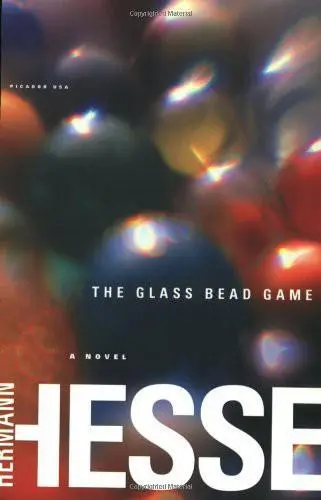
- Название:The Glass Bead Game
- Автор:
- Жанр:
- Год:1969
- ISBN:нет данных
- Рейтинг книги:4 / 5. Голосов: 2
-
Избранное:Добавить в избранное
- Отзывы:
-
Ваша оценка:
The Glass Bead Game: краткое содержание, описание и аннотация
Предлагаем к чтению аннотацию, описание, краткое содержание или предисловие (зависит от того, что написал сам автор книги «The Glass Bead Game»). Если вы не нашли необходимую информацию о книге — напишите в комментариях, мы постараемся отыскать её.
Something like chess but far more intricate, the game of Magister Ludi known as the Glass Bead Game is thought in its purest form, a synthesis through which philosophy, art, music and scientific law are appreciated simultaneously. The scholar-players are isolated within Castalia, an autonomous elite institution devoted wholly to the mind and the imagination…
The Glass Bead Game — читать онлайн бесплатно полную книгу (весь текст) целиком
Ниже представлен текст книги, разбитый по страницам. Система сохранения места последней прочитанной страницы, позволяет с удобством читать онлайн бесплатно книгу «The Glass Bead Game», без необходимости каждый раз заново искать на чём Вы остановились. Поставьте закладку, и сможете в любой момент перейти на страницу, на которой закончили чтение.
Интервал:
Закладка:
Knecht’s studies went beyond the task of acquainting himself in the utmost detail with the contents, principles, books, and systems contained in the Game plan, and retracting as he went a way back through various cultures, sciences, languages, arts, and centuries. He had also set himself the task that none of his teachers even recognized, of employing these objects to check in detail the systems and possibilities of expression in the art of the Glass Bead Game.
To anticipate his results: here and there he found a gap, an inadequacy, but on the whole our Glass Bead Game withstood his stringent reassessment. Otherwise he would not have returned to it at the end of his work.
If we were writing a study in cultural history, a good many of the places and scenes of Knecht’s student days would certainly merit description. As far as possible he preferred places where he could work alone, or with only a very few others, and to some of these places he retained a lifelong grateful attachment. He frequently stayed in Monteport, sometimes as the Music Master’s guest, sometimes as a participant in a musicological seminar. Twice we find him in Hirsland, the headquarters of the Order, as a participant in the “Great Exercise,” the twelve-day period of fasting and meditation. He used later to tell his intimates with special affection about the “Bamboo Grove,” the lovely hermitage which was the scene of his I Ching studies. There he learned and experienced things of crucial importance. There, too, guided by a wonderful premonition or Providence, he found unique surroundings and an extraordinary person: the founder and inmate of the Chinese hermitage, who was called Elder Brother. We think it proper to describe at greater length this most remarkable episode in his years of free study.
Knecht had begun his studies of the Chinese language and classics in the famous Far Eastern College which for generations had been affiliated to St. Urban’s, the academic complex devoted to classical philology. There he had made rapid progress in reading and writing and also struck up friendships with several of the Chinese working there, and had learned a number of the odes of the Shih Ching by heart. In the second year of his stay he turned to a more and more intense study of the I Ching, the Book of Changes. The Chinese provided him with all sorts of information, but no introductory course; there was no teacher available in the college, and after Knecht had repeatedly petitioned them for an instructor for a thorough study of the I Ching , he was told about Elder Brother and his hermitage.
It had become apparent to Knecht that his interest in the Book of Changes was leading him into a field which the teachers at the college preferred to keep at a distance, and he therefore grew more cautious in his inquiries. Now, as he made efforts to obtain further information about this legendary Elder Brother, it became obvious to him that the hermit enjoyed a measure of respect, and indeed a degree of fame, but more as an eccentric loner than as a scholar. Knecht sensed that he would have to help himself; he finished a paper he had begun for a seminar as quickly as possible, and took his leave. On foot, he made his way to the region in which the mysterious man, perhaps a sage and Master, perhaps a fool, had long ago established his Bamboo Grove.
He had gathered a few bits of information about the hermit. Some twenty-five years before, the man had been the most promising student in the Chinese Department. He seemed to have been born for these studies, outdid his best teachers, both Chinese by birth and Westerners, in the technique of brush writing and the deciphering of ancient texts, but became somewhat notorious for the zeal with which he also tried to make himself into a Chinese in outward matters also. Thus he obstinately refused to address his superiors, from the instructor of a seminar to the Masters, by their titles, as all other students did. Instead, he called them “My Elder Brother,” until at last this appellation became attached to himself as a nickname. He devoted special attention to the oracular game of the I Ching , and developed a masterly skill at practicing it with the traditional yarrow stalks. Along with the ancient commentaries on the Book of Changes, his favorite book was the philosophical work of Chuang Tzu. Evidently the rationalistic, somewhat antimystical, and declaredly Confucian spirit of the Chinese Department of the college, as Knecht encountered it, had already been prevalent at that time, for one day Elder Brother left the Institute, which would gladly have kept him as a teacher, and set out on a walking tour, armed with brush, Chinese ink saucer, and two or three books. He made his way to the southern part of the country, turning up here and there to visit for a while with brethren of the Order. He looked for and finally found the suitable spot for the hermitage he planned, stubbornly bombarded both the secular authorities and the Order with written and oral petitions until they granted him the right to settle there and cultivate the area. Ever since, he had been living in an idyllic retreat strictly governed by ancient Chinese principles. Some referred to him with amusement as a crank, others venerated him as a kind of saint. But apparently he was content with himself and at peace with the world, devoting his days to meditation and the copying of ancient scrolls whenever he was not occupied with his Bamboo Grove, which sheltered from the north wind a carefully laid out Chinese miniature garden.
Joseph Knecht, then, tramped toward this hermitage, making frequent stops to rest, delighting in the landscape that lay smiling beneath him as soon as he had climbed through the mountain passes, stretching southward in a blue haze, with sunlit terraced vineyards, brown stone walls alive with lizards, stately chestnut groves, a piquant mingling of southland and high mountain country. It was late afternoon when he reached the Bamboo Grove. He entered and looked with astonishment upon a Chinese pavilion set in the midst of a curious garden, with a splashing fountain fed by a wooden pipe. The overflow ran along a gravel bed into a masonry basin, in whose crevices all sorts of green plants flourished. A few goldfish swam around in the still, crystalline water. Fragile and peaceful, the feathery crowns of the bamboos swayed on their strong, slender shafts. The sward was punctuated by stone slabs carved with inscriptions in the classical style.
A frail man dressed in tan linen, glasses over blue eyes that bore a tentative look, straightened up from a flower bed over which he had been bending and slowly approached the visitor. His manner was not unfriendly, but it had that somewhat awkward shyness rather common among solitaries and recluses. He looked inquiringly at Knecht and waited for what he had to say. With some embarrassment Knecht spoke the Chinese words he had already formulated: “The young disciple takes the liberty of paying his respects to Elder Brother.”
“The well-bred guest is welcome,” Elder Brother said. “May a young colleague always be welcome to a bowl of tea and a little agreeable conversation; and a bed for the night may be found for him, if this is desired.”
Knecht kowtowed, expressed his thanks, and was led into the pavilion and served tea. Then he was shown the garden, the carved slabs, the pond, the goldfish, and was even told the age of the fish. Until suppertime they sat under the swaying bamboos exchanging courtesies, verses from odes, and sayings from the classical writers. They looked at the flowers and took pleasure in the fading pinks of sunset along the mountain ranges. Then they re-entered the house. Elder Brother served bread and fruit, cooked an excellent pancake for each of them on a tiny stove, and after they had eaten he asked in German the purpose of his visit, and in German Knecht explained why he had come and what he desired, which was to stay as long as Elder Brother permitted him, and to become his disciple.
Читать дальшеИнтервал:
Закладка:
Похожие книги на «The Glass Bead Game»
Представляем Вашему вниманию похожие книги на «The Glass Bead Game» списком для выбора. Мы отобрали схожую по названию и смыслу литературу в надежде предоставить читателям больше вариантов отыскать новые, интересные, ещё непрочитанные произведения.








Обсуждение, отзывы о книге «The Glass Bead Game» и просто собственные мнения читателей. Оставьте ваши комментарии, напишите, что Вы думаете о произведении, его смысле или главных героях. Укажите что конкретно понравилось, а что нет, и почему Вы так считаете.