Hermann Hesse - The Glass Bead Game
Здесь есть возможность читать онлайн «Hermann Hesse - The Glass Bead Game» весь текст электронной книги совершенно бесплатно (целиком полную версию без сокращений). В некоторых случаях можно слушать аудио, скачать через торрент в формате fb2 и присутствует краткое содержание. Год выпуска: 1969, Жанр: Современная проза, Социально-психологическая фантастика, на английском языке. Описание произведения, (предисловие) а так же отзывы посетителей доступны на портале библиотеки ЛибКат.
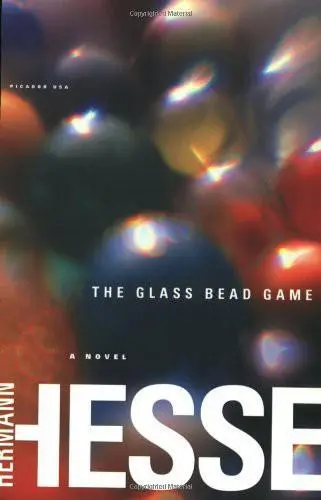
- Название:The Glass Bead Game
- Автор:
- Жанр:
- Год:1969
- ISBN:нет данных
- Рейтинг книги:4 / 5. Голосов: 2
-
Избранное:Добавить в избранное
- Отзывы:
-
Ваша оценка:
The Glass Bead Game: краткое содержание, описание и аннотация
Предлагаем к чтению аннотацию, описание, краткое содержание или предисловие (зависит от того, что написал сам автор книги «The Glass Bead Game»). Если вы не нашли необходимую информацию о книге — напишите в комментариях, мы постараемся отыскать её.
Something like chess but far more intricate, the game of Magister Ludi known as the Glass Bead Game is thought in its purest form, a synthesis through which philosophy, art, music and scientific law are appreciated simultaneously. The scholar-players are isolated within Castalia, an autonomous elite institution devoted wholly to the mind and the imagination…
The Glass Bead Game — читать онлайн бесплатно полную книгу (весь текст) целиком
Ниже представлен текст книги, разбитый по страницам. Система сохранения места последней прочитанной страницы, позволяет с удобством читать онлайн бесплатно книгу «The Glass Bead Game», без необходимости каждый раз заново искать на чём Вы остановились. Поставьте закладку, и сможете в любой момент перейти на страницу, на которой закончили чтение.
Интервал:
Закладка:
“Well, I shall not take a lifetime and I hope I won’t regret it. And now for my request. Since at present you are working in the Game Archives and I for special reasons prefer to keep away from Waldzell for a good while longer, I hope you will answer quite a barrage of questions for me every so often. That is, I shall be asking you to send me from the Archives the unabbreviated forms of the official clefs and symbols for all sorts of themes. I am counting on you, and counting on your asking reciprocal favors as soon as there is anything I can do for you.”
Perhaps this is the place to cite that other passage from Knecht’s letters which also deals with the Glass Bead Game, although the letter in question, addressed to the Music Master, was written at least a year or two later. “I imagine,” Knecht wrote to his patron, “that one can be an excellent Glass Bead Game player, even a virtuoso, and perhaps even a thoroughly competent Magister Ludi, without having any inkling of the real mystery of the Game and its ultimate meaning. It might even be that one who does guess or know the truth might prove a greater danger to the Game, were he to become a specialist in the Game, or a Game leader. For the dark interior, the esoterics of the Game, points down into the One and All, into those depths where the eternal Atman eternally breathes in and out, sufficient unto itself. One who had experienced the ultimate meaning of the Game within himself would by that fact no longer be a player; he would no longer dwell in the world of multiplicity and would no longer be able to delight in invention, construction, and combination, since he would know altogether different joys and raptures. Because I think I have come close to the meaning of the Glass Bead Game, it will be better for me and for others if I do not make the Game my profession, but instead shift to music.”
The Music Master, who usually confined his correspondence to a minimum, was evidently troubled by these remarks and replied with a rather lengthy piece of friendly admonition: “It is good that you yourself do not require a master of the Game to be an ‘esoteric’ in your sense of the word, for I hope you wrote that without irony. A Game Master or teacher who was primarily concerned with being close enough to the ‘innermost meaning’ would be a very bad teacher. To be candid, I myself, for example, have never in my life said a word to my pupils about the ‘meaning’ of music; if there is one, it does not need my explanations. On the other I have always made a great point of having my pupils count their eighths and sixteenths nicely. Whatever you become, teacher, scholar, or musician, have respect for the ‘meaning,’ but do not imagine that it can be taught. Once upon a time the philosophers of history ruined half of world history with their efforts to teach such ‘meaning’; they inaugurated the Age of the Feuilleton and are partly to blame for quantities of spilled blood. If I were introducing pupils to Homer or Greek tragedy, say, I would also not try to tell them that the poetry is one of the manifestations of the divine, but would endeavor to make the poetry accessible to them by imparting a precise knowledge of its linguistic and metrical strategies. The task of the teacher and scholar is to study means, cultivate tradition, and preserve the purity of methods, not to deal in incommunicable experiences which are reserved to the elect — who often enough pay a high price for this privilege.”
There is no other mention of the Glass Bead Game and its “esoteric” aspect in all the rest of Knecht’s correspondence of that period. Indeed, he does not seem to have written many letters, or else some of them have been lost. At any rate, the largest and best-preserved correspondence, that with Ferromonte, deals almost entirely with problems of music and musical stylistic analysis.
Thus there was a special meaning and resolution behind the peculiar zigzag course of Knecht’s studies, which consisted in nothing less than the circumstantial retracing and prolonged analysis of a single Game pattern. In order to assimilate the contents of this one pattern, which the schoolboys had composed as an exercise within a few days, and which could be read off in a quarter hour in the language of the Glass Bead Game, he spent year after year sitting in lecture halls and libraries, studying Froberger and Alessandro Scarlatti, fugues and sonata form, reviewing mathematics, learning Chinese, working through a system of tonal figuration and the Feustelian theory of the correspondence between the scale of colors and the musical keys.
We may ask why he had chosen this toilsome, eccentric, and above all lonely path, for his ultimate goal (outside of Castalia, people would say: his choice of profession) was undoubtedly the Glass Bead Game. He might freely have entered one of the institutes of the Vicus Lusorum, the settlement of Glass Bead Game players in Waldzell, as a guest scholar. In that case all the special studies connected with the Game would have been made easier for him. Advice and information on all questions of detail would have been available to him at any time, and in addition he could have pursued his studies among other scholars in the same field, young men with the same devotion to the Game, instead of struggling alone in a state that often amounted to voluntary banishment. Be that as it may, he went his own way. We suspect that he avoided Waldzell partly to expunge as far as possible from his own mind and the minds of others the memory of his role as a student there, partly so that he would not stumble into a similar role among the community of Glass Bead Game players. For he probably bore away the feeling from those early days that he was predestined to become a leader and spokesman, and he did all that he could to outwit the obtrusiveness of fate. He sensed in advance the weight of responsibility; he could already feel it toward his fellow students from Waldzell, who went on adulating him even though he withdrew from them. And he felt it especially toward Tegularius, who would go through fire and water for him — this he knew instinctively.
Therefore he sought seclusion and contemplation, while his destiny tried to propel him forward into the public realm. It is in these terms that we imagine his state of mind at the time. But there was another important factor that deterred him from taking the usual courses at the higher Glass Bead Game academies and made an outsider of him. That was an inexorable urge toward research arising from his former doubts about the Glass Bead Game. To be sure, he had once tasted the experience that the Game could be played in a supreme and sacred sense; but he had also seen that the majority of players and students of the Game, and even some of the leaders and teachers, by no means shared that lofty and sacramental feeling for the Game. They did not regard the Game language as a lingua sacra, but more as an ingenious kind of stenography. They practiced the Game as an interesting or amusing specialty, an intellectual sport or an arena for ambition. In fact, as his letter to the Music Master shows, he already sensed that the search for ultimate meaning does not necessarily determine the quality of the player, that its superficial aspects were also essential to the Game, that it comprised technique, science, and social institution. In short, he had doubts and divided feelings; the Game was a vital question for him, had become the chief problem of his life, and he was by no means disposed to let well-meaning spiritual guides ease his struggles or benignly smiling teachers dismiss them as trivial.
Naturally he could have made any one of the tens of thousands of recorded Glass Bead Games and the millions of possible games the basis of his studies. He knew this and therefore proceeded from that chance Game plan that he and his schoolmates had composed in an elementary course. It was the game in which he had for the first time grasped the meaning of all Glass Bead Games and experienced his vocation as a player. During those years he kept with him at all times an outline of that Game, noted down in the usual shorthand. In the symbols, ciphers, signatures, and abbreviations of the Game language an astronomical formula, the principles of form underlying an old sonata, an utterance of Confucius, and so on, were written down. A reader who chanced to be ignorant of the Glass Bead Game might imagine such a Game pattern as rather similar to the pattern of a chess game, except that the significances of the pieces and the potentialities of their relationships to one another and their effect upon one another multiplied manyfold and an actual content must be ascribed to each piece, each constellation, each chess move, of which this move, configuration, and so on is the symbol.
Читать дальшеИнтервал:
Закладка:
Похожие книги на «The Glass Bead Game»
Представляем Вашему вниманию похожие книги на «The Glass Bead Game» списком для выбора. Мы отобрали схожую по названию и смыслу литературу в надежде предоставить читателям больше вариантов отыскать новые, интересные, ещё непрочитанные произведения.






Обсуждение, отзывы о книге «The Glass Bead Game» и просто собственные мнения читателей. Оставьте ваши комментарии, напишите, что Вы думаете о произведении, его смысле или главных героях. Укажите что конкретно понравилось, а что нет, и почему Вы так считаете.