Hermann Hesse - The Glass Bead Game
Здесь есть возможность читать онлайн «Hermann Hesse - The Glass Bead Game» весь текст электронной книги совершенно бесплатно (целиком полную версию без сокращений). В некоторых случаях можно слушать аудио, скачать через торрент в формате fb2 и присутствует краткое содержание. Год выпуска: 1969, Жанр: Современная проза, Социально-психологическая фантастика, на английском языке. Описание произведения, (предисловие) а так же отзывы посетителей доступны на портале библиотеки ЛибКат.
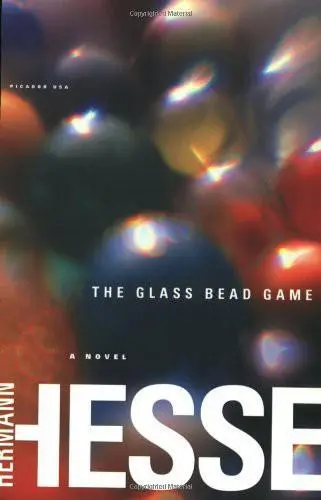
- Название:The Glass Bead Game
- Автор:
- Жанр:
- Год:1969
- ISBN:нет данных
- Рейтинг книги:4 / 5. Голосов: 2
-
Избранное:Добавить в избранное
- Отзывы:
-
Ваша оценка:
The Glass Bead Game: краткое содержание, описание и аннотация
Предлагаем к чтению аннотацию, описание, краткое содержание или предисловие (зависит от того, что написал сам автор книги «The Glass Bead Game»). Если вы не нашли необходимую информацию о книге — напишите в комментариях, мы постараемся отыскать её.
Something like chess but far more intricate, the game of Magister Ludi known as the Glass Bead Game is thought in its purest form, a synthesis through which philosophy, art, music and scientific law are appreciated simultaneously. The scholar-players are isolated within Castalia, an autonomous elite institution devoted wholly to the mind and the imagination…
The Glass Bead Game — читать онлайн бесплатно полную книгу (весь текст) целиком
Ниже представлен текст книги, разбитый по страницам. Система сохранения места последней прочитанной страницы, позволяет с удобством читать онлайн бесплатно книгу «The Glass Bead Game», без необходимости каждый раз заново искать на чём Вы остановились. Поставьте закладку, и сможете в любой момент перейти на страницу, на которой закончили чтение.
Интервал:
Закладка:
Knecht informed his friend Ferromonte of Plinio’s confession with deep emotion. And Ferromonte himself added, in the letter we have just cited: “To me, as a musician, this confession of Plinio, to whom I had not always been entirely fair, was like a musical experience. The contrast of world and Mind, or of Plinio and Joseph, had before my eyes been transfigured from the conflict of two irreconcilable principles into a double concerto.”
When Plinio had come to the end of his four-year course and was about to return home, he brought the headmaster a letter from his father inviting Joseph Knechf to spend the coming vacation with him. This was an unusual proposal. Leaves for journeys and stays outside the Pedagogic Province did exist, chiefly for purposes of study. They were not so very rare, but were exceptional and generally granted only to older and more seasoned researchers, never to younger students still at school. But since the invitation had come from so highly esteemed a family and personage, Headmaster Zbinden did not presume to reject it on his own, but presented it to a committee of the Board of Educators. The reply was a laconic refusal. The friends had to say good-by to each other.
“We’ll try the invitation again sometime,” Plinio said. “Sooner or later it will work out. You must someday see my home and meet my family, and realize that we are not just commercial-minded scum. I shall miss you very much. And make sure, Joseph, that you rise quickly in this complicated Castalia of yours. Of course you’re highly suited to become a member of the hierarchy, but in my opinion more at the top than the bottom of the heap — in spite of your name. I prophesy a great future for you; one of these days you’ll be a Magister and be counted among the illustrious.”
Joseph gave him a sad look.
“Go ahead and make fun of me,” he said, struggling with the emotion of parting. “I am not so ambitious as you, and if I should ever attain to some office, you will long since have become president or mayor, university professor, or deputy. Think kindly of us, Plinio, and of Castalia; don’t become entirely estranged from us. After all, there have to be a few people in the outside world who know more about Castalia than the jokes they make about us out there.”
They shook hands, and Plinio departed.
For his last year in Waldzell, Joseph remained out of the limelight. His exposed and strenuous function as a more or less public personality had suddenly come to an end. Castalia no longer needed a defender. Joseph devoted his free time during that year chiefly to the Glass Bead Game, which enthralled him more and more. A notebook of jottings from that period, dealing with the meaning and theory of the Game, begins with the sentence: “The whole of both physical and mental life is a dynamic phenomenon, of which the Glass Bead Game basically comprehends only the aesthetic side, and does so predominantly as an image of rhythmic processes.”
THREE
YEARS OF FREEDOM
JOSEPH KNECHT WAS about twenty-four years old at this time. With graduation from Waldzell, his school days were over, and there now began his years of free study. With the exception of his uneventful boyhood in Eschholz, these were probably the most serene and happy years of his life. There is, after all, always something wonderful and touchingly beautiful about a young man, for the first time released from the bonds of schooling, making his first ventures toward the infinite horizons of the mind. At this point he has not yet seen any of his illusions dissipated, or doubted either his own capacity for endless dedication or the boundlessness of the world of thought.
Especially for young men with gifts like those of Joseph Knecht, who have not been driven by a single talent to concentrate on a specialty, but whose nature rather aims at integration, synthesis, and universality, this springtide of free study is often a period of intense happiness and very nearly of intoxication. Were it not preceded by the discipline of the elite schools, by the psychic hygiene of meditation exercises and the lenient supervision of the Board of Educators, this freedom would even be dangerous for such natures and might prove a nemesis to many, as it used to be to innumerable highly gifted young men in the ages before our present educational pattern was set, in the pre-Castalian centuries. The universities in those days literally swarmed with young Faustian spirits who embarked with all sails set upon the high seas of learning and academic freedom, and ran aground on all the shoals of untrammeled dilettantism. Faust himself, after all, was the prototype of brilliant amateurishness and its consequent tragedy.
In Castalia, as it happens, the intellectual freedom of the student is infinitely greater than it ever was at the universities of earlier ages, since the available materials and opportunities for study are far ampler. Moreover, studies in Castalia are in no way restricted or colored by material considerations, by ambition, timidity, straitened circumstances of the parents, prospects for livelihood and career, and so on. In the academies, seminars, libraries, archives, and laboratories of the Pedagogic Province every student is completely equal, no matter what his origins and prospects. The hierarchy grades the student solely by his qualities of mind and character. On the other hand most of the freedoms, temptations, and dangers to which so many talented youths succumb at the secular universities simply do not exist in Castalia. Not that there is a dearth of danger, passion, and bedazzlement there — how could these elements ever be completely absent from human life? But at least certain opportunities for going off the rails, for disappointment and disaster, have been eliminated. There is no danger of the Castalian student’s becoming a drinker. Nor can he waste the years of his youth in tomfoolery, or the empty braggadocio of secret societies, as did some generations of students in olden times. Nor is he apt to make the discovery someday that his degree was a mistake, that there are gaps in his preparatory education which can never be filled. The Castalian order of things protects him against such blunders.
The danger of wasting himself on women or on losing himself in sports is also minimal. As far as women are concerned, the Castalian student is not subject to the temptations and dangers of marriage, nor is he oppressed by the prudery of a good many past eras which imposed continence on students or else made them turn to more or less venal and sluttish women. Since there is no marriage for the Castalians, love is not governed by a morality directed toward marriage. Since the Castalian has no money and virtually no property, he also cannot purchase love. It is customary in the Province for the daughters of the citizenry not to marry early, and in the years before marriage they look upon students and scholars as particularly desirable lovers. The young men, for their part, are not interested in birth and fortune, are prone to grant at least equal importance to mental and emotional capacities, are usually endowed with imagination and humor and, since they have no money, must make their repayment by giving more of themselves than others would. In Castalia the sweetheart of a student does not ask herself: will he marry me? She knows he will not. Actually, there have been occasions when he did; every so often an elite student would return to the world by way of marriage, giving up Castalia and membership in the Order. But these few, rare cases of apostasy in the history of the schools and of the Order amount to little more than a curiosity.
After graduation from the preparatory schools the elite student truly enjoys a remarkable degree of freedom and self-determination in choosing among the fields of knowledge and research. Unless a student’s own talents and interests dictate natural bounds from the start, the only limit on this freedom is his obligation to present a plan of study for each semester. The authorities oversee the execution of fhis plan in only the mildest way. For young men of versatile talents and interests — and Knecht was one of these — the scope thus allowed him is wonderfully enticing and a source of continual delight. The authorities permit such students, if they do not drift into sheer idleness, almost paradisiacal freedom. The student may dabble in all sorts of fields, combine the widest variety of subjects, fall in love with six or eight disciplines simultaneously, or confine himself to a narrower selection from the beginning. Aside from observing the general rules of morality that apply to the whole Province and the Order, nothing is asked of him except presentation once a year of the record of the lectures he has attended, the books he has read, and the research he has undertaken at the various institutes. His performance comes in for closer check only when he attends technical courses and seminars, including courses in the Glass Bead Game and at the Conservatory of Music. Here every student has to take the official examinations and write the papers or do the work required by the head of the seminar, as is only natural. But no one forces him to take such courses. For semesters or for years he may, if he pleases, merely make use of the libraries and listen to lectures. Students who take a long while before deciding upon a single field of knowledge thereby delay their admission into the Order, but the authorities show great patience in allowing and even encouraging their explorations of all possible disciplines and types of study. Aside from good moral conduct, nothing is required of them except the composition of a “Life” every year.
Читать дальшеИнтервал:
Закладка:
Похожие книги на «The Glass Bead Game»
Представляем Вашему вниманию похожие книги на «The Glass Bead Game» списком для выбора. Мы отобрали схожую по названию и смыслу литературу в надежде предоставить читателям больше вариантов отыскать новые, интересные, ещё непрочитанные произведения.






Обсуждение, отзывы о книге «The Glass Bead Game» и просто собственные мнения читателей. Оставьте ваши комментарии, напишите, что Вы думаете о произведении, его смысле или главных героях. Укажите что конкретно понравилось, а что нет, и почему Вы так считаете.