Hermann Hesse - The Glass Bead Game
Здесь есть возможность читать онлайн «Hermann Hesse - The Glass Bead Game» весь текст электронной книги совершенно бесплатно (целиком полную версию без сокращений). В некоторых случаях можно слушать аудио, скачать через торрент в формате fb2 и присутствует краткое содержание. Год выпуска: 1969, Жанр: Современная проза, Социально-психологическая фантастика, на английском языке. Описание произведения, (предисловие) а так же отзывы посетителей доступны на портале библиотеки ЛибКат.
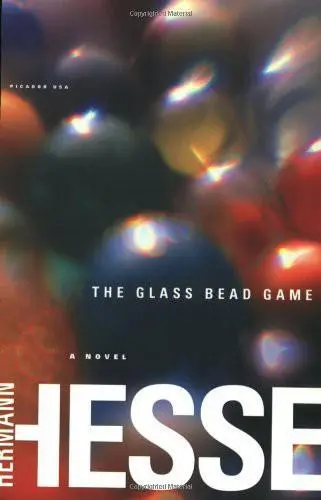
- Название:The Glass Bead Game
- Автор:
- Жанр:
- Год:1969
- ISBN:нет данных
- Рейтинг книги:4 / 5. Голосов: 2
-
Избранное:Добавить в избранное
- Отзывы:
-
Ваша оценка:
The Glass Bead Game: краткое содержание, описание и аннотация
Предлагаем к чтению аннотацию, описание, краткое содержание или предисловие (зависит от того, что написал сам автор книги «The Glass Bead Game»). Если вы не нашли необходимую информацию о книге — напишите в комментариях, мы постараемся отыскать её.
Something like chess but far more intricate, the game of Magister Ludi known as the Glass Bead Game is thought in its purest form, a synthesis through which philosophy, art, music and scientific law are appreciated simultaneously. The scholar-players are isolated within Castalia, an autonomous elite institution devoted wholly to the mind and the imagination…
The Glass Bead Game — читать онлайн бесплатно полную книгу (весь текст) целиком
Ниже представлен текст книги, разбитый по страницам. Система сохранения места последней прочитанной страницы, позволяет с удобством читать онлайн бесплатно книгу «The Glass Bead Game», без необходимости каждый раз заново искать на чём Вы остановились. Поставьте закладку, и сможете в любой момент перейти на страницу, на которой закончили чтение.
Интервал:
Закладка:
There were reasons behind this conduct. Joseph had long since come to feel that this other boy would mean something important to him, perhaps something fine, an enlargement of his horizon, insight or illumination, perhaps also temptation and danger. Whatever it was, this was a test he had to pass. He had told his friend Ferromonte about the first stirrings of skepticism and restlessness that Plinio’s talks had aroused in him, but his friend had paid little attention; he dismissed Plinio as a conceited and self-important fellow not worth listening to, and promptly buried himself in his music again. Instinct warned Joseph that the headmaster was the proper authority to whom to bring his doubts and queries; but since that little clash he no longer had a cordial and candid relationship with Zbinden. He was afraid the headmaster might regard his coming to him with this question as a kind of talebearing.
In this dilemma, which grew increasingly painful because of Plinio’s efforts to strike up a friendship, he turned to his patron and guardian angel, the Music Master, and wrote him a very long letter which has been preserved. In part, it read:
“I am not yet certain whether Plinio hopes to win me over to his way of thinking, or whether he merely wants someone to discuss these matters with. I hope it is the latter, for to convert me to his views would mean leading me into disloyalty and destroying my life, which after all is rooted in Castalia. I have no parents and friends on the outside to whom I could return if I should ever really desire to. But even if Plinio’s sacrilegious speeches are not aimed at conversion and influencing, they leave me at a loss. For to be perfectly frank with you, dear Master, there is something in Plinio’s point of view that I cannot gainsay; he appeals to a voice within me which sometimes strongly seconds what he says. Presumably it is the voice of nature, and it runs utterly counter to my education and the outlook customary among us. When Plinio calls our teachers and Masters a priestly caste and us a pack of spoon-fed eunuchs, he is of course using coarse and exaggerated language, but there may well be some truth to what he says, for otherwise I would hardly be so upset by it. Plinio can say the most startling and discouraging things. For example, he contends that the Glass Bead Game is a retrogression to the Age of the Feuilleton, sheer irresponsible playing around with an alphabet into which we have broken down the languages of the different arts and sciences. It’s nothing but associations and toying with analogies, he says. Or again he declares that our resigned sterility proves the worthlessness of our whole culture and our intellectual attitudes. We analyze the laws and techniques of all the styles and periods of music, he points out, but produce no new music ourselves. We read and exposit Pindar or Goethe and are ashamed to create verse ourselves. Those are accusations I cannot laugh at. And they are not the worst; they are not the ones that wound me most. It is bad enough when he says, for example, that we Castalians lead the life of artifically reared songbirds, do not earn our bread ourselves, never face necessity and the struggle for existence, neither know or wish to know anything about that portion of humanity whose labor and poverty provide the base for our lives of luxury.”
The letter concluded: “Perhaps I have abused your friendliness and kindness, Reverendissime, and I am prepared to be reproved. Scold me, impose penances on me — I shall be grateful for them. But I am in dire need of advice. I can sustain the present situation for a little while longer. But I cannot shape it into any real and fruitful development, for I am too weak and inexperienced. Moreover, and perhaps this is the worst of all, I cannot confide in our headmaster unless you explicitly command me to do so. That is why I have troubled you with this affair, which is becoming a source of great distress to me.”
It would be of the greatest value to us if we also possessed the Master’s reply to this cry for help in black and white. But the reply was given orally. Shortly after Knecht wrote, the Magister Musicae himself arrived in Waldzell to direct an examination in music, and during the days he spent there he devoted considerable time to his young friend. We know of this from Knecht’s later recollections. The Music Master did not make things easy for him. He began by looking closely into Knecht’s grades and into the matter of his private studies as well. The latter, he decided, were much too one-sided; in this regard the headmaster had been right, and he insisted that Knecht admit as much to the headmaster. He gave precise directives for Knecht’s conduct toward Designori, and did not leave until this question, too, had been discussed with Headmaster Zbinden. The outcome was twofold: that remarkable joust between Designori and Knecht, which none who looked on would ever forget; and an entirely new relationship between Knecht and the headmaster. Not that this relationship ever partook of the affection and mystery that linked Knecht to the Music Master, but at least it was lucid and relaxed.
The course that had been traced for Knecht determined the shape of his life for some time. He had been given leave to accept Designori’s friendship, to expose himself to his influence and his attacks without intervention or supervision by his teachers. But his mentor specifically charged him to defend Castalia against the critic, and to raise the clash of views to the highest level. That meant, among other things, that Joseph had to make an intensive study of the fundamentals of the prevailing system in Castalia and in the Order, and to recall them to mind again and again. The debates between the two friendly opponents soon became famous, and drew large audiences. Designori’s aggressive and ironic tone became subtler, his formulations stricter and more responsible, his criticism more objective. Hitherto Plinio had been the winner in this contest; coming from the “world,” he possessed its experience, its methods, its means of attack, and some of its ruthlessness as well. From conversations with adults at home he knew all the indictments the world could muster against Castalia. But now Knecht’s replies forced him to realize that although he knew the world quite well, better than any Castalian, he did not by any means know Castalia and its spirit as well as those who were at home here, for whom Castalia had become both native soil and destiny. He was forced to realize, and ultimately to admit, that he was a guest here, not a native; that the outside world had no exclusive claim on self-evident principles and truths arrived at through centuries of experience. Here too, in the Pedagogic Province, there was a tradition, what might even be called a “nature,” with which he was only imperfectly acquainted and which was now being upheld by its spokesman, Joseph Knecht.
Knecht, for his part, in order to cope with his part as apologist, was obliged to put a great deal of study, meditation, and self-discipline into clarifying and deepening his understanding of what he was required to defend. In rhetoric Designori remained his superior; his worldly training and cleverness supported his natural fire and ambition. Even when he was being defeated on a point, he managed to think of the audience and contrive a facesaving or witty line of retreat. Knecht, on the other hand, when his opponent had driven him into a corner, was apt to say: “I shall have to think about that for a while, Plinio. Wait a few days; I’ll come back to that point.”
The relationship had thus been given a dignified form. In fact, for the participants and the listeners the dispute had already become an indispensable element in the school life of Waldzell. But the pressure and the conflict had scarcely grown any easier for Knecht. Because of the high degree of confidence and responsibility that had been placed upon him, he mastered his assignment, and it is proof of the strength and soundness of his nature that he carried it out without any visible damage. But privately, he suffered a great deal. If he felt friendship for Plinio, he felt it not only for an engaging and clever, cosmopolitan and articulate schoolmate, but also for that alien world which his friend and opponent represented, with which he was becoming acquainted, however dimly, in Plinio’s personality, words, and gestures: that so-called “real” world in which there were loving mothers and children, hungry people and poorhouses, newspapers and election campaigns; that primitive and at the same time subtle world to which Plinio returned at every vacation in order to visit his parents, brothers, and sisters, to pay court to girls, to attend union meetings, or stay as a guest at elegant clubs, while Joseph remained in Castalia, went tramping or swimming, practiced Froberger’s subtle and different fugues, or read Hegel.
Читать дальшеИнтервал:
Закладка:
Похожие книги на «The Glass Bead Game»
Представляем Вашему вниманию похожие книги на «The Glass Bead Game» списком для выбора. Мы отобрали схожую по названию и смыслу литературу в надежде предоставить читателям больше вариантов отыскать новые, интересные, ещё непрочитанные произведения.








Обсуждение, отзывы о книге «The Glass Bead Game» и просто собственные мнения читателей. Оставьте ваши комментарии, напишите, что Вы думаете о произведении, его смысле или главных героях. Укажите что конкретно понравилось, а что нет, и почему Вы так считаете.