Hermann Hesse - The Glass Bead Game
Здесь есть возможность читать онлайн «Hermann Hesse - The Glass Bead Game» весь текст электронной книги совершенно бесплатно (целиком полную версию без сокращений). В некоторых случаях можно слушать аудио, скачать через торрент в формате fb2 и присутствует краткое содержание. Год выпуска: 1969, Жанр: Современная проза, Социально-психологическая фантастика, на английском языке. Описание произведения, (предисловие) а так же отзывы посетителей доступны на портале библиотеки ЛибКат.
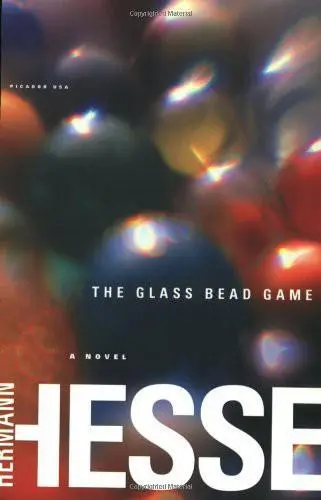
- Название:The Glass Bead Game
- Автор:
- Жанр:
- Год:1969
- ISBN:нет данных
- Рейтинг книги:4 / 5. Голосов: 2
-
Избранное:Добавить в избранное
- Отзывы:
-
Ваша оценка:
The Glass Bead Game: краткое содержание, описание и аннотация
Предлагаем к чтению аннотацию, описание, краткое содержание или предисловие (зависит от того, что написал сам автор книги «The Glass Bead Game»). Если вы не нашли необходимую информацию о книге — напишите в комментариях, мы постараемся отыскать её.
Something like chess but far more intricate, the game of Magister Ludi known as the Glass Bead Game is thought in its purest form, a synthesis through which philosophy, art, music and scientific law are appreciated simultaneously. The scholar-players are isolated within Castalia, an autonomous elite institution devoted wholly to the mind and the imagination…
The Glass Bead Game — читать онлайн бесплатно полную книгу (весь текст) целиком
Ниже представлен текст книги, разбитый по страницам. Система сохранения места последней прочитанной страницы, позволяет с удобством читать онлайн бесплатно книгу «The Glass Bead Game», без необходимости каждый раз заново искать на чём Вы остановились. Поставьте закладку, и сможете в любой момент перейти на страницу, на которой закончили чтение.
Интервал:
Закладка:
Joseph had no doubt that he belonged in Castalia and was rightly leading a Castalian life, a life without family, without a variety of legendary amusements, a life without newspapers and also without poverty and hunger — though for all that Plinio hammered away at the drones’ existence of the elite students, he too had so far never gone hungry or earned his own bread. No, Plinio’s world was not better and sounder. But it was there, it existed, and as Joseph knew from history it had always been and had always been similar to what it now was. Many nations had never known any other pattern, had no elite schools and Pedagogic Province, no Order, Masters, and Glass Bead Game. The great majority of all human beings on the globe lived a life different from that of Castalia, simpler, more primitive, more dangerous, more disorderly, less sheltered. And this primitive world was innate in every man; everyone felt something of it in his own heart, had some curiosity about it, some nostalgia for it, some sympathy with it. The true task was to be fair to it, to keep a place for it in one’s own heart, but still not relapse into it. For alongside it and superior to it was the second world, that of Castalia, the world of Mind — artificial, more orderly, more secure, but still in need of constant supervision and study. To serve the hierarchy, but without doing an injustice to that other world, let alone despising it, and also without eying it with vague desire or nostalgia — that must be the right course. For did not the small world of Castalia serve the great world, provide it with teachers, books, methods, act as guardian for the purity of its intellectual functions and its morality? Castalia remained the training ground and refuge for that small band of men whose lives were to be consecrated to Mind and to truth. Then why were these two worlds apparently unable to live in fraternal harmony, parallel and intertwined; why could an individual not cherish and unite both within himself?
One of the rare visits from the Music Master came upon a day when Joseph, exhausted by his task, was having a hard time preserving his balance. The Master diagnosed his state from a few of the boy’s allusions; he read it even more plainly in Joseph’s strained appearance, his restive looks, his somewhat nervous movements. He asked a few probing questions, was met by moroseness and uncommunicativeness, and gave up that approach. Seriously concerned, he took the boy to one of the practice rooms under the pretext of telling him about a minor musicological discovery. He had Joseph bring in and tune a clavichord, and involved him in a long tutoring session on the origin of sonata form until the young man somewhat forgot his anxieties, yielded, and listened, relaxed and grateful, to the Master’s words and playing. Patiently, the Music Master took what time was needed to put Joseph into a receptive state. And when he had succeeded, when his lecture was over and he had concluded by playing one of the Gabrieli sonatas, he stood up, began slowly pacing the little room, and told a story.
“Many years ago I was once much preoccupied with this sonata. That was during the period of my free studies, before I was called to teaching and later to the post of Music Master. At the time I was ambitious to work out a history of the sonata from a new point of view; but then for a while I stopped making any progress at.all. I began more and more to doubt whether all these musical and historical researches had any value whatsoever, whether they were really any more than vacuous play for idle people, a scanty aesthetic substitute for living a real life. In short, I had to pass through one of those crises in which all studies, all intellectual efforts, everything that we mean by the life of the mind, appear dubious and devalued and in which we tend to envy every peasant at the plow and every pair of lovers at evening, or every bird singing in a tree and every cicada chirping in the summer grass, because they seem to us to be living such natural, fulfilled, and happy lives. We know nothing of their troubles, of course, of the elements of harshness, danger, and suffering in their lot. In brief, I had pretty well lost my equilibrium. It was far from a pleasant state; in fact it was very hard to bear. I thought up the wildest schemes for escaping and gaining my freedom. For example, I imagined myself going out into the world as an itinerant musician and playing dances for wedding parties. If some recruiting officer from afar had appeared, as in old tales, and coaxed me to don a uniform and follow any company of soldiers into any war, I would have gone along. And so things went from bad to worse, as so often happens to people in such moods. I so thoroughly lost my grip on myself that I could no longer deal with my trouble alone, and had to seek help.”
He paused for a moment and chuckled softly under his breath. Then he continued: “Naturally I had a studies adviser, as the rules require, and of course it would have been sensible and right as well as my duty to ask him for advice. But the fact is, Joseph, that precisely when we run into difficulties and stray from our path and are most in need of correction, precisely then we feel the greatest disinclination to return to the normal way and seek out the normal form of correction. My adviser had been dissatisfied with my last quarterly report; he had offered serious objections to it; but I had thought myself on the way to new discoveries and had rather resented his objections. In brief, I did not like the idea of going to him; I did not want to eat humble pie and admit that he had been right. Nor did I want to confide in my friends. But there was an eccentric in the vicinity whom I knew only by sight and hearsay, a Sanscrit scholar who went by the nickname of ‘the Yogi.’ One day, when my state of mind had grown sufficiently unbearable, I paid a call on this man, whose solitariness and oddity I had both smiled at and secretly admired. I went to his cell intending to talk with him, but found him in meditation; he had adopted the ritual Hindu posture and could not be reached at all. With a faint smile on his face, he hovered, as it were, in total aloofness. I could do nothing but stand at the door and wait until he returned from his absorption. This took a very long time, an hour or two hours, and at last I grew tired and slid to the floor. There I sat, leaning against the wall, continuing to wait. At the end I saw the man slowly awaken; he moved his head slightly, stretched his shoulders, slowly uncrossed his legs, and as he was about to stand, up his gaze fell upon me.
“‘What do you want?’ he asked.
“I stood up and said, without thinking and without really knowing what I was saying: ‘It’s the sonatas of Andrea Gabrieli.’
“He stood up at this point, seated me in his lone chair, and perched himself on the edge of the table. ‘Gabrieli?’ he said. ‘What has he done to you with his sonatas?’
“I began to tell him what had been happening to me, and to confess the predicament I was in. He asked me about my background with an exactness that seemed to me pedantic. He wanted to know about my studies of Gabrieli and the sonata, at what hour I rose in the morning, how long I read, how much I practiced, when were my mealtimes and when I went to bed. I had confided in him, in fact imposed myself on him, so that I had to put up with his questions, but they made me ashamed; they probed more and more mercilessly into details, and forced me to an analysis of my whole intellectual and moral life during the past weeks and months.
“Then the Yogi suddenly fell silent, and when I looked puzzled he shrugged and said: ‘Don’t you see yourself where the fault lies?’ But I could not see it. At this point he recapitulated with astonishing exactness everything he had learned from me by his questioning. He went back to the first signs of fatigue, repugnance, and intellectual constipation, and showed me that this could have happened only to someone who had submerged himself disproportionately in his studies and that it was high time for me to recover my self-control, arid to regain my energy with outside help. Since I had taken the liberty of discontinuing my regular meditation exercises, he pointed out, I should at least have realized what was wrong as soon as the first evil consequences appeared, and should have resumed meditation. He was perfectly right. I had omitted meditating for quite a while on the grounds that I had no time, was too distracted or out of spirits, or too busy and excited with my studies. Moreover, as time went on I had completely lost all awareness of my continuous sin of omission. Even now, when I was desperate and had almost run aground, it had taken an outsider to remind me of it. As a matter of fact, I was to have the greatest difficulty snapping out of this state of neglect. I had to return to the training routines and beginners’ exercises in meditation in order gradually to relearn the art of composing myself and sinking into contemplation.”
Читать дальшеИнтервал:
Закладка:
Похожие книги на «The Glass Bead Game»
Представляем Вашему вниманию похожие книги на «The Glass Bead Game» списком для выбора. Мы отобрали схожую по названию и смыслу литературу в надежде предоставить читателям больше вариантов отыскать новые, интересные, ещё непрочитанные произведения.











Обсуждение, отзывы о книге «The Glass Bead Game» и просто собственные мнения читателей. Оставьте ваши комментарии, напишите, что Вы думаете о произведении, его смысле или главных героях. Укажите что конкретно понравилось, а что нет, и почему Вы так считаете.